Related articles:


I am walking through the hundred and ten acres of Père Lachaise Cemetery in the 20th arrondissement to find the grave of Gertrude Stein. Here in the wind and rain I see the dead buried in my mind, lit up, lit up with life, vanity, suffering and fame. I know what a few of them looked like from photographs and paintings, the various attitudes in their eyes and their various talents. Oscar Wilde, Edith Piaf, Chopin, Proust, Apollinaire, Georges Perec, Colette, Modigliani are all buried here.
I know a few things about Oscar Wilde. Oscar Fingal O’Fflahertie Wills Wilde from Dublin. He had just published The Ballad of Reading Gaol when he set foot in Paris in 1898. Stein would arrive five years later, by which time he would be dead. When he eventually found the hotel room in which he died, on the Rue des Beaux Arts, he ate the same lunch every day, a lamb chop and two boiled eggs. Fortunately, he drank four bottles of brandy a week to gentle the pain of the injustice that broke him. When he was young, he wore a stylish velvet cape, his hair long and free. Dying and high on morphine he converted to Catholicism. The statue on his grave, a winged sphinx with sandstone penis and testicles, crowned with a tiara, was made by American artist Jacob Epstein. When he arrived at Père Lachaise to put the finishing touches to this sculpture, he discovered it was surrounded by the gendarmerie. The tomb was “under arrest” and the testicles on the statue had been covered by plaster “to protect public Decency”.
An epitaph in Wilde’s own words is carved into the stone on the back of the tomb:
And alien tears will fill for him
Pity’s long-broken urn.
For his mourners will be outcast men
And outcasts always mourn.
The Ballad of Reading Gaol (1898)
Related articles:
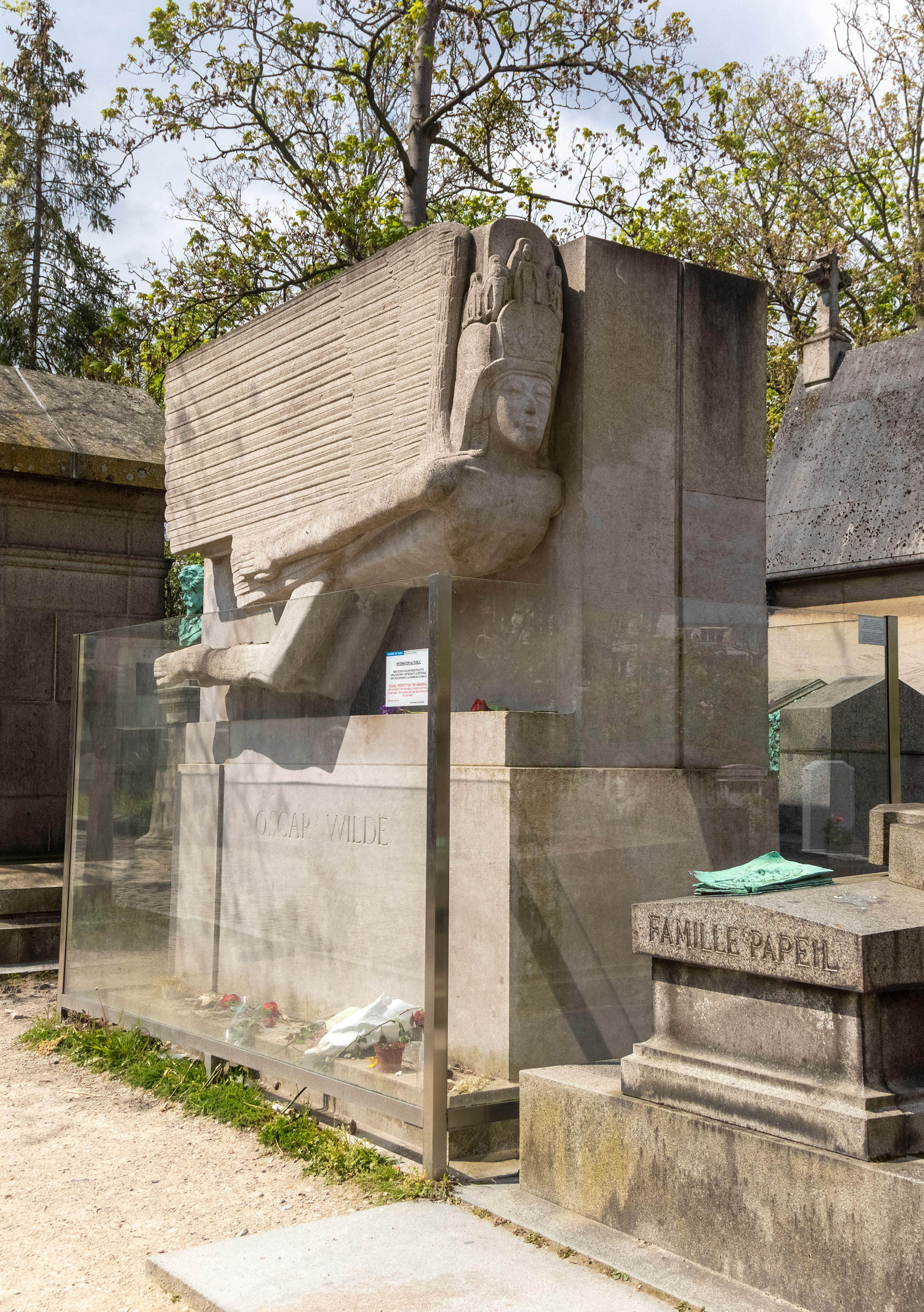
The tomb of Oscar Wilde in the Père Lachaise cemetery in Paris
Oscar Wilde’s grave is covered in lipstick kisses. No one has kissed Proust’s grave. Made from sterner material, grey marble, it does not invite the kisses of strangers. Proust is embraced in the soil of his own country. Oscar Wilde has a martyred body and Marcel Proust has a private body.
I know some things about Gertrude Stein’s body, too. When she was in her twenties it would be bent over a microscope.
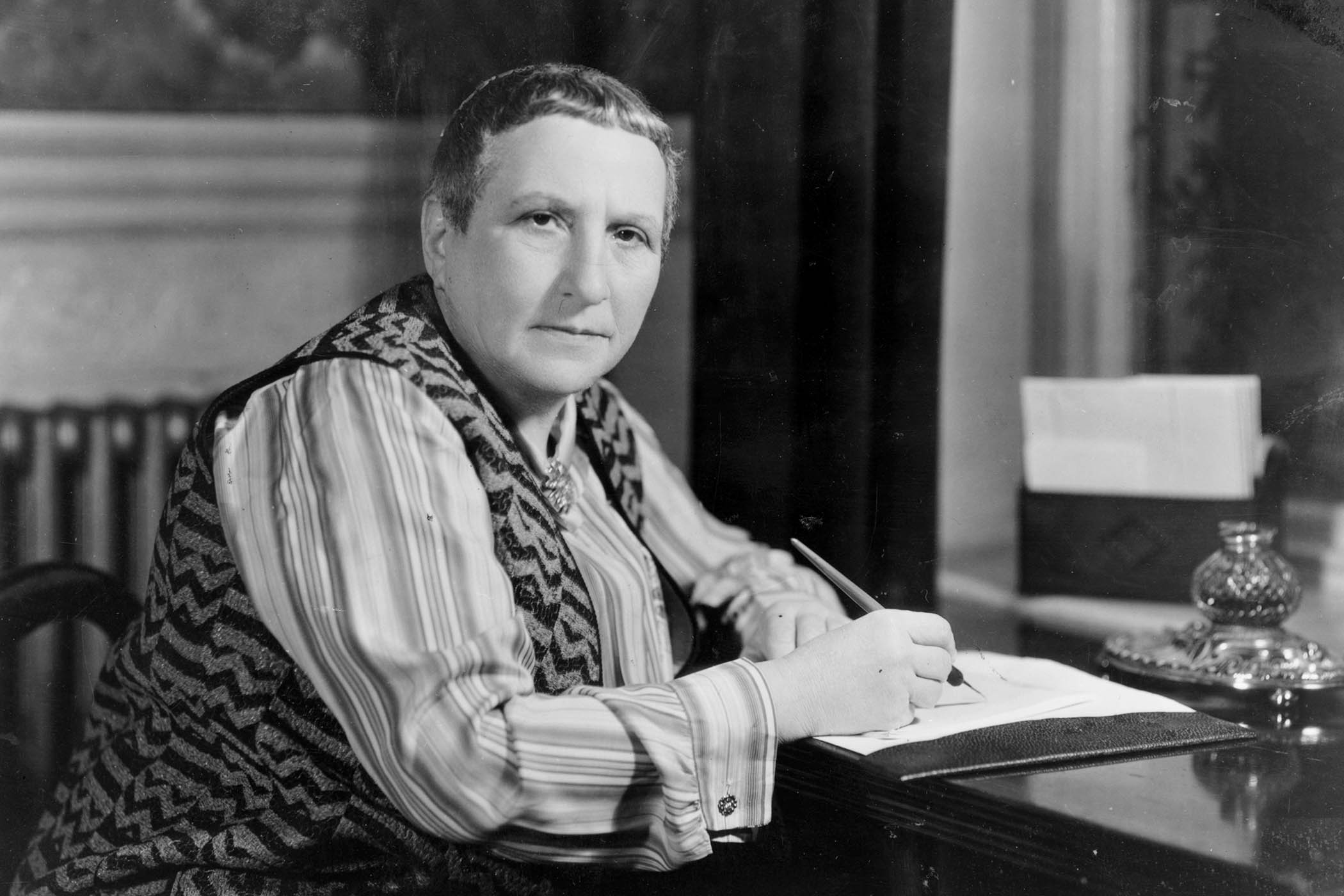
Stein was going to devote eight years of her life to scientific inquiry, first at Radcliffe College in 1893 when she was nineteen, now Harvard, and then four years at Johns Hopkins in Baltimore. As a medical student at Johns Hopkins, Stein worked a few hours each day in the pathology lab to research the development of the human brain in the embryo. There she is. A future pioneer of the modernist movement wearing a blouse with large puffed sleeves and a bell-shaped skirt stiffened at the hem with a lining of horsehair. Sitting at her desk in the laboratory staring down a microscope, one of the early female students at Hopkins taking a medical degree. She will eventually stare at modern art instead and try to work out how it is put together. She had no idea how to put herself together. Her thick hair is piled on top of her head in a chaotic bun. A few decades later she is going to ask her wife, Alice B Toklas, to cut it all off. Out come the pins. Where are the scissors?
And where is James Joyce? Stein was furious that Ulysses was published before her own novel, The Making of Americans. He is buried with his family in Zurich, along with his two main phobias, thunder and dogs. Gertrude and Alice B loved their two giant white poodles, Basket 1 and his successor, Basket 2, also their little dog Pepe. Gertrude would listen to the rhythm of Basket’s tongue lapping water from a bowl and claim it helped her understand the difference between writing sentences and writing paragraphs. She considered paragraphs to be more emotional than sentences. The various Baskets literally spoke in tongues to Gertrude Stein.
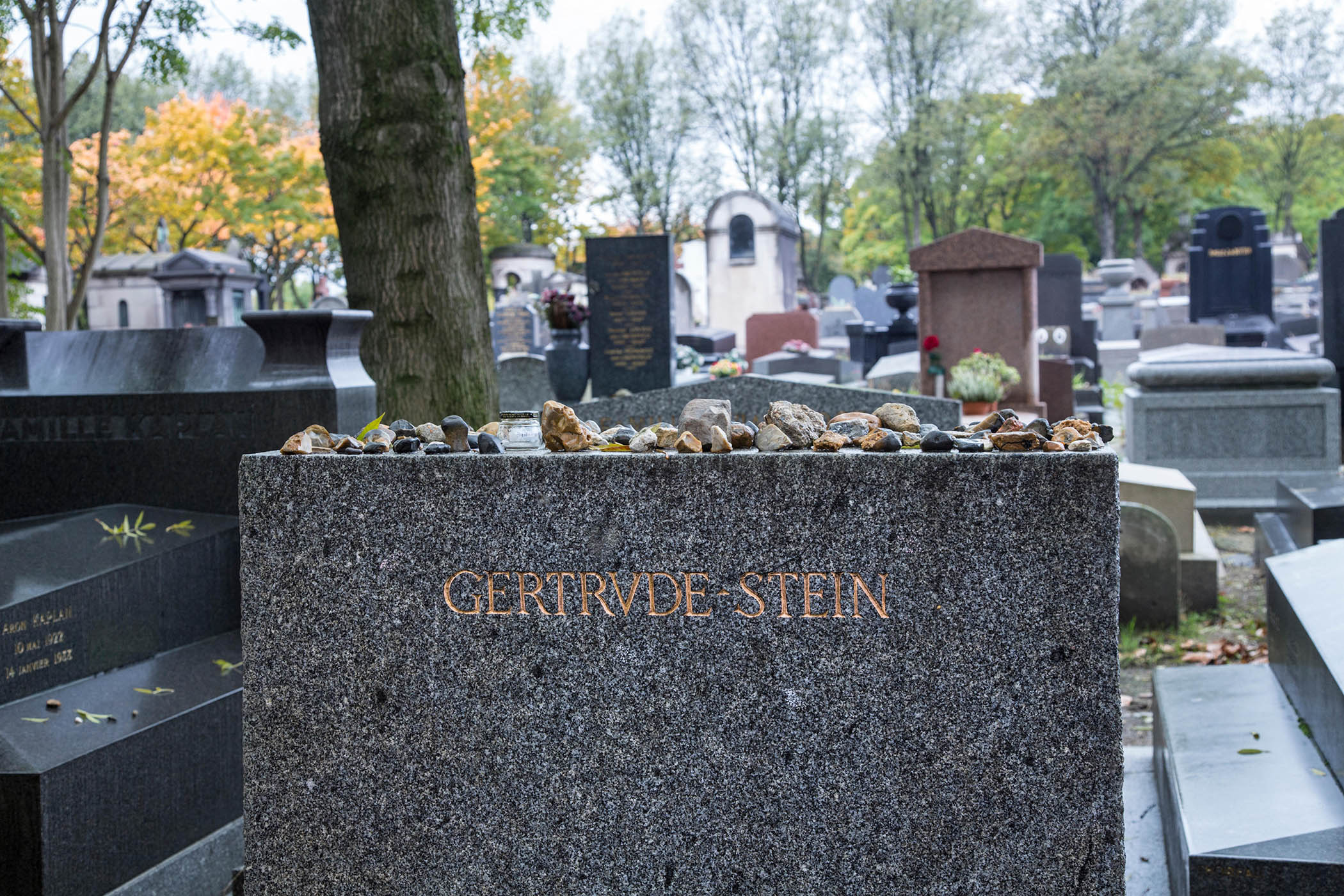
Gertrude Stein’s grave
Alice B liked to bath Basket 1 in sulphur water.
Looking at the map it’s a twenty-five-minute walk to her grave.
What I am thinking as the wind blows my hair around is that Stein put her immense writing energies into making sure she was not understood. This is what interested me most about her writing. She did not believe it is worth having a conversation if everything is understandable. Is this a desirable way to live? Or is it the only way to live?
“They ask me to tell why an author like myself can become popular. It is very easy everybody keeps saying and writing what anybody feels that they are understanding and so they get tired of that, anybody can get tired of anything everybody can get tired of something and so they do not know it but they get tired of feeling they are understanding and so they take pleasure in having something that they feel they are not understanding.”
Everybody’s Autobiography (1937) by Gertrude Stein
I am hiking in the rain in the hope that I might find it.
What is it?
Daring.
Courage.
What did she want words to do and what did they do for her?
“It takes a lot of time to be a genius, you have to sit around so much doing nothing, really doing Nothing.”
Everybody’s Autobiography
I agree that everyone spends some of their time thinking without consciously thinking. Is that understandable? Does it matter? Gertrude Stein worked in obscurity until the age of fifty-nine, when she wrote the bestselling Autobiography of Alice B Toklas. She was lost to readers for decades. But I know she wanted to be found and Alice B knew that as well. In the 1950s and ’60s, poet Frank O’Hara found her and the Living Theatre found her. She was an American expatriate who had made a space for the American avant garde in America to happen. But she was dead by then.
I had to keep reminding myself she was born in 1874.
Some of her titles were:
Tender Buttons: Objects, Food, Rooms;
Have They Attacked Mary. He Giggled;
A Book Concluding with As a Wife Has a Cow: A Love Story;
A Village: Are You Ready Yet Not Yet: A Play in Four Acts;
Lucy Church Amiably
Her wish to kill the 19th century still leaves an afterglow of radical resistance in our own century. How did she kill the 19th century? With her pen. After writing her more conventional early trio of novellas, Three Lives, she poked her pen under the bonnet of the 19th century and whipped it off. And then she set to work on the shawl.
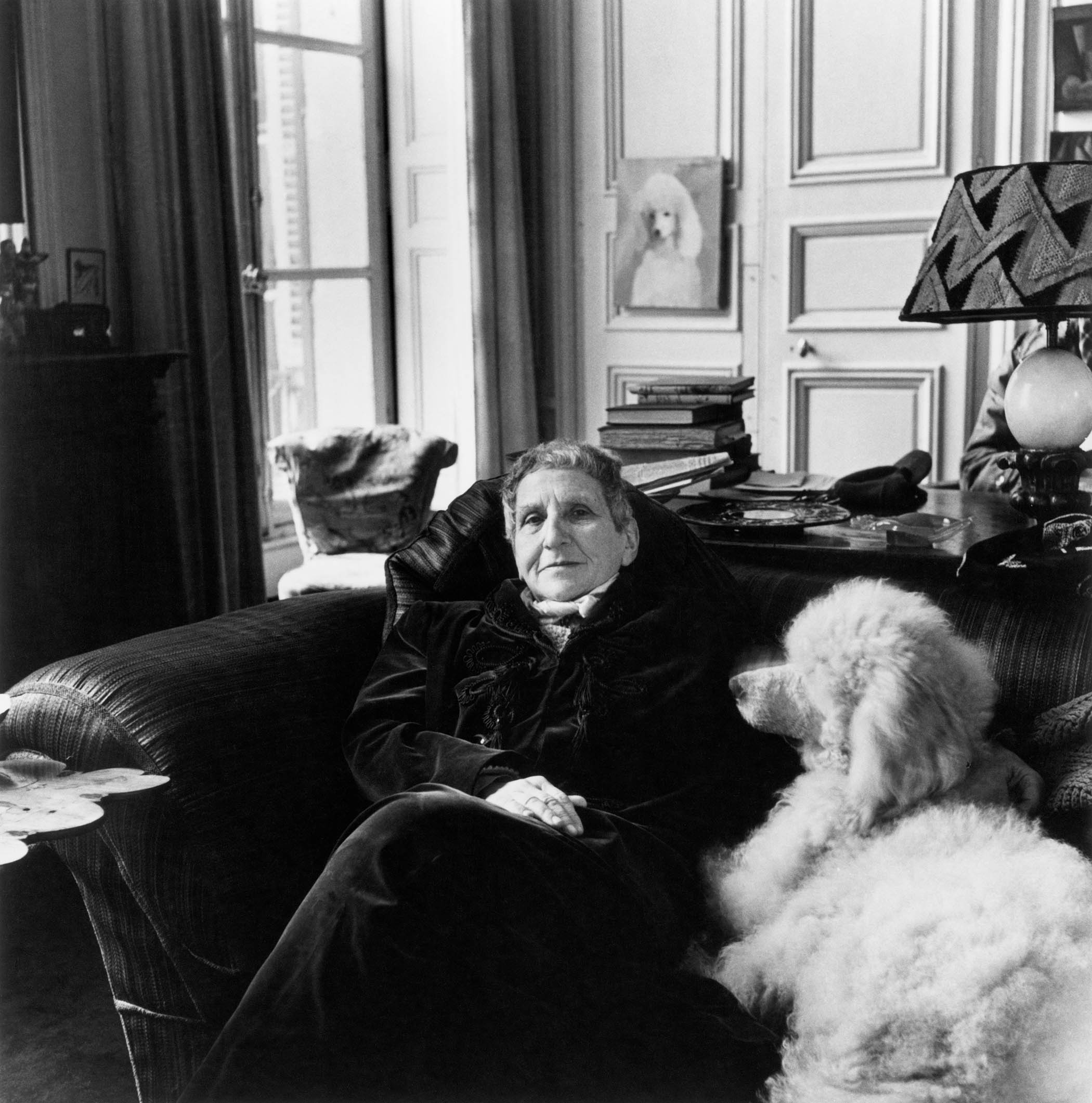
Stein with her dog Basket 2 in 1946. Basket 1 is in the painting behind her
In Jane Austen’s novel Emma, written in 1815, Miss Bates (described wittily by Austen as “a great talker upon little matters”) insists that her mother wear a shawl when she goes visiting. After all, their low-cut Regency dresses were light and flimsy, and England, with its endless talk about little matters, was cold, riddled with class antagonisms, tea rituals and the necessity of securing a husband, which was a big economic matter. “I made her take her shawl – for the evenings are not warm – her large new shawl – Mrs. Dixon’s wedding-present – So kind of her to think of my mother! Bought at Weymouth, you know – Mr Dixon’s choice.”
Stein killed this 19th-century shawl in her collection of prose poems, Tender Buttons, published in 1914.
“A SHAWL.
A shawl is a hat and hurt and a red balloon and an under coat and a sizer a sizer of talks.”
Tender Buttons
“They were entering the hall. Mr Knightley’s eyes had preceded Miss Bates’s in a glance at Jane. From Frank Churchill’s face, where he thought he saw confusion suppressed or laughed away, he had involuntarily turned to hers; but she was indeed behind, and too busy with her shawl.”
Emma (1815) by Jane Austen
“A shawl is a wedding, a piece of wax a little build. A shawl.”
Tender Buttons
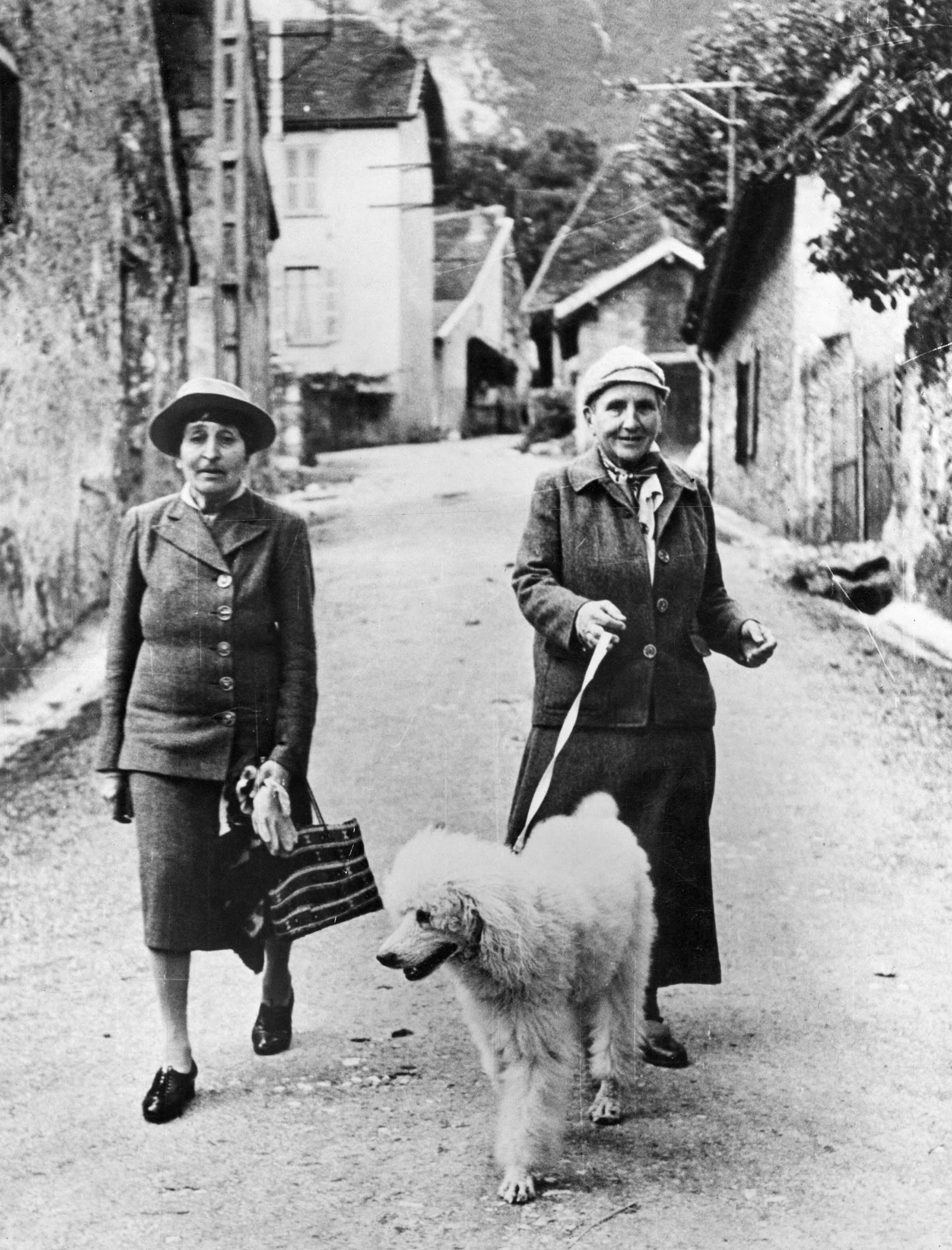
Stein walking Basket 2 with Alice B Toklas in south-east France
Alice B Toklas would have typed out these words just as I have done. Stein wrote by hand at night and left the pages for Alice B to gather in the morning. Alice B was in love with Gertrude, as excited to harvest her words as she was to harvest the radishes she later grew in the garden of their country home. Frankly, my life is being ruined by Gertrude. Is it respectful to refer to her as Gertrude? Picasso called Gertrude Stein by her first name. She is often referred to as Miss Stein in The Autobiography of Alice B. Toklas. I could be at home reflecting on all of this, or being a genius and doing nothing at all.
It is raining hard now in Père Lachaise, my trainers are soaked, I am working too hard for her. I’m not sure she worked that hard for me. If Ernest Hemingway, who was her friend in Paris and she his mentor, is to be believed, she never revised a draft. I don’t believe him. What do we have to lose to become modern? She had to lose her corset. The hourglass figure. It was Miss Stein’s pleasure to lift up her fork and knife and saw through a five-inch steak. Only men were allowed to possess appetite, but she had no desire to make herself smaller to please men. And she did lose it. The corset. The hourglass was smashed because she was ahead of her time.
The experimental pull of Stein’s writing across the 20th century was made with her training in early psychology. Her writing can mostly be read through her enchantment with the vision of her tutor at Radcliffe College, the psychologist and philosopher William James – the “movement of thoughts and words endlessly the same and endlessly different”. That was the beginning of Stein finding something like a technique. The visual language of cubism offered her some strategies too. Early psychology and cubism. This is already an exciting mix of influences for a writer. The language of her new century, the 20th century, came to her through being the fifth and youngest child of German Jewish immigrants. As a child, Stein spoke German and English at home. Secrets would have been whispered by adults in the language less familiar to the children. I thought about the Stein parents speaking secrets or arguing with each other in German when the five children were in bed. They probably did not want to be understood by the children.
Stein put her immense writing energies into making sure she was not understood
Stein put her immense writing energies into making sure she was not understood
The experimental pull of Stein’s language came to her from learning how to talk about visual art and her friendship with Picasso and from being queer. It came from escaping the tyranny of her father, who had died when she was seventeen. Virginia Woolf in 1928 wrote of the death of her own demanding father, “His life would have entirely ended mine. What would have happened? No writing, no books; – inconceivable.” With all of this, Stein made a language quite different from her own reading, the books she devoured in her late teens. Shakespeare, Richardson, Wordsworth, Trollope, Browning, Swift, Defoe, Keats, Byron. She would meet the woman she considered to be her wife in 1907. It would be love at first sight for Alice B Toklas. Originally from San Francisco, chain-smoker with a taste for expensive gloves, she would stuff lettuce leaves with sweetbreads and truffles cooked in sherry for her beloved, edit her work, help Gertrude self-publish her work and find time to sauté one hundred frog legs in butter and cream.
As it happens, Stein and her siblings had a modest trust fund from their deceased father’s cable car business in San Francisco. Her older brother Michael Stein looked after their stocks and shares and rental income from various properties he purchased in San Francisco. She would receive a monthly allowance, never have to work or endure being sexually available to a husband in return for his guardianship. Instead she would support Alice B, who described their erotic life as “gathering wild violets”.
What I am thinking as the wind blows my hair around and rain soaks my shoes is that I’m going home without finding her grave. Yes, I am going to find the exit. Earlier that morning I had queued up at my local boulangerie for a particular baguette that is charred at each end, cut it in half and inserted into it a slab of oozing brie. Its salty grey rind, like ash, had cracked from the sheer life force of this fast-flowing river of cheese. If the rind was the frame, this brie like Gertrude Stein had burst through it. My cheeks stinging in the wind, the trees dripping, I unwrapped the oozing baguette and devoured it there and then among the dead. The living have appetites. Desires. To drive us mad. To make us joyful. To make us cry. To lead us up the wrong path and down the right path. The dead have done all that. The dead who can no longer feel the rain had spent a lifetime creating themselves.
This is an edited extract from My Year in Paris with Gertrude Stein, published by Hamish Hamilton (£18.99). Order a copy at observershop.co.uk for £17.09. Delivery charges may apply.
Photographs by Hulton Archive/Getty Images, David A Barnes/Alamy, Ben Gingell/Alamy, Horst P. Horst/Conde Nast via Getty Images, Granger/Historical Picture Archive/Alamy