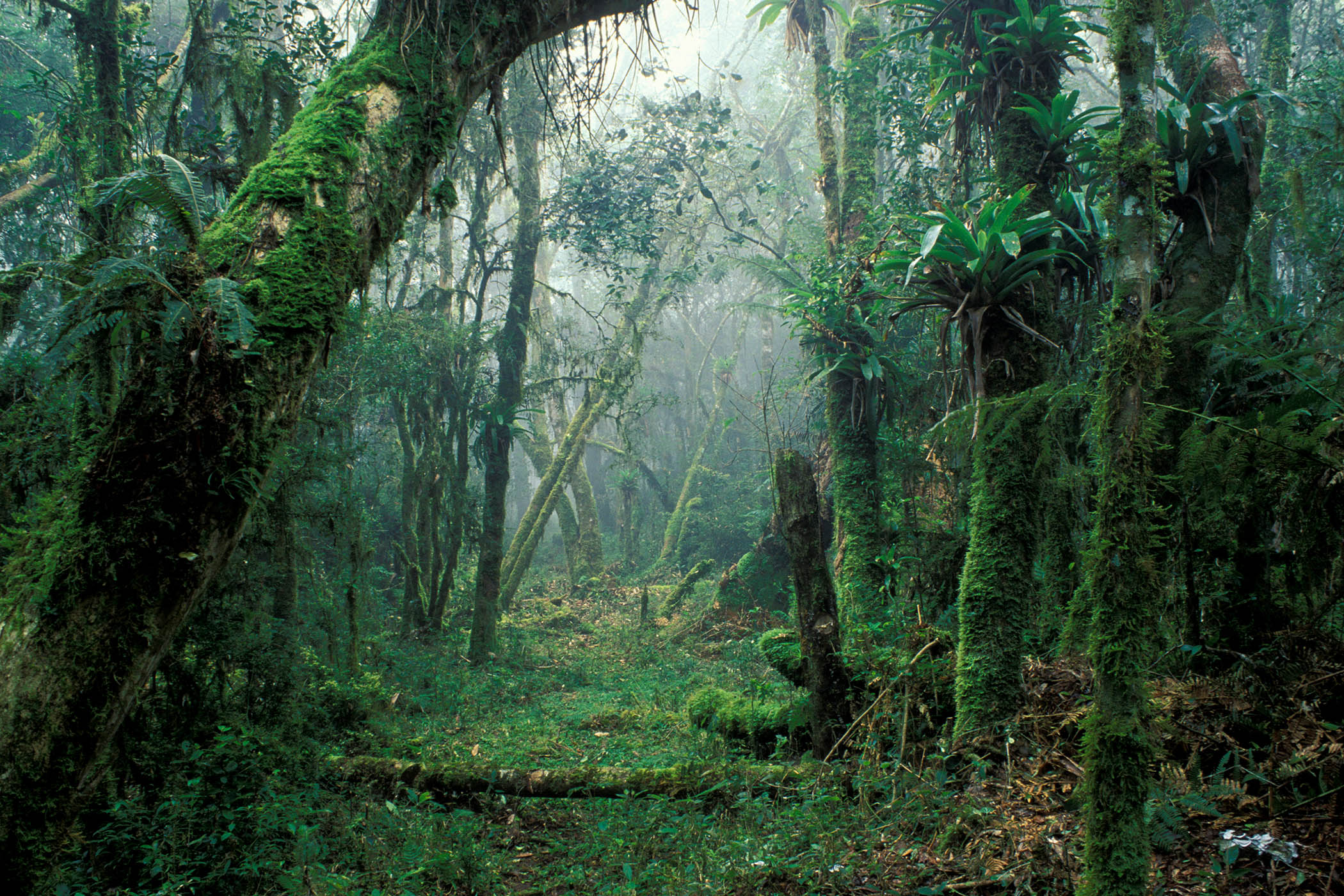


In the forests of South and Central America, an enterprising insect farms fungi for food. Every day, dense columns of leafcutter ants issue forth from their underground nests to raid nearby trees. The workers cut segments of leaf and carry them home, where other ants chop the segments smaller and feed them to a greyish fungus growing in the depths of the nest. Gardener ants weed their crop and deploy a bacterial fungicide to deter pests; engineers create vents to release CO2 emissions. After millions of years in partnership, neither ant nor fungus can live without the other. As the ants grow the fungus, which has lost the ability to produce spores, the fungus feeds the ants, which have lost the ability to digest leaves. Everyone (apart, perhaps, from the trees, which try to mitigate the damage by producing a toxin) is a winner.
Ant-fungus mutualism is one of the more bizarre examples of symbiosis in nature, but it’s far from unique. Indeed, as Rowan Hooper shows in his eye-opening book Togetherness, symbiosis is everywhere you’d care to look, from the grandest trees down to the humblest microbes. The idea that nature is profoundly interconnected has been circulating for millennia – Herodotus intuited the bond between wasps and fig trees back in the fifth century BC. But western societies in particular have had a hard time accepting that mutual dependency is a central fact of life.
The Bible didn’t help when it talked about God letting humans have dominion over fish and fowl and every creeping thing. Nor did Descartes when he assigned minds to humans but not animals, which he cast as unfeeling machines. When Darwin was researching On the Origin of Species, he was aware of many instances of cooperation in nature and indeed haunted by them, writing that altruism was “one special difficulty, which at first appeared to me insuperable, and actually fatal to my whole theory”. But he came down on the side of competition. The accretion of ideas of life as a struggle to survive – with humans not separate from but nonetheless superior to our planetary kin – has had an extraordinary influence on how we conduct ourselves in the modern world, extending to our economic and social systems as well as how we treat the ecosystems around us.
In the shadow of Darwin’s masterwork, the idea of symbiosis struggled to take root. The term was coined in the 1870s; Hooper defines it as “the persistent association between two different species, which is generally of mutual benefit”. But it would be another century or more before it entered the scientific mainstream. Even in the 1960s and 70s, the pioneering microbiologist Lynn Margulis was ostracised for her view that everything around us owes its existence to symbiosis.
It sounds lovely, all the species banding together. But it’s not quite as warm and fuzzy as all that
It sounds lovely, all the species banding together. But it’s not quite as warm and fuzzy as all that
Over the past decade or two a flush of popular science books have shed light on the process, but they have tended to focus on particular spheres: forests in Suzanne Simard’s Finding the Mother Tree; mushrooms in Merlin Sheldrake’s Entangled Life; the gut microbiome in Ed Yong’s I Contain Multitudes. Hooper, an English science journalist who hosts the New Scientist’s weekly podcast, takes a broader view in Togetherness, zooming out to the planetary scale and going back billions of years to show that symbiosis may have been instrumental in sparking life on Earth.
It’s an ambitious task that Hooper attacks with vigour, both in his writing – which is lively and engaging, dotted with references to nature-attentive writers such as John Milton and Emily Dickinson – and in his research. He jets around, whisking us from the Atlantic rainforest in Brazil (where he witnesses leafcutter ants in full flow) to coral reefs off Borneo, and a national park in eastern Tanzania. In each place we see life entangled in ways that are far more complex than they first appear.
It sounds like a lovely idea, all these species banding together and lending each other a helping hand. But it’s not quite as warm and fuzzy as all that, and Hooper, a Darwinist at heart, is careful to show that competition remains a factor even in these apparently harmonious relationships. Symbiosis, he writes, is “a long-lasting marriage between enemies where both partners manage to find a way to get along”.
The various examples of interconnectedness do begin to pile up, but Hooper does a good job in showing how pervasive symbiosis is, to the point where the notion of being a discrete individual stops making sense (our bacteria-filled human bodies are no exception). Understanding the process isn’t just enlightening for its own sake, it also has practical value, and the last third of the book looks at ingenious ways in which symbiosis has been harnessed to boost sustainability in agriculture, construction and even computing. God knows we need it.
In a world that is being trashed by systems informed by ideas of competition and human exceptionalism, any help from our non-human partners to mitigate the worst effects of our actions is dearly welcome.
Togetherness: Symbiosis and the Hidden Story of Life’s Greatest Collaborations by Rowan Hooper is published by Fern Press (£25). Order a copy from The Observer Shop for £21.25 (15% off RRP). Delivery charges may apply
Newsletters
Choose the newsletters you want to receive
View more
For information about how The Observer protects your data, read our Privacy Policy
Photography by Ricardo Siqueira/Brazil Photos/LightRocket via Getty Images