

In most reviews of translated fiction there will at some point appear a line that runs, “skilfully translated from the German/Swahili/Finnish by…,” despite the reviewer having no facility for the original language. Translators’ work must and should be acknowledged, but it’s valuable to understand the difference between how something reads in English and whether or not it successfully renders the original.
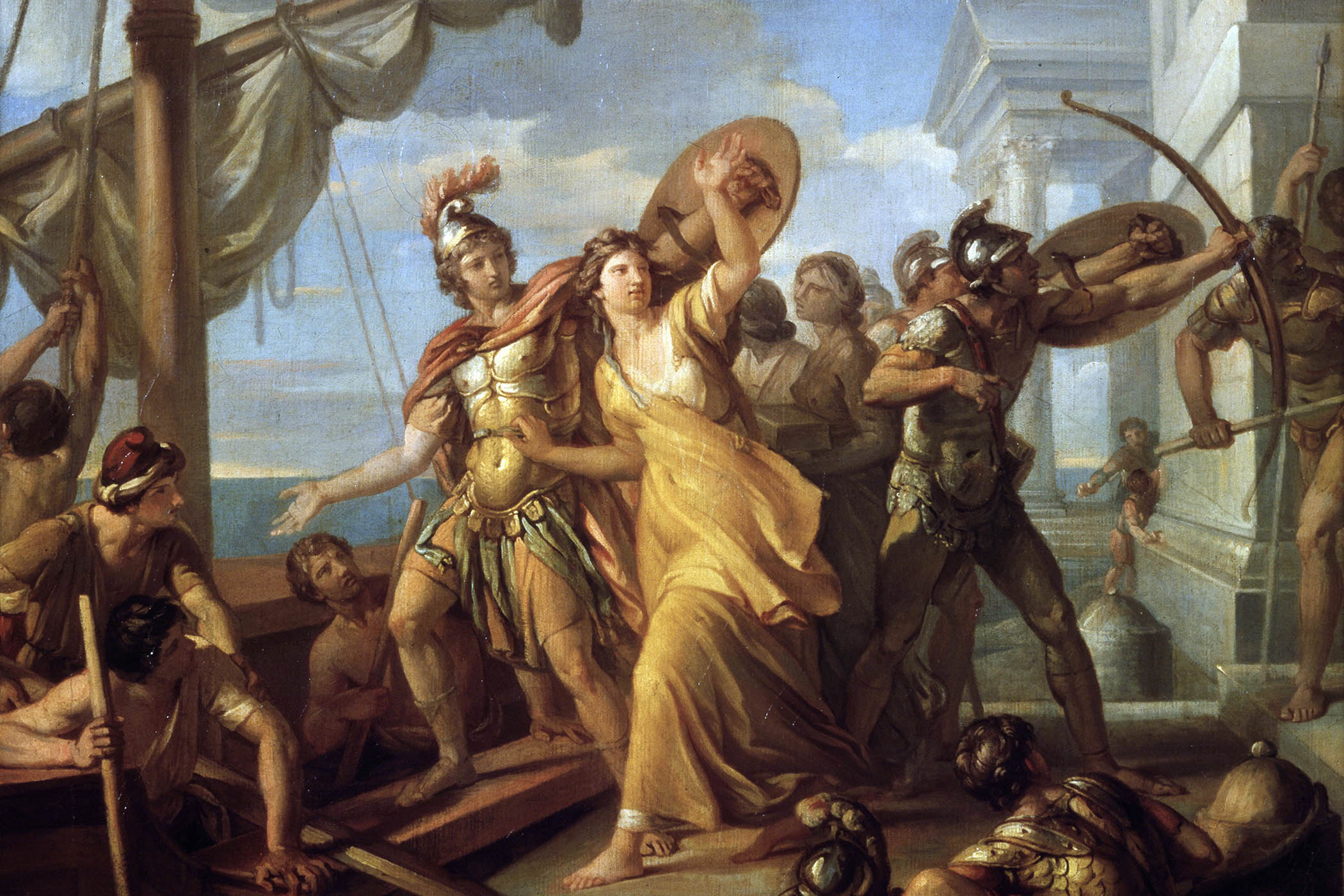
The matter is central to Crossing the Wine-Dark Sea, the classicist Emily Wilson’s engaging investigation into the translator’s art. Collecting together previously published essays, some of which are presented here in expanded form, the subjects include the poetry of Sappho, the Roman adoption of Greek culture, and the “slut shaming” of Helen of Troy.
Wilson considers modern retellings of classical Greek literature, too. Alice Oswald’s stark poem Memorial and Madeline Miller’s novel The Song of Achilles meet with approval. Simplifying popularisers such as Stephen Fry and Natalie Haynes do not, although she credits them for marrying their “shtick about classics with something much more nebulous and hard to achieve: a popular persona”.
That comment has a backstory. Classicists with public personae are rarely a thing, but Wilson became one in 2017 when she published her hugely popular and divisive translation of The Odyssey (the version Christopher Nolan has used as the primary source for his upcoming film adaptation). She was the first woman to translate the poem in full, and you needn’t voyage far online to encounter misogynistic responses to it. She confesses here to being “a Homerist who makes the basic error of being female in public”.
The book’s highlight is its longest essay, previously unpublished, which expands on a series of tweets posted by Wilson in which she analysed a raft of Odyssey translations, from Shakespeare’s contemporary George Chapman to Alexander Pope, and more recent ones including Richmond Lattimore, Robert Fitzgerald, Robert Fagles, and Daniel Mendelsohn, whose version was published just last year.
Wilson’s subjects include the poetry of Sappho, the Roman adoption of Greek culture and the “slut shaming” of Helen of Troy
Wilson’s subjects include the poetry of Sappho, the Roman adoption of Greek culture and the “slut shaming” of Helen of Troy
Wilson’s response, grounded in close reading, is nuanced: admiring certain decisions and damning others. Lattimore has a fondness for participles that slow the poem down, even when the Greek “has finite verbs that create a far more energetic effect”. Fitzgerald is “allusive and ornately literary, in a high modernist mode”. Fagles veers “between chattiness and melodrama”. There are 60 pages of this stuff – Wilson spends 13 of them on the poem’s opening two lines alone – and I would happily have it be twice as long.
Convinced as I was by Wilson’s incisive arguments, I recall Mendelsohn providing a comparative analysis in his own edition, and finding against Wilson’s approach. His primary complaint is that because her version matches the original in its number of lines – but ancient Greek can say in one word what might take seven in English – her adherence to iambic pentameter (Homer’s original is in the longer metre of dactylic hexameter) results in details being cut; an MP3 to the original’s WAV. Yet, in her essay, Wilson gives no impression of having left anything out and claims Mendelsohn’s version adds phrases “that correspond to nothing specific in the Greek”. What I, a civilian in this war, can say is that having read Wilson’s and Mendelsohn’s very different Odysseys, I’m glad to have both.
Irreconcilable differences are perhaps unavoidable when it comes to translation, as shown by the response to a review Wilson wrote for the London Review of Books in 2021. A classicist from the University of St Andrews wrote a letter complaining that Wilson’s piece had reinforced the idea that the plays of Aristophanes were more obscene than they really are. Wilson replied, defending her position. Then a third correspondent joined the fray, expanding on Wilson’s idea of certain swear words having different meanings even in their home language: “Were Aristophanes abroad in the Kingdom of Fife,” he wrote, “he would be considered a funny (ha ha) cunt. To be a ‘guid cunt’ is high praise throughout once industrialised lowland Scotland. A twat, by distinction, remains a twat.” Wilson’s review is included here. The letters it provoked, sadly, are not.
Crossing the Wine-Dark Sea: Journeys Through Ancient Literature by Emily Wilson is published by Profile (£12.99). Order a copy from The Observer Shop for £11.04 (15% off RRP). Delivery charges may apply
Photography by Fine Art Images/Heritage Images/Getty Images
Newsletters
Choose the newsletters you want to receive
View more
For information about how The Observer protects your data, read our Privacy Policy