


‘I was afraid yesterday. I remember the roaring crowd as I walked forward, I remember my fear and sweat. I was upset I had killed many people but …”
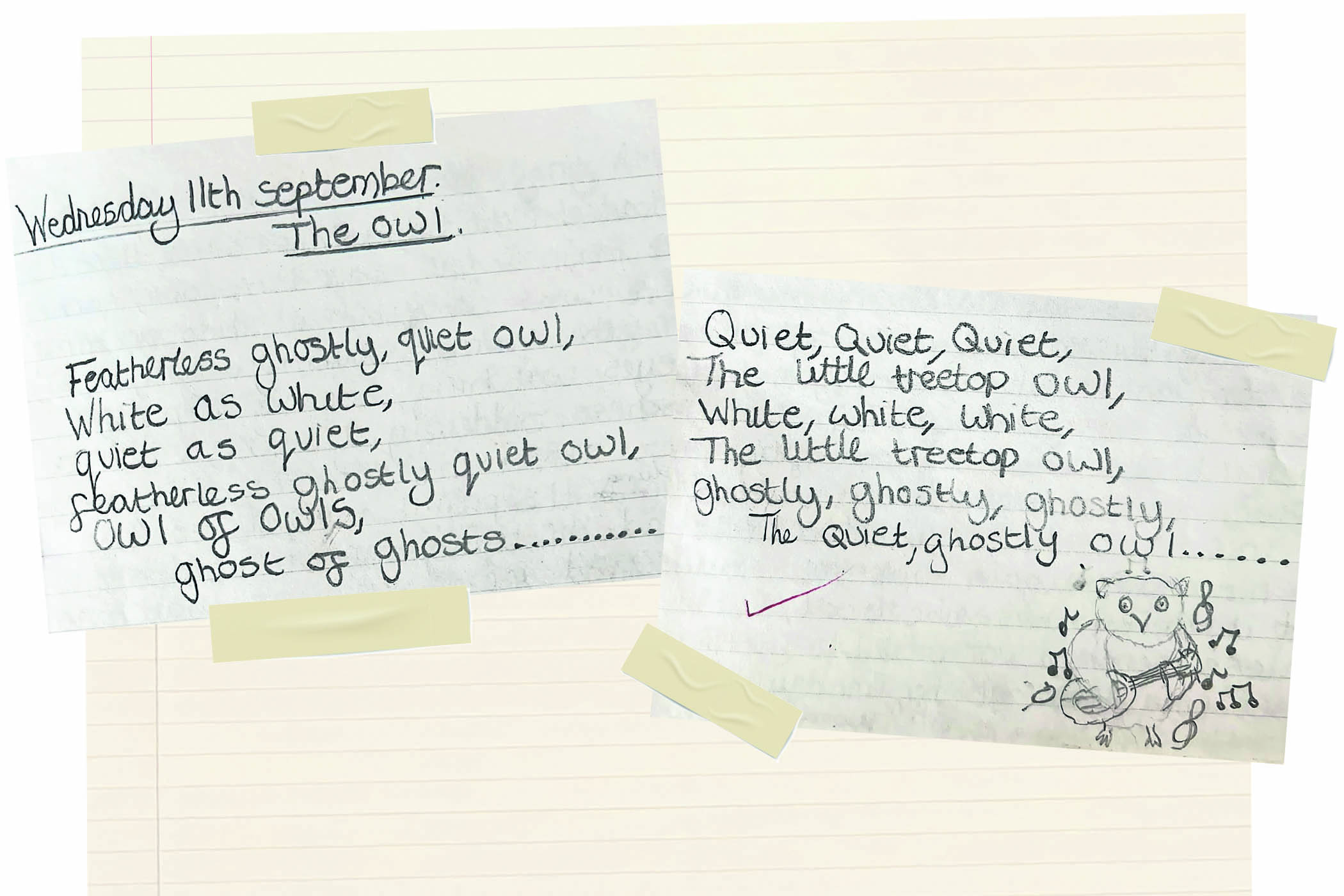
This is the beginning of a story I wrote in my English exercise book in April 2003, when I was 10 years old. Today, I’m a children’s author, and the line between these junior scribblings and my debut book is perhaps the straightest I could trace in my entire life. I always loved writing stories. I loved Wednesdays in Mrs Chatt’s classroom, when time was carved out purely for creative writing. I loved going home and composing even more comics, diary entries and poems.
More than 20 years later, children’s writing for pleasure is in crisis. Since 2010 the National Literacy Trust has been surveying young people aged five to 18 about their reading and writing habits. Last year its report on the decline in reading for pleasure prompted a nationwide initiative to designate 2026 the National Year of Reading; but less well covered was its finding that children’s enjoyment of writing fell to a 15-year low, with only 26.6% of children enjoying writing in their free time. This year the trust surveyed 125,375 children and gave The Observer exclusive access to its findings, which will be published in full on 24 June.
Children’s enjoyment of writing has risen slightly in 2026, and now 28.7% of children in the UK enjoy writing in their free time. But this is still a dramatic fall from a peak of 50.7% in 2016, and the charity warns: “Despite this upturn, writing engagement levels are still critically low.” Today only one in 10 children writes something in their free time daily, compared with about a third of children in 2014.
A pragmatist may argue we need more doctors than we do authors, but writing for a living shouldn’t be the only goal; we can also write to live. “As well as academic qualifications, writing is really important for children to develop their sense of identity, of self, of wellbeing, of creativity,” says Dinny Smith, the assistant director of education at the National Literacy Trust.
Surely, then, it’s crucial to find out what’s gone wrong with children’s writing – and how we can put it right.
“It’s a generational problem now,” says Ross Young, a literary researcher and co-founder of the literacy organisation the Writing for Pleasure Centre. “When teachers were at school, many of them didn’t receive the kind of writing apprenticeship that I think they probably deserved.”
A decade ago, Young was a full-time primary school teacher who found teaching writing “miserable”: he believes teacher training doesn’t focus enough on helping teachers to teach writing effectively.
Young also believes there has been “an explosion of really narrow and controlling writing schemes in this country”. Last year, as part of his research with Edinburgh University’s Literacy Lab, he interviewed children across the country and found they wanted more agency when writing; they wanted to choose their own ideas, not just write what a textbook or teacher told them to. “The classic is: we’re going to have 33 copies of Queen Victoria’s biography written all in exactly the same way, all with the exact same grammar in exactly the same places, in exactly the same paragraphs,” Young says.
In my year 6 English book, I wrote about a pet shop owner, Mrs Cat Food, and her escaped parrot, Joey. I personified a Christmas tree that lost its needles (and its family) after being sprayed with fake snow. One prompt was simply “mad scientist”, and I chose to describe a man with “the most peculiar squashy nose” who invented a robot that ran away (my teacher didn’t write the word “derivative” in the margins, but I do note my propensity for one particular plot).
We had time for creative writing such as this when I was a child, partly because a writing test was part of our year 6 SATs, but it was scrapped in 2012, and since Michael Gove introduced the revised curriculum in schools in England in 2014, there has been a greater emphasis on grammar. In primary school exams, I might have been asked to write a story based on four images in a storyboard, whereas children today are asked to identify the fronted adverbial in a sentence.
I’m not remotely embarrassed to tell you I don’t know what one of those is, and yet I’m certain it hasn’t stopped me using them properly throughout this piece.
“Bless their hearts, we’ve got structural linguists now at age 11,” Young says. “I love linguistics, but is it necessary for an 11-year-old to be able to be able to identify the subjunctive mood?”
Young’s thoughts are echoed by Tom Griffiths, a headteacher in Solihull, who notes that teachers need to be passionate to ensure writing lessons feel relevant to children’s daily lives. “We look at letter writing, and we’re trying to link it more to emails,” he explains. “We had a nonfiction text that we were doing around smartphone-free childhoods, and what the children were investigating independently and then choosing to write about was really powerful.”
Newsletters
Choose the newsletters you want to receive
View more
For information about how The Observer protects your data, read our Privacy Policy
How can we encourage children to not only write, but love writing? Young says writing for pleasure isn’t just about the act of writing itself, but also the pleasure of having an audience. The Writing for Pleasure Centre has enabled children’s writing to be published on tubes and trains, inside cafes and libraries, and even in a fish and chip shop. The National Literacy Trust is now running a three-year writing initiative with the Goldsmiths’ Foundation charity that hopes to improve the literacy of more than 1,000 primary school age children in Bradford.
As part of the programme, children explore football stadiums, ride steam trains and try rapping; there is even an American school bus that has been converted into a library, featuring stickers a local illustrator has designed to bring the children’s own stories to life.
These sorts of experience “give them a spark”, says Smith. She notes, too, that the decline of writing for pleasure isn’t just about what happens at school. “There are lots of other demands that are competing for [children’s] time and their attention, like homework, sports and socialising.”
On top of this, she adds, some children may not understand the value of writing and why it’s relevant to their lives. The children least likely to enjoy writing – those the trust calls “averse writers” – can actually see writing as incompatible with their sense of self; potentially because they’ve had bad experiences in school in the past, or because they don’t relate to the writers they are taught or those who they see in the media. Other children struggle with the physical act of writing on paper, though Smith says many of them enjoy writing song lyrics, reviews and scripts on screens, which can act as a gateway into writing generally.
One persistent finding of the National Literacy Trust’s surveys is that children on free school meals not only enjoy writing more, but are also more likely to be writing daily than their peers. It is difficult to say exactly why, though it could be that some of these children have access to writing programmes for youngsters from disadvantaged backgrounds. Another consistent finding is that girls enjoy writing more than boys; this year about 35% of girls reported that they enjoyed writing compared with about 21% of boys (although boys like writing comics more than girls).
Smith says she has “cautious hope” about the small rise in children’s writing for pleasure, but there is still a long way to go. What may happen if we don’t see further change? The humanities are already under threat, with the number of English literature undergraduates falling by a third between 2011 and 2021, and some universities closing their English courses altogether. And yet, on the flipside, creative writing degrees are on the rise: it was the most popular postgraduate subject within English in 2024.
Young of the Writing for Pleasure Centre has a theory about why. When children are taught that there’s only one correct way to read a text, they may not feel they can bring much of themselves to the table; students relishing the freedoms of their creative writing master’s courses could be “healing wounds from their school experience”.
Creative writing is linked to improved memory, a better attention span and higher self-esteem. But what if we encouraged children to write for a simpler reason? The National Literacy Trust found that, of children who write once a month, 30% do because it makes them feel happy. Writing my first children’s book was the happiest I’ve ever felt: the sense of joy was similar to that I experienced in Mrs Chatt’s English classroom.
Clearly keen to self-mythologise from a young age, I kept all my English exercise books from year 6 to year 11. It’s clear that, when I went into secondary school, the curriculum still had room for creative writing; in my year 8 book, we had to write a “chilling short story” and mine opened: “It was all his sister’s fault really – her and her dolls.” The encouraging annotations (and sometimes stamps) from my teachers motivated me, and it didn’t seem to matter that I spelled favourite “faviroute” and thieves “theives”; I was trusted to get there in the end.
The story I mentioned at the start of this piece was about a gladiator, but the last story in that exercise book is about a young girl who dreams of being a writer. “Her crystal blue eyes stared at the tattered rags she called ‘clothes’,” it began. “How she wished she was away from here! How she wished she had a typewriter or even a pencil to write down her stories!”
Lily Tripp: Diary of an Accidental Time Traveller by Amelia Tait is published by Starboard (£8.99). Order a copy from The Observer Shop for £8.09, 10% of RRP. Delivery charges may apply.