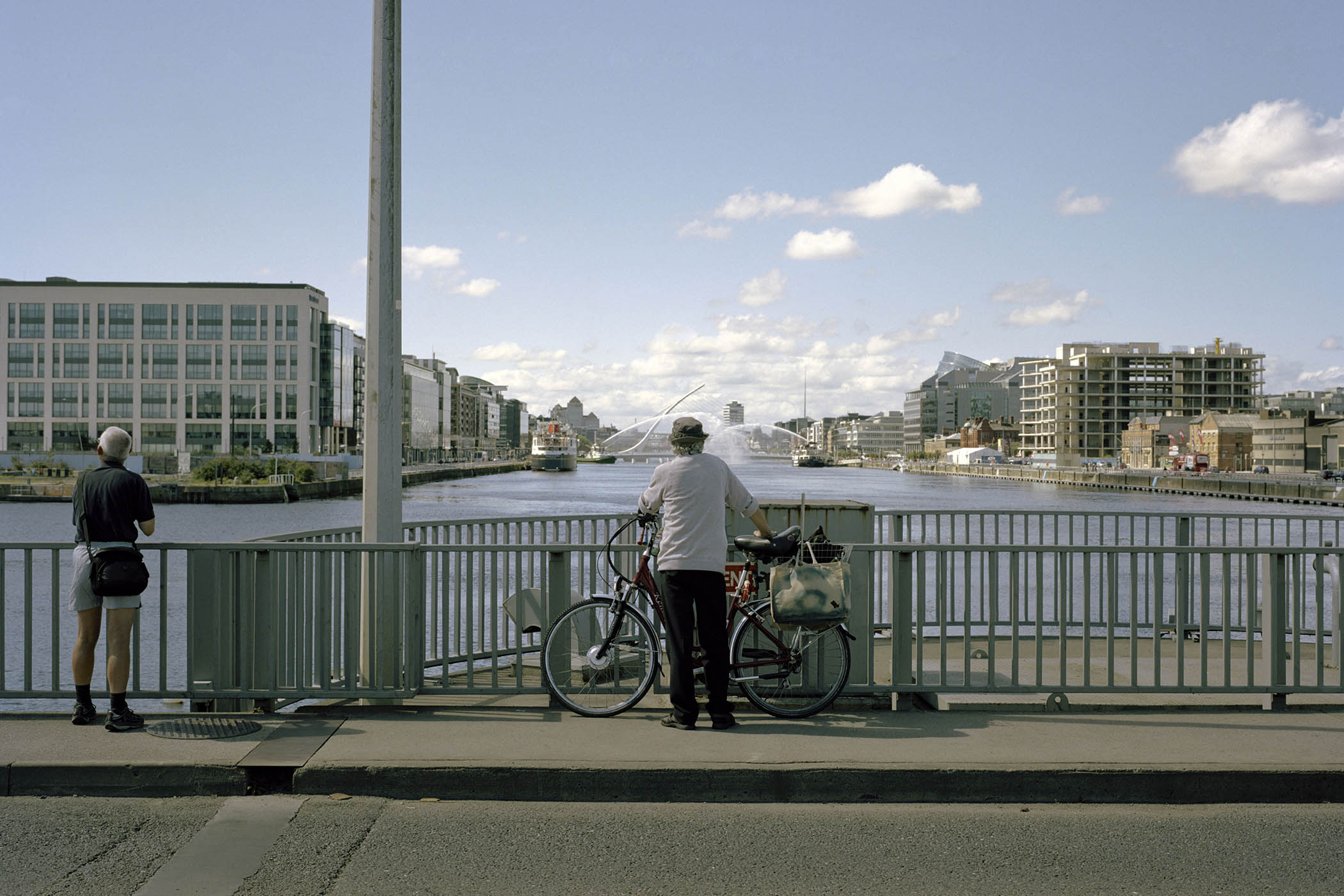

A man walks into a bush in Burgess Park, south-east London, and emerges from another in central Dublin. Bartholomew Port (“Mew”) is returning to his home city for a literary festival but has arrived at a bad time: strikes and protests against the government are breaking out. There is an atmosphere of imminent violence.
When I think of undervalued great writers, Keith Ridgway is one of the first names on my list. His six novels and one story collection take place in Dublin, London and some surreal, indeterminate space that is Ridgway’s alone. His phrasing is memorable, his imagination extraordinary. He can be eerie, uncomfortable, hilarious, deranged and heartbreaking.
Dooneen, which is all those things, takes place in a world like ours – Mew and his boyfriend, Mootie, discuss Palestine, the rent and the increasingly hot weather – but, as the portal in the bushes suggests, it’s a variant that has taken a few different turns. Dublin, for example, has been car-free for decades, its city centre pavements replaced by moving footpaths called “clickers”.
Things go awry from the moment Mew arrives at his hotel. He’s soon being followed, hearing about political assassinations and joining – or at least spending a lot of time with – a group of insurgents fighting for housing reform and other social justice issues. They try to explain the battle lines between numerous groups: DISH, IPRO, JAHFA, SPIKE, CHUD and the RDC. “I gave up trying to follow,” he tells Mootie in one of the letters that make up the bulk of the novel.
It proceeds more like a dream than a conventional narrative, the text full of puzzles that might unlock its mysteries
It proceeds more like a dream than a conventional narrative, the text full of puzzles that might unlock its mysteries
Political factionalism isn’t the only baffling thing about Dooneen. The novel is named for a ballad that situates certain cliffs in County Clare when in fact they’re in neighbouring Kerry, so if things seem confusing we can’t say we weren’t warned. It proceeds more like a dream than a conventional narrative, the text full of puzzles that might unlock its mysteries. As Mew recounts his journey through the city, for example, he forgets the name of the bridge between Watling Street and Benburb Street. Engrossed as I was, I couldn’t resist looking it up. Two pages later, Mew reminisces about a boy whom he once snogged at a church youth group, Rory O’Moore, which also happens to be the name of the bridge. O’Moore (also spelled O’More) was an organiser of the Irish rebellion of 1641, who fought for self-governance and the return of confiscated Catholic land. None of this is ever revealed, which I suppose makes it a joke for Dubliners and an Easter egg for everyone else. Who knows how many more like it there are.
A reader can’t spend much time following a man around Dublin without thinking of Ulysses. Joyce said if the city was destroyed “it could be reconstructed out of my book”, a claim Ridgway reverses when Mew, pondering the city’s street names, writes, “Ah Mootie. What do you know of Dublin? I could make it all up and you’d never know.”
There are references to Finnegans Wake, too – probably more than I spotted. I was also reminded of Alasdair Gray’s Lanark, another picaresque, in which Glasgow is made strange and reborn as the city of Unthank, and in which the main character’s dreamlike experiences might be the phantoms of a dying mind (more than once Mew wonders if he’s dying, or dead). As ever with Ridgway, Flann O’Brien’s antic presence can also be felt.
Then there’s the matter of the festival’s reception being held in Dublin Castle. That, and Mew’s inability to get there, invites comparison with Kafka’s The Castle, another epic of non-arrival.
Some will be frustrated by Dooneen’s unwillingness to divulge its mysteries. I found myself admiring its determination to leave the questions it poses unanswered – as well as casting doubt over what those questions could be. Like another book published this month, M John Harrison’s The End of Everything, Dooneen steps outside consensus reality and goes deep into defamiliarisation to convey just how weird and chaotic life feels right now.
Dooneen by Keith Ridgway is published by Fitzcarraldo (£14.99). Order a copy from The Obsevrer Shop for £13.50 (10% off RRP). Delivery charges may apply
Newsletters
Choose the newsletters you want to receive
View more
For information about how The Observer protects your data, read our Privacy Policy
Photograph by Tristan Hutchinson/Millennium Images, UK