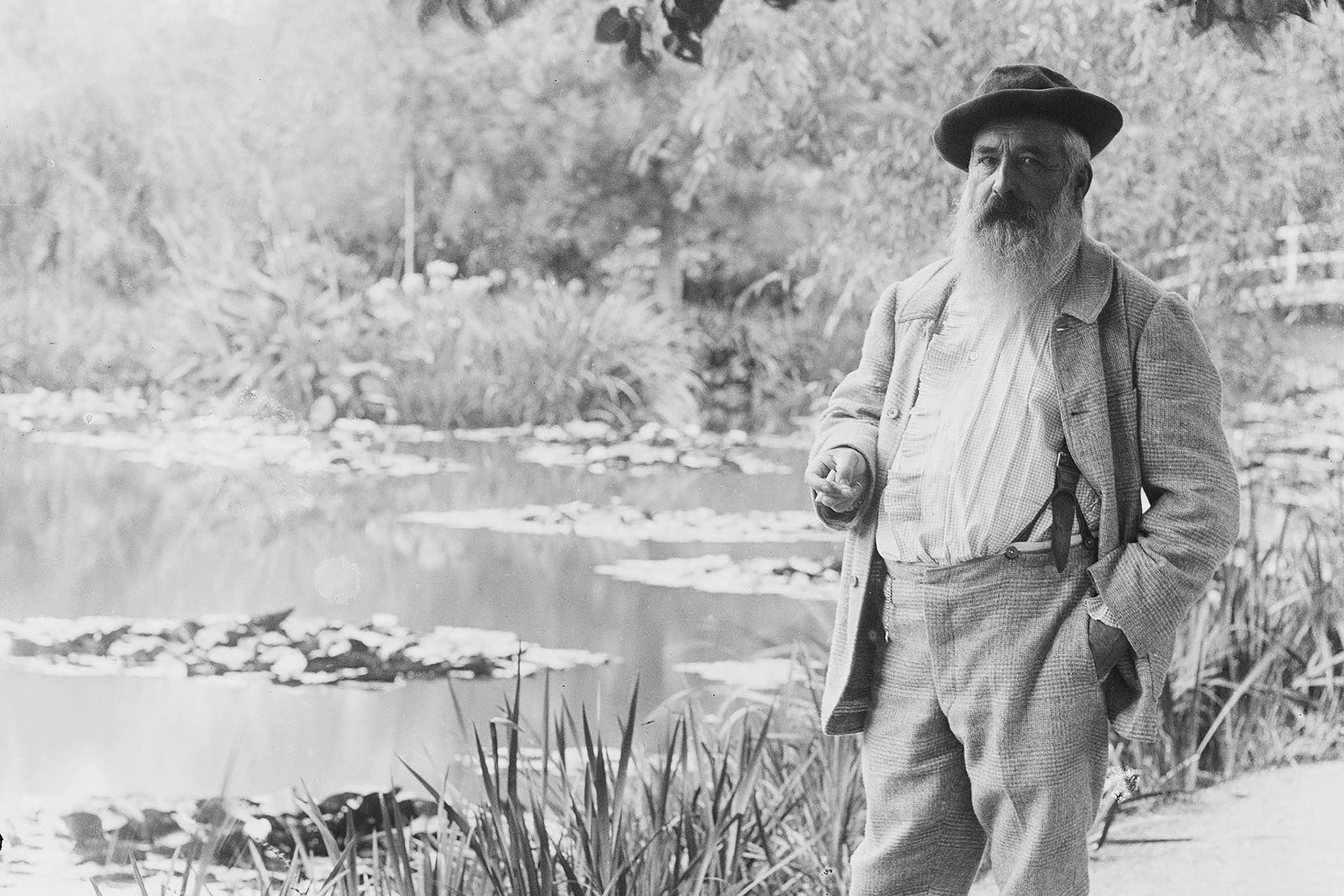


When Claude Monet died in 1926, he was a titan of French art but for the avant garde a has-been. The cubists considered Cézanne the foremost impressionist. After his death, Monet’s final grand project, the Water Lilies series that dominated the last 20 years of his life, hung mostly ignored for the same length of time again. Often these monumental panels, for which a gallery had been specially constructed at the Musée de l’Orangerie, were covered up for other exhibitions.
Sixty years earlier, Monet had become the pre-eminent impressionist, but impressionism’s own ascent took much longer. In the 1860s, the Salon still ruled the French artistic scene; acceptance to its annual exhibition was essential for any creative painter building a serious career.
For several years, Monet’s paintings – alongside those of Manet, Renoir, Pissarro and others – were refused as often as they were accepted. But as the impressionists’ popularity grew, they organised their own group shows, while commercial galleries superseded the Salon in terms of guiding buyers and thus controlling the market.
Monet became enormously wealthy, but it happened late. At the age of 42, asked to be a pallbearer at Manet’s funeral, he had to borrow funds for mourning dress and the train fare to Paris. Much like James Joyce a few decades later, Monet displayed breathtaking entitlement when pestering friends for money.
In the 1860s, the most frequent recipient of these demands was the wealthy young impressionist Frédéric Bazille, whose great generosity was tested by letters like these: “I have a lot to pay out tomorrow and afterwards, so you need to find a way to give me some money.” To this peremptory demand, Monet adds, untruthfully: “I never harass you.”
The most joyful passages in Jackie Wullschläger’s superb biography describe Monet painting en plein air: digging a trench into which he could lower his canvas to maintain consistency of viewpoint; painting his Poplars series from his studio boat, its deck grooved to hold multiple canvases; trapping grains of sand in the oils of his paintings from Trouville beach; being washed from the rocks at Étretat by a surprise wave, losing his picture to the Channel and hitting himself in the face with his palette (“my beard was covered in blue, yellow”).
At the age of 42, asked to be a pallbearer at Manet’s funeral, he had to borrow funds for mourning dress and the train fare to Paris
At the age of 42, asked to be a pallbearer at Manet’s funeral, he had to borrow funds for mourning dress and the train fare to Paris
Monet married twice. His first wife, Camille, populates his early work in the most literal sense: in paintings where there is more than one woman, for example Le Déjeuner sur l’herbe and Women in the Garden, they are all Camille. Wullschläger talks about these works not in terms of artist and model, but as a creative partnership. After Camille’s death in 1879, figures largely disappeared from his work.
Because Monet was a deeply internal – perhaps even unknowable – man, the paintings prove to be the most valuable resource to help understand him. Wullschläger describes the Haystacks series from the 1890s, which signalled a revolutionary shift in Monet’s work that would have a major impact on the direction of art itself: “This was the breakthrough. Monet had built landscapes on nuances of effect through the 1880s … but it was something else to construct them deliberately as a moment-by-moment series – paintings declaring themselves to be primarily about time rather than place. An Argenteuil picture [from the 1870s] gives the viewer the uncomplicated delight of looking at nature in one fresh moment. By contrast the Haystacks insist on contemplation of that moment passing, of the transience of all moments.”
The radicalism of Monet’s late style was eventually recognised in the mid-20th century as a gateway leading to abstract expressionism. Towards the close of her account, Wullschläger describes the Water Lilies series – what Paul Valéry called Monet’s “vast pure poems” – in terms that underline the connection, and finds the universal in Monet’s journey into subjectivity: “The water is boundless, the horizon line has gone, there is no vanishing point, the canvases form an endless continuum. The picture plane has become primarily a painted surface rather than a site for representation.”
Monet: The Restless Vision by Jackie Wullschläger is published by Penguin (£18.99). Order a copy from The Observer Shop for £17.09. Delivery charges may apply
Newsletters
Choose the newsletters you want to receive
View more
For information about how The Observer protects your data, read our Privacy Policy
Photograph of Claude Monet in 1905 by Fine Art Images/Heritage Images via Getty Images