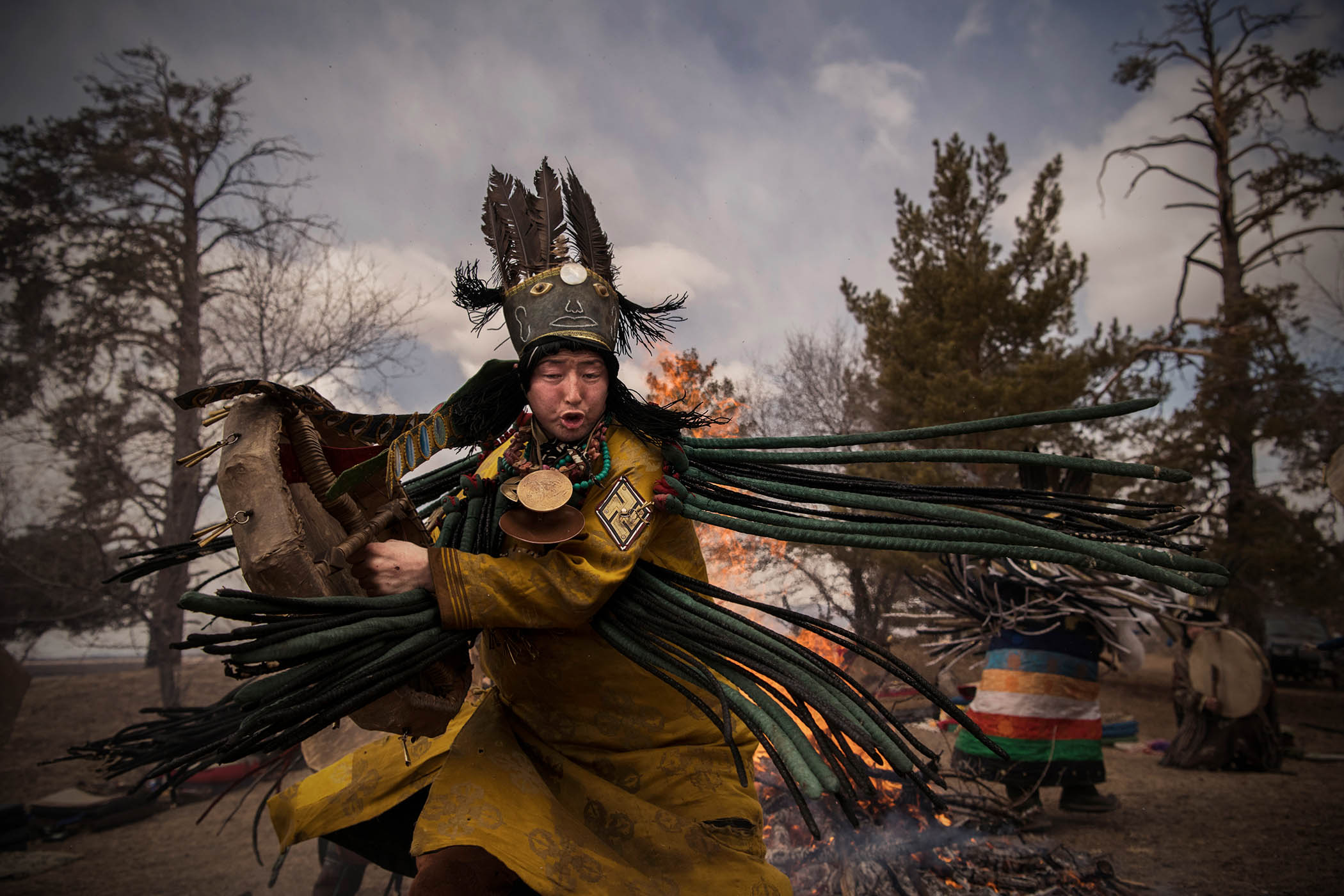


Before picking up this book I would have said a shaman was a medicine man or woman of some kind, operating on the border between folk medicine and magic. But the American anthropologist Manvir Singh argues convincingly that this is too narrow a view. He says we should think of shamanism as “a mind technology”, one that has developed to help humans deal with the uncertainty of life. “Shamans are not healers who happen to do other stuff,” Singh writes. “They are mystical intermediaries who offer security to the insecure.”
How do they do it? Singh breaks shamanism down into three basic elements: entering a “non-ordinary” state (like a trance); engagement with an unseen reality (battling malign spirit forces, possession by the spirits of the dead); and the provision of services (healing, prompting rainfall, cursing or even killing one’s enemies).
As well as documenting shamans performing such actions in the Indigenous settings where we most readily associate them – the remote island of Siberut, off Sumatra; in the jungles of Central and South America; and the snowy wastes of the Arctic – he also identifies shamanic practices in the money managers of Wall Street, at music festivals, among Pentecostal preachers, and in biblical accounts of figures such as John the Baptist and Jesus Christ.
Singh rejects the view that shamanism is “an evolutionarily earlier stage [of] more sophisticated forms such as priests, bishops, and ayatollahs”. Neither does he accept the opinion of the Romanian historian Mircea Eliade (once highly influential, now much more widely criticised) that shamanism originally spread via historical diffusion from Siberia (the word “shaman” comes from Tungusic). Rather than a single tradition with an unfathomably long reach, Singh suggests many different versions grew in parallel, all born of the same fundamental human needs. He sees shamanism as having been a “convergent cultural evolution”: “something about human minds or societies fates the practice to develop whenever we lanky primates get together”.
For Singh, the belief that psychedelics have been widely used for millennia is completely fallacious
For Singh, the belief that psychedelics have been widely used for millennia is completely fallacious
Singh is an excellent guide, well ordered in his thought, as well as curious and reasonable. In making his case he leads us through an initiation ceremony on Siberut, snorts hallucinogenic powder in the Orinoco basin, descends into cave systems in the Pyrenees, and attends Burning Man in Nevada, where the “Shamandome” offers “Find Your Power Animal” workshops.
In recent years, a key element of shamanism to enter the mainstream is the use of psychedelics. As someone who mainly used hallucinogens to escape the boredom of my teenage years in Hampshire (while listening, coincidentally, to the Shamen), I’m not best placed to evaluate the therapeutic claims made by the increasing number of people who now participate in ayahuasca ceremonies, or microdose themselves to mental wellness (in Hampshire we only ever megadosed).
But, for Singh, the belief that psychedelics have been widely used for millennia, as promoted by, among others, the anthropologist Michael Winkelman, bestselling author Michael Pollan and the psychiatrist Charles Grob (who has enthused on Goop about the ancient shamanic tradition of psychedelic use), is completely fallacious. The supposed ubiquity of psychedelic rituals simply isn’t present in either anthropological or historical records. Singh traces the upsurge of interest in the topic to an article in a 1957 issue of Life magazine called “Seeking the Magic Mushroom”.
Since then, “much of what passes as psychedelic history has been distorted by a seductive mixture of flimsy archaeological evidence, outdated anthropological approaches, and economically expedient ideology”. There is some historical evidence of psychedelic use, but the research Singh cites, buttressed by his own, puts it at less than 1% of the world’s cultures in the pre-Columbian era. For the most part, he says, the narratives around ayahuasca and its alternatives are “market-friendly perversions”.
Seductive as the vision of shamans offering an ancient form of psychotherapy might be, it’s hogwash. Fads – of which the psychedelics boom might well turn out to be an example – favour simplification. The truth, as Singh shows here, is messier, weirder and far more interesting.
Shamanism: The Timeless Religion by Manvir Singh is published by Penguin (£12.99). Order a copy from The Observer Shop for £11.69. Delivery charges may apply
Newsletters
Choose the newsletters you want to receive
View more
For information about how The Observer protects your data, read our Privacy Policy
Photograph by Kevin Frayer/Getty Images