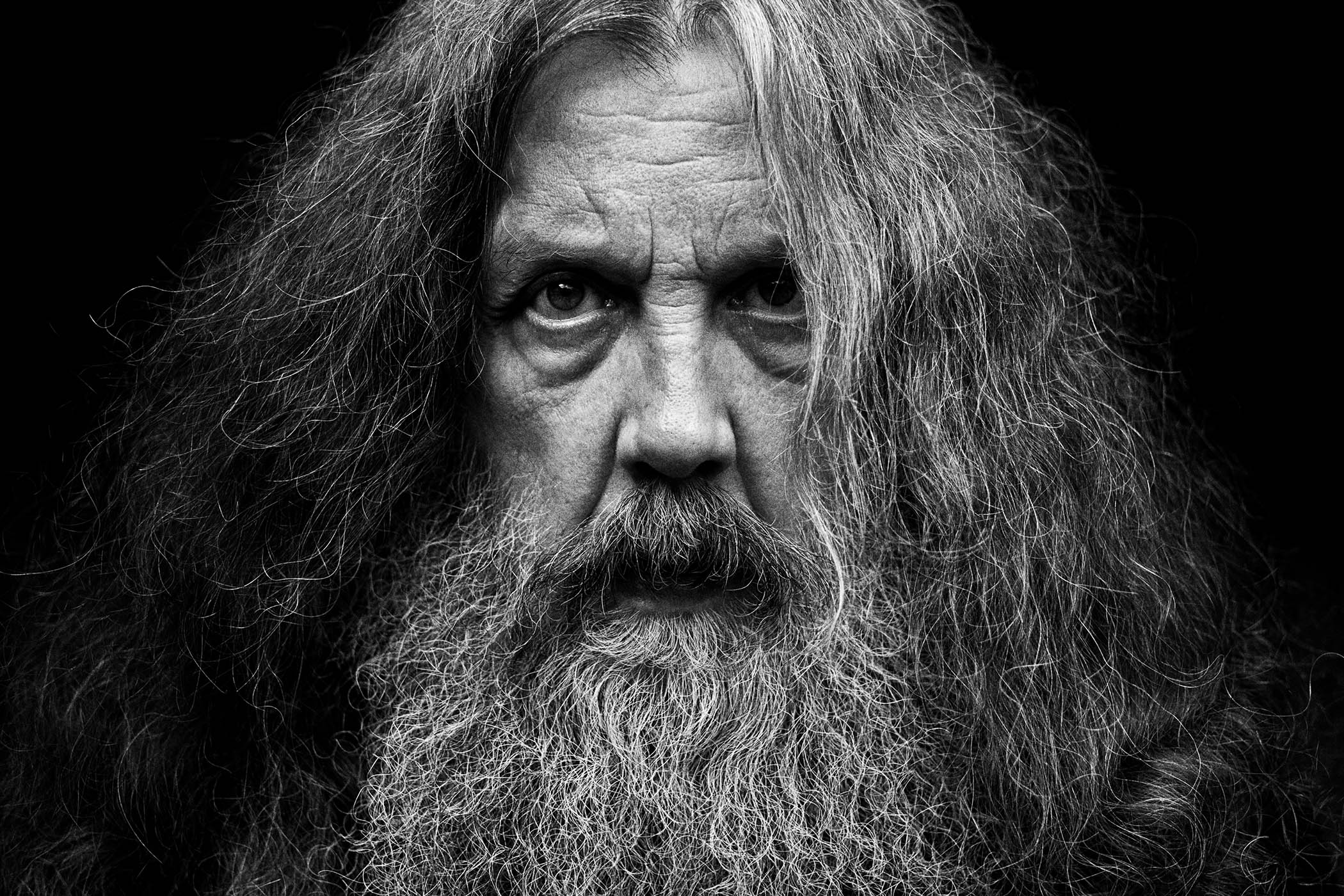
Alan Moore is the bestselling comic book writer behind Watchmen, V for Vendetta and The League of Extraordinary Gentlemen. His first novel, 2016’s Jerusalem, was wholly set in his hometown, Northampton, where he lives with his wife and sometime collaborator, comic artist Melinda Gebbie. He has two daughters, Leah and Amber, with his first wife, Phyllis Dixon. His latest novel, I Hear a New World, is the second in his Long London quintet.
What is the idea behind Long London?
I had an urge to investigate shadowy London, the horse tipsters, gangsters, record producers and other lowlife characters. I’ve created a narrative that could include them, which collides happily with the idea of another London hidden behind our own. There’s a wonderful short story called N by Arthur Machen that suggested our London was a flimsy curtain hung before a blazing, eternal paradisal London.
A sort of Platonic shadow of London?
Exactly. It starts in 1949, when London had been physically and psychologically reduced to rubble. I was born in 1953, and it took me decades to realise that the adults I was growing up among were suffering from PTSD.
Do you have a thesis?
It might not snap into focus until the fifth book. I think, for instance, that Margaret Thatcher destroyed the fundamental concepts of postwar consensus, the unions, the idea we should do something about inequality. Just before she died, she said her greatest triumph was New Labour. She was probably right.
You are ‘divorced’ from your earlier works like Watchmen and V for Vendetta, but they are powerfully predictive, rather than histories.
They were never meant to be predictive. Friends want me to write something nice. Why do I have to keep doing these terrible dystopian stories that then actually happen?
With the [Guy Fawkes] mask from V for Vendetta, you created a symbol for resistance.
It’s one of the works that I’ve disowned, although I am very glad if that mask has been useful to a global protest movement. I was glad that Occupy could find a use for it. I was optimistic when I saw Tunisian school kids wearing it at the start of the Arab Spring, but that replaced the old governments with worse ones and led inexorably to [war in] Syria. If the old world refuses to die, the new world cannot be born.
What do you mean by ‘the old world’?
The ferocity of the rightwing push that we’ve seen over the last 10 years. I can’t really attribute that to anything other than a desperate sense that they and their politics have no part in the future.
There must have been a series of obstacles to becoming Alan Moore, including the way you were educated. How did you overcome them?
My parents were happy for me to get on with whatever I wanted to do as long as I wasn’t causing trouble – drawing or reading or imaginative play. At grammar school, I found the regimentation of the place very different. You were referred to by your surname, all wearing the same uniform. There were arbitrary rules of conduct. It was supposed to let down ladders, but in fact it creamed off the most intelligent of the working class. I was happy with the warmth of working class living.
How did you get from learning in the library to writing Future Shocks, a sci-fi cartoon strip in 2000 AD?
I asked my friend Steve Moore, who had been working as a comic script writer. He taught me the basics, and I started submitting stories to Doctor Who weekly and 2000 AD. The 2000 AD editor rejected them but liked my style, so gave me Future Shocks. They were a great way to learn how to tell a story. I don’t acknowledge them [now]. The companies have lawyers and will fight you in court until you are destitute. I don’t want to be associated with the comics industry, which is poisonous.
OK… a couple of questions about that poison. The Dark Knight’s Frank Miller, who I think you fell out with…
He’s one of the reasons I’m embarrassed to be connected with the comics industry.
There is one year, 1986, when he releases Batman: The Dark Knight Returns, you release Watchmen, and it changes comics for ever. He’s now worth $45m.
I’m aware of this. Comics are a wonderful medium but the industry is corrupt. One of the reasons I disowned that work is because it is owned by DC Comics. They can give it to any writer. There was a TV series called Watchmen and my only connection with that was receiving a parcel with a powder blue barbecue apron bearing the hydrogen symbol and a letter that began, “Mr. Moore, I am one of the bastards currently destroying Watchmen…” I wrote back a brief letter, saying that this work has been stolen from me so, as far as I’m concerned, it is unauthorised.
You have become a magician, and not the rabbit-out-of-a-hat kind. Do some ideas have magical properties?
When I became a magician at the age of 40, I took it very seriously, and it has transformed my life. There’s no difference between magic and creativity. One part of magic is changing the consciousness of other people. Writing has always been the best way of doing that. If a wizard puts a curse on you, maybe your hands weigh too much, big deal. If you offended a bard they might put a satire on you, destroy you in the eyes of everybody who knows you, your own eyes, and if it’s good enough people might still be laughing at you in 200 years’ time. I think a lot of us have forgotten what art is for. It’s an engine of human progress. Art and culture stay with us. It’s the wars we’re ashamed of.
I Hear a New World is published by Bloomsbury on 21 May (£22). Order a copy at The Observer Shop for £19.80. Delivery charges may apply.
Photograph by Mitch Jenkins