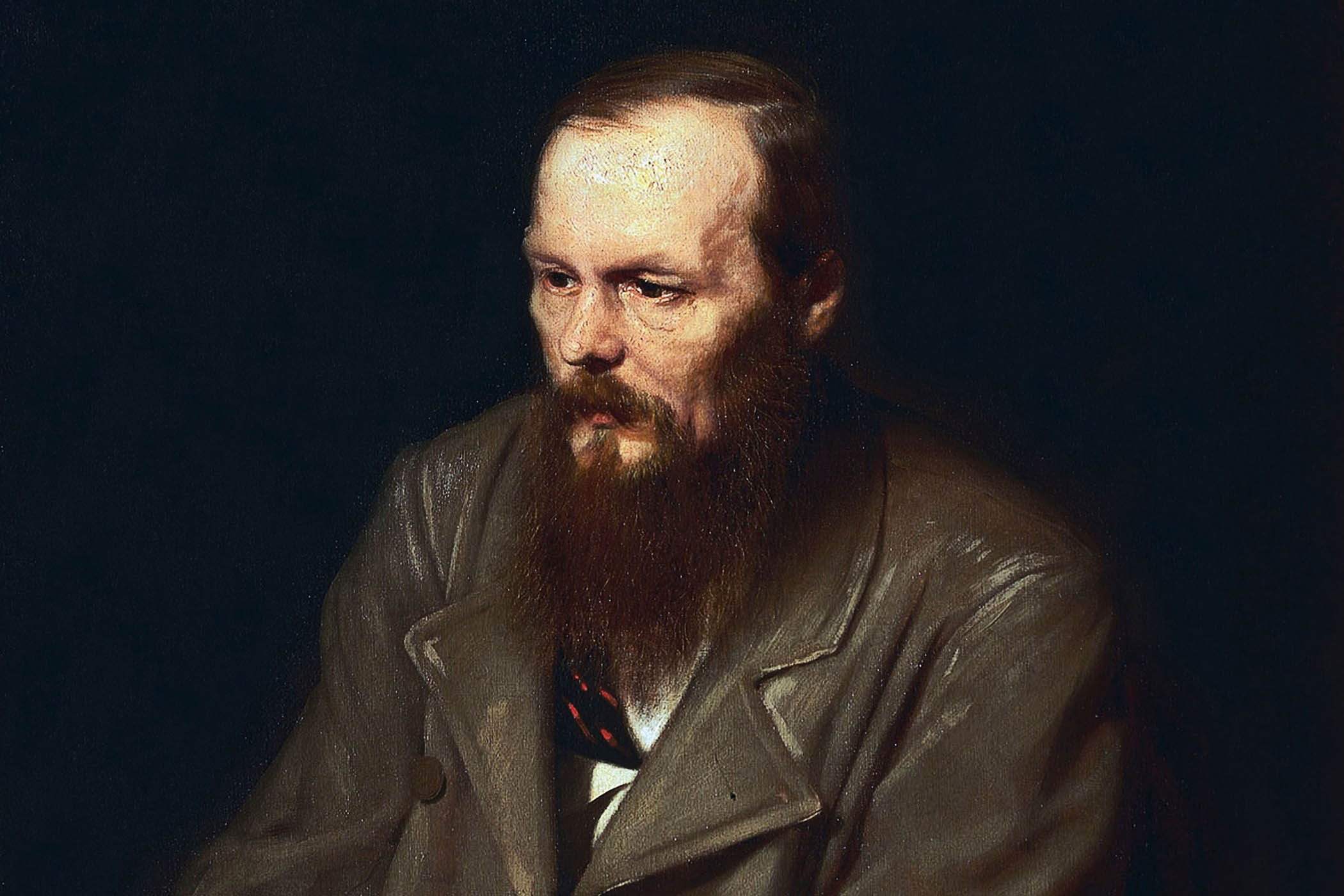

Describing a murder, investigation and trial in the fictional Russian town of Skotoprigonyevsk, The Brothers Karamazov is a straightforward story of endless complexity. More than 800 pages in length, it describes the events of three days, then a fourth two months later. Within this compressed timeline, Dostoevsky, who died three months after the novel’s publication, packs centuries of theology, philosophy, art and psychology, alongside two love triangles, madness, gambling, disease, all-night benders, and deaths sudden and lingering. “Out of Shakespeare,” Virginia Woolf wrote of the book in 1925, “there is no more exciting reading.”
The Karamazovs are introduced as a “nice little family”, the phrase pulsing with the irony, verging on sarcasm, that veins the narration of this grim, funny, savage and fleetingly beautiful novel. In fact, the father, Fyodor Pavlovich, is a monster: a violent, dishonest, money-grubbing and emotionally manipulative landowner with two dead wives behind him. His sons are all conflicted young men. The eldest, the retired army officer Dmitri, is passionate and dissolute, engaged to marry but in love with his mistress, whom he unhappily shares with his father. Ivan, a journalist and supposed arch-rationalist, is divided to his core, an atheist tortured by the ramifications of God’s absence. In love with Dmitri’s fiancee, he is sliding towards mental breakdown. Alyosha, the youngest, is a novice at the local monastery, but his elder tells him his future lies beyond its walls. Finally there is the resentful Smerdyakov, Fyodor Pavlovich’s likely bastard, who works as a servant in the Karamazov household.
This edition repackages Richard Pevear and Larissa Volokhonsky’s 1990 translation along with a new introduction by Karl Ove Knausgård, for whom the essential thing about the book is “the experience of it… and this makes it difficult to write about”. Pevear’s own introduction, however, serves to unlock, or at least outline, the novel’s mysteries. (It’s notable that Dostoevsky’s translators always take pains to explain just how weird his prose is; in his 1994 translation, Ignat Avsey wrote that Dostoevsky “breaks every rule of grammar, syntax and punctuation; his vocabulary is full of unusual words”.) In the past, Dostoevsky was considered great despite his style, but Pevear explains that the publication of Dostoevsky’s notebooks in the 1930s put the lie to the idea he was “a careless and indifferent stylist. All the oddities of his prose are deliberate; they are a sort of ‘learned ignorance’, a willed imperfection of artistic means, that is essential to his vision.”
This approach reaches its apogee in The Brothers Karamazov, which is narrated by a nameless inhabitant of Skotoprigonyevsk. David McDuff, whose version was published in 1993 (the 90s were a boom time for Karamazov translations, clearly), noted the narrator’s “narrow, prejudiced but none the less curiously perceptive eye”. His idiosyncratic voice, partial to redundancies and strange infelicities of language that keep the reader always slightly off balance (the “fresh evening air refreshed him”), is essential to the effect of the novel; in a book that presents a sequence of arguments the validity of which it is the reader’s task to judge, dialectic without synthesis, the prose is as restless and undecided as the characters.
For Dostoevsky’s biographer, Joseph Frank, The Brothers Karamazov belongs alongside The Divine Comedy, Paradise Lost, King Lear and Faust. As those comparisons suggest, the novel stages a conflict between reason and Christian faith, and the question of Dmitri’s crime, and its punishment, transforms into a matter of humanity’s universal, existential guilt. What is the nature of the transgression for which we are in the dock? Do we accept or refute the charge? And what will our sentence be? These are the questions Dmitri, Ivan and Alyosha are, in their own radically different ways, struggling to answer. That Dostoevsky can make of such abstract moral and intellectual material so immersive and engrossing a novel – and one possessed of such irresistible momentum – is the greatest of his achievements, and one of the greatest of any writer.
The Brothers Karamazov by Fyodor Dostoevsky is published by Picador (£19.99). Order a copy from The Observer Shop for £17.99. Delivery charges may apply
Photography by Getty Images
Newsletters
Choose the newsletters you want to receive
View more
For information about how The Observer protects your data, read our Privacy Policy