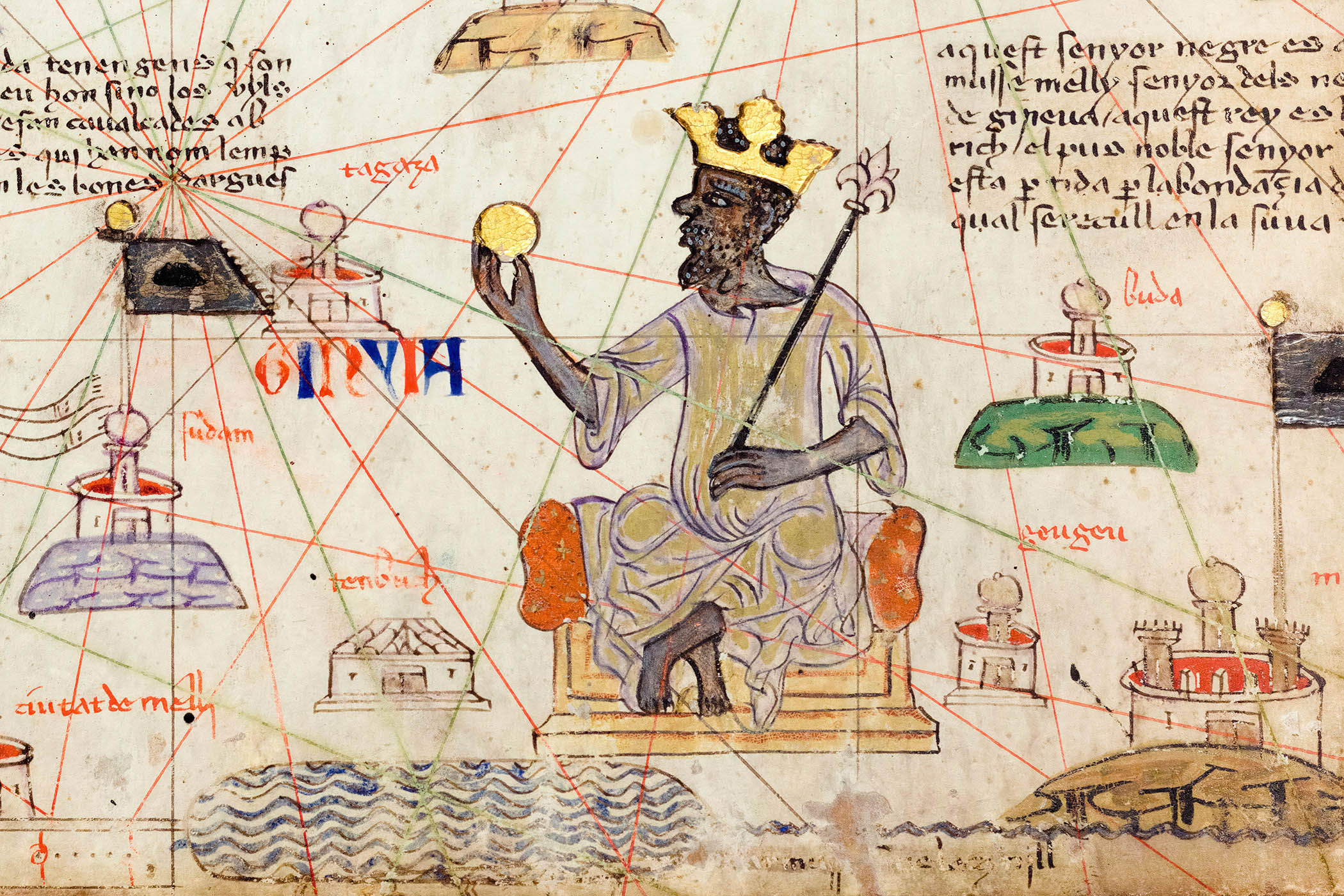


While reading Motherland, by the British Ghanaian historian and anthropologist Luke Pepera, at times I felt like a companion on Doctor Who, popping my head out of the Tardis to witness an otherworldly view. Across 10 chapters, Pepera not only covers thousands of years of African history but also takes us into the inner worlds of such notable figures as the incomparably wealthy Mansa Musa, who ruled over the Mali empire in the 14th century. Musa was a devout Muslim, who, after accidentally causing the death of his mother, set off on a long hajj to Mecca, accompanied by more than 60,000 people, plus 100 elephants and 80 camels carrying tons of gold. His travels led to talk of his great wealth spreading across the world – and speculation that, in Mali, gold must grow as if like a plant.
Pepera grew up between London and Accra in the early 2000s. He was disappointed that the only stories he was exposed to about the continent where all human life originated started with transatlantic slavery and European colonialism. In other words, narratives that adopted Hugh Trevor-Roper’s view that the only story worth telling about the continent is the “history of Europeans in Africa”, or Hegel’s belief that the continent could not be judged to be a “historical part of the world”. So Pepera took it upon himself to research that overlooked history.
Pepera’s book – first published last year and now out in paperback – touches on everything from west Africa’s centuries-old griot tradition of storytelling to the transcontinental connections that led to the formation of Swahili identity on Africa’s east coast – blending cultures from as far as Yemen, India and China.
The scope is ambitious, and although some passages about the lives of key figures are written in great detail, even Pepera admits that what he is able to accomplish in this book “represents just a fraction of the African past”. While reading, I was sometimes left wondering why certain topics were left out and if others had been tied up too neatly. For example, Pepera comes to the conclusion that “in African peoples’ histories, racism wasn’t widespread or longstanding”. But as Bruce S Hall writes in A History of Race in Muslim West Africa, for centuries some Arab populations in Africa “came to see themselves as distinct and superior to the neighbouring desert-edge Black populations with whom they interacted”. By making definitive statements about “African history” and “African peoples”, Pepera risks homogenising the people who, elsewhere in the book, he acknowledges as having incredibly diverse cultures and traditions. But the 270 pages of Motherland do provide a crucial and accessible way in for those who have been told the continent’s story only started 500 years ago.
Pepera ensures the stories of traders, travellers, warriors, artists, scholars and rulers are acknowledged and celebrated
Pepera ensures the stories of traders, travellers, warriors, artists, scholars and rulers are acknowledged and celebrated
I was fascinated to learn that the world’s oldest language is Khoisan, which can be traced to southern Africa around 20,000 years ago, and that people from my own ethnic group, the Yoruba, have ancient Eurasian ancestry. The back-into-Africa migrations that took place thousands of years ago remain relatively unknown: how people who left the continent to settle in Europe, reproducing with Neanderthals, doubled back and introduced new genes back into Africa. As Pepera explains, this is in part why Africa is home to the most genetically diverse human population in the world.
Some of the most captivating parts of the book are when Pepera links Africa’s past and present to the lives of those of African descent now living in the “new world”. After explaining the reverence for ancestors in some cultures in west and east Africa, he connects this to the life of the late Black Panther star Chadwick Boseman. Through Boseman’s embodiment of several African American pioneers on screen – from baseball player Jackie Robinson to civil rights lawyer Thurgood Marshall – Pepera writes that “the ancestors spoke through him”. Elsewhere, when writing about the quick-footed lyricism of rap battles in America, he finds echoes within the intricate proverbs of west Africa’s Urhobo community. Readers are gifted some brilliant aphorisms from the Urhobo, including this gem: “A person carrying an elephant home on his head need not use his toes to dig up cricks on the way.” In other words, “someone already with a job that earns them more than enough doesn’t need side-hustles”.
Pepera explains complex subjects using simple, conversational language, and Motherland often feels like an animated discussion over lunch with a well-informed friend who’s keen for us to think more critically about the world. He succeeds in his aim to showcase the full spectrum of African life and ensure the stories of African “traders, travellers, warriors, artists, scholars and rulers” are acknowledged and celebrated. And in an era where we’ve had a prime minister of African Asian descent, and seen Afrobeats artists dominate the charts and an African American man circle the moon, a book highlighting the multifaceted triumphs of people of African descent undoubtedly meets the moment.
Motherland: A Journey Through African History, Culture and Identity by Luke Pepera is published by Weidenfeld & Nicolson (£12.99). Order a copy from The Observer Shop for £11.69 (10% off RRP). Delivery charges may apply
Photograph by Alamy
Newsletters
Choose the newsletters you want to receive
View more
For information about how The Observer protects your data, read our Privacy Policy