

Early on in her book One Bad Mother, EJ Dickson tells us that she “really, really loves being on her phone”, and on one level her book – a study of the demonisation of mothers in the social media age – reflects how her own parenting has been shaped by digital culture. Is it hashtag relatable if she tells you she texts her friends TikToks while her baby plays on the floor? That small children are often less compelling than hate-scrolling the Instagram feed of a Mormon momfluencer who has just (oh, mere minutes ago!) given birth to her ninth adorable child? For millennial and gen Z mothers, social media is both lifeline and judgment system, turning parenthood into a competition and a performance.
In this climate, the template for the “good mother” is simple and evergreen, Dickson writes. That idealised figure is thin, white, wealthy, self-sacrificing and her children “say cute things about Ruth Bader Ginsburg that she posts on social media”. But today’s bad mothers are manifold and therefore more revealing. Dickson, a senior writer at New York magazine, sets up for the purposes of her book a Google alert for the phrase “bad mom” and in a single day gets the following: the actor Sophie Turner, for drinking in a bar after the announcement of her divorce; the YouTuber Ruby Franke, for the abuse of her children; one poor woman for excessive “gentle parenting”; and an elderly mother, for dying in a house fire with her son.
It takes all sorts, and so Dickson narrows her focus to the bad mothers – the ones burnished by the internet and served up to us through popular culture. “The bad mom is a social tool designed to control women,” she writes, and today that means the selfish career moms on TV (Midge in The Marvellous Mrs Maisel, Deborah Vance in Hacks), the milfs who dare to be attractive (Dickson identifies the man who coined, and now regrets, that acronym), the transactional stage moms, the anti-vaxxers and the welfare queens.
Dickson is funny, though occasionally guilty of three punchlines where one would do, and deftly weaves in her own experiences: being fired during her first pregnancy; being put on full bed rest for her second; and struggling to breastfeed. Her preferred tone is non-serious, but one of the book’s strongest chapters is devoted to the demonisation of the working class, or what one academic calls “parenting under poverty”. Here are mothers, many of them Black, who are jailed for leaving their children to go to work because they have no childcare, or are humiliated on TV shows like Judge Judy (“Terrible mother wants to party instead of taking care of kids” runs the headline on one viral clip). Dickson writes that she has made similar calculations – is it so bad if she leaves her sons for five minutes to run out for nappies? – but as a white, middle-class woman would face less severe judgment.
More than 100 women were charged in connection with the 2021 US Capitol riot, and Dickson finds some surprising common ground between the “QAnon Karens and Maha [Make America Healthy Again] moms”. She maps the rise of the Covid-era anti-vaxxers and subsequent boom in rightwing conspiracy theories, many of them preying on ordinary maternal anxieties. “It’s easy to dismiss the Maha moms as horrible people,” Dickson writes. “It’s a lot harder to acknowledge the reality: that when women become so consumed by the desire to be good mothers… they may find themselves becoming the worst kind of all.”
Some of this is personal for Dickson, who was dismissed by doctors, specialists and even family members after becoming concerned about her son’s developmental milestones. For years she swung between feeling she was doing too much and not doing enough, paying an army of experts to figure out the problem: “vision therapists, executive functioning coaches, parent-child-interaction therapy providers who… gave me instructions via earpiece for how to talk and play with him, like Cyrano de Bergerac for middle-class moms”. She is diagnosed with OCD, and “Harry continues to have struggles”. If this experience goes to the heart of Dickson’s sense of being judged a good or bad mother, it is not the book she wants to write – partly (and this is surely good mothering) out of respect for her son’s privacy.
Dickson is an astute analyst of the alt-right tradwife and the true-crime junkie who devours stories about matricide as a way of feeling superior. But her default wisecracking starts to frame motherhood as a fundamentally ironic experience – one giant eye roll at her fellow not-regular-but-cool moms. There are too many footnotes, and footnotes to footnotes, and a distancing reluctance to be sincere or hold a thought.
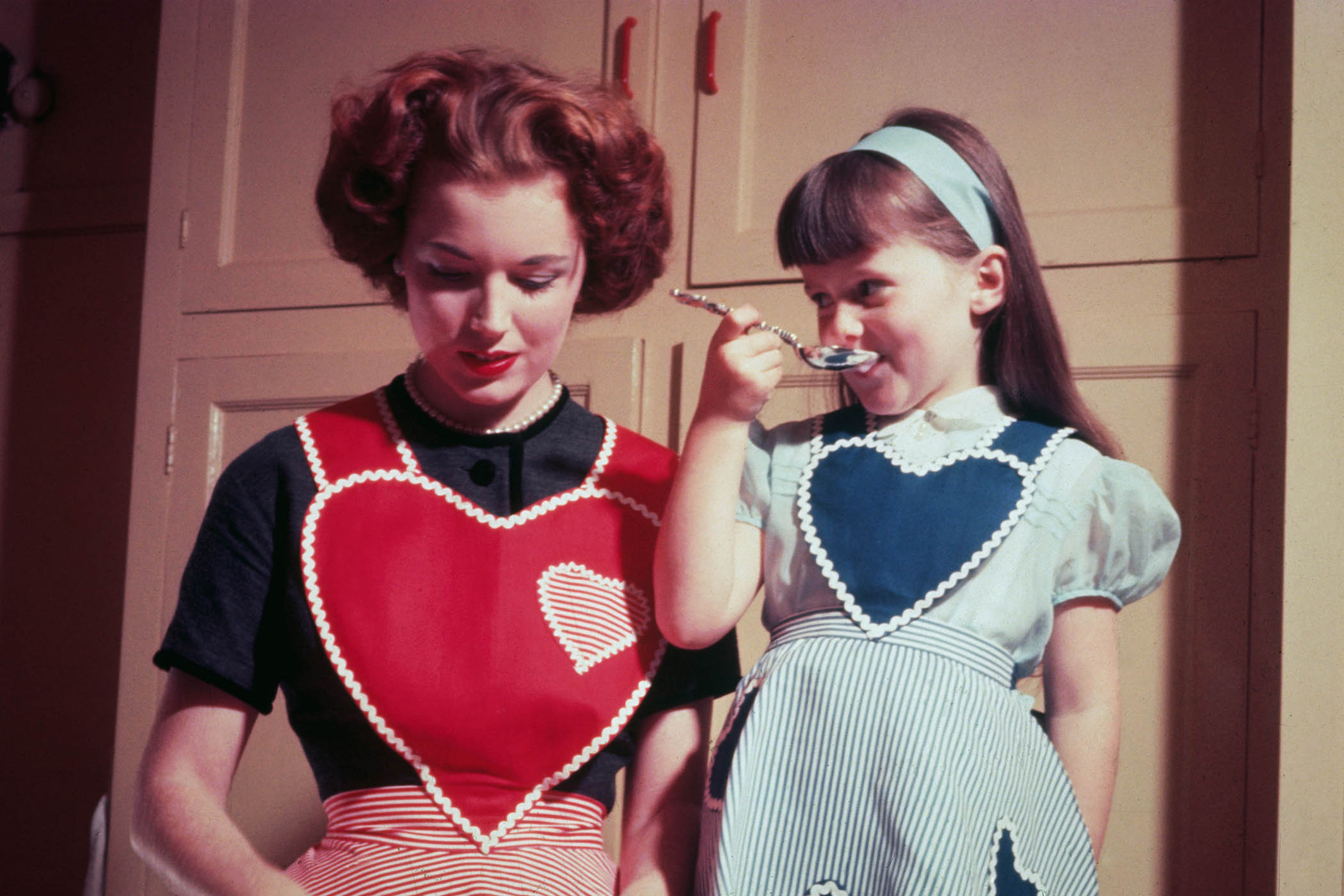
For millennial and gen Z mothers, social media is both lifeline and judgment system, turning parenthood into a competition and a performance
For millennial and gen Z mothers, social media is both lifeline and judgment system, turning parenthood into a competition and a performance
You could argue this hyper-distracted style is illustrative of the hyper-distracted age of parenting. Dickson’s conclusion that everyone needs to give themselves, and one another, a goddamn break – to “serve the fucking chicken fingers and turn on the fucking TV and disassociate on your phone for a few minutes” – is itself a judgment on the square moms who serve the carrots and set the screen time. And aren’t I judging here? Nobody wins at this game.
Elinor Cleghorn’s A Woman’s Work is a more conventional history of mothering, from ancient Greece to the present day, which draws on the earliest written guides (many of them by women) to fertility, birth and raising children. Before the internet, there was the sorority of midwives and wet nurses, and before them, the bad science of the Hippocratic physicians of the 5th century BC. Want to know if you’re fertile? Drink butter mixed with another woman’s breast milk and if you burp, bingo. Insert a whole head of garlic into your vagina when you go to bed, and if the scent reaches your mouth by morning, you’re good to go. In 77AD, Pliny the Elder recommended applying the ash of burnt hedgehogs to prevent pregnancy loss.
Cleghorn’s aim is to reclaim mothering as a radical, intentional act – not purely a biological function, devoid of thought, creativity or labour. One of its 12th-century students was the German abbess Hildegard of Bingen, who became the first woman to describe the female orgasm: “A sense of heat in her brain, which brings forth with it sensual delight.”
Newsletters
Choose the newsletters you want to receive
View more
For information about how The Observer protects your data, read our Privacy Policy
Like Dickson, Cleghorn looks at mothering in poverty – this time in 18th-century England, when many women were hanged for having babies who died or were stillborn. At the 1726 trial of one woman who denied ever being pregnant, a midwife forcibly examined her and carried the breast milk to the jurors in her cupped hands. There is an engrossing chapter on the American abolitionist Sojourner Truth, who in 1828 won custody of her son from a slave owner. If white women had motherhood forced upon them, enslaved Black women were often deprived of it: Cleghorn movingly describes how Truth worked the fields with a newborn, hanging a basket from a tree so that she could breastfeed while standing.
There is a repetitive quality to some of the chapters, many finding the same failures (“the cultural insistence on motherhood as women’s natural duty”) and solutions. But you can’t blame Cleghorn for that. She writes as Britain reckons with a maternity care crisis, and as rightwing parties show fresh interest in motherhood and the means of controlling it – the overturning of Roe v Wade in 2022, the return of motherhood medals in Putin’s Russia. As her title suggests, the work is never done.
One Bad Mother: In Praise of Psycho Housewives, Stage Parents, Momfluencers, and Other Women We Love to Hate by EJ Dickson is published by Simon & Schuster/Simon Element (£20).
by Elinor Cleghorn is published by Weidenfeld & Nicolson (£22).
Order a copy of either book from The Observer Shop to receive a 10% discount. Delivery charges may apply
Photography by Getty Images