

In September 2023, King Charles III presented an edition of Voltaire’s Letters Concerning the English Nation to French president Emmanuel Macron at the Élysée Palace. The royal visit to Paris came immediately before a state banquet at the Palace of Versailles – postponed for six months due to widespread rioting – and 290 years after the philosopher’s letters were first published in London. A chronicle of his time exiled in England between 1726 and 1729, during which he had an audience with Charles’s predecessor George I, this series of essays criticises France as a bigoted nation while commending the more enlightened constitutional monarchy across the Channel.
Despite his disloyalty, the author of Candide, born François-Marie Arouet, is revered in his home country, and to mark the centenary of his death a bronze statue was erected in its capital. As noted by the historian Andrew S Curran at the start of The Race Makers, the name Voltaire became “synonymous with liberty, tolerance, and freedom of thought”, which may be why the Vichy government melted his likeness down, “transformed into Nazi bullets and shell casings” for Hitler’s war machine.
A replacement marble figure was commissioned under Charles de Gaulle, though in 2018 that too was defaced, which Curran believes was in protest against the veneration of a human rights icon who had written that Black Africans and Native Americans were “intellectually inferior” and owned shares in a company that trafficked slaves. Amid this ongoing battle of ideas, the author argues that now is the time to examine the contested legacies of great Enlightenment thinkers who published “corrosive and often dehumanising writings on race”.
Apart from a single chapter on Swedish botanist Carl Linnaeus, the first half of Curran’s history of race – “the most dangerous idea ever” – focuses on key figures from France, the “breeding ground” for some of its more important developments. In 1685, Louis XIV, the Sun King, issued his Code Noir, “the most famous of the era’s European slave laws”, which codified the “absolute authority of the enslaver over the enslaved”. The first copies were dispatched to French colonies on the other side of the Atlantic, in Martinique, then Saint-Domingue (Haiti), before a version found its way into parish churches in Louisiana, land named after the king himself.
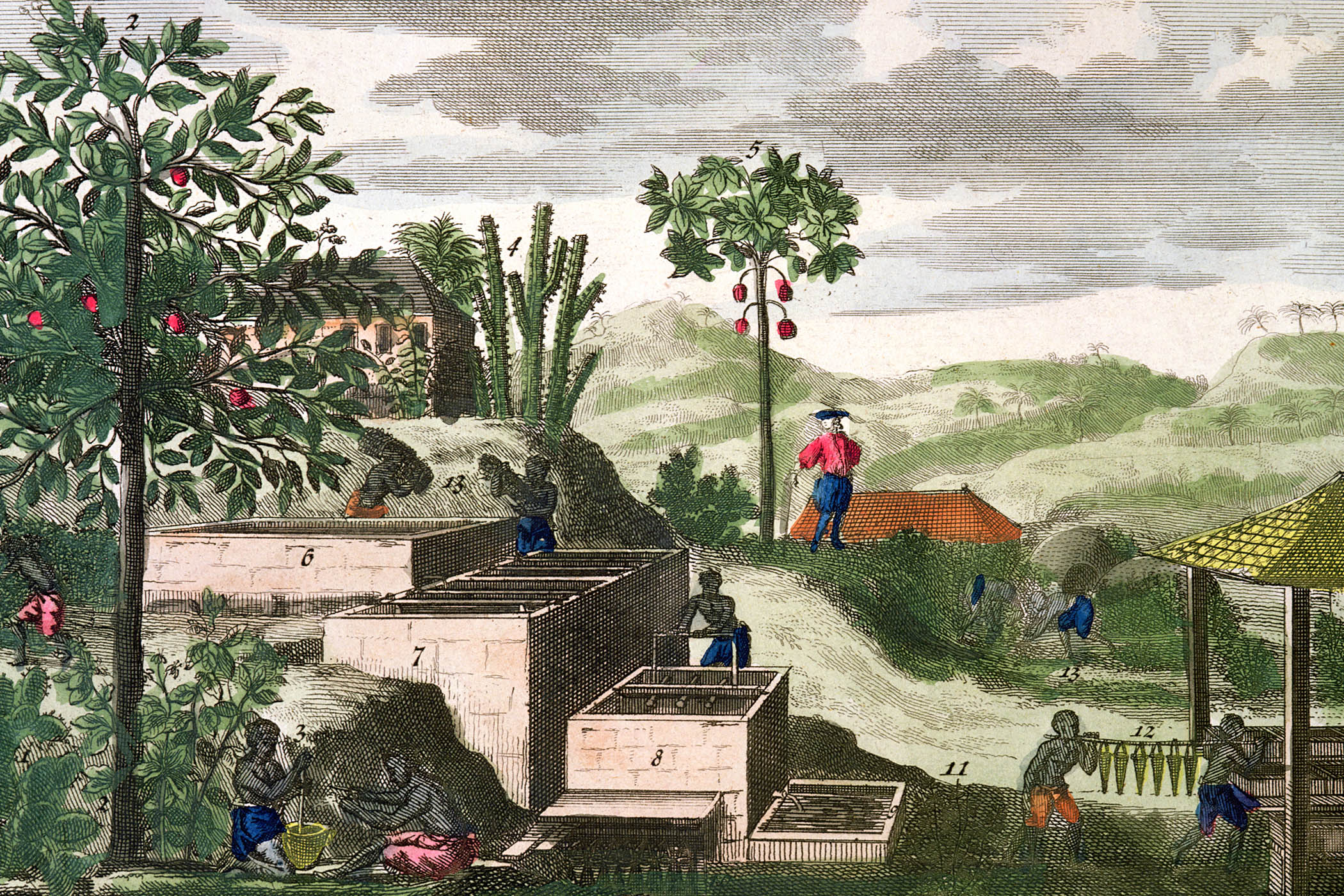
Louis’s “comptroller general” Jean-Baptiste Colbert – the second most powerful man in France, who oversaw the construction of Versailles while managing the country’s “labyrinthine finances” – took charge of colonial policymaking. Curran demonstrates how, under “constant threat of attack from France’s Protestant rivals”, Caribbean territory came to be a cornerstone of its empire, cultivating precious commodities including cocoa, coffee beans and cotton largely through slave labour. Although transporting captives from Africa across dangerous waters was risky for investors – as many as 15% died on board – the French economy undoubtedly benefited, with import levies swelling the royal coffers and port cities receiving boatloads of goods to supply new domestic industries or to be “bartered” for more Africans. Colbert – who “would have doubtless crafted the final language of the slave laws” – felt that “no business in the world… produces as many advantages as the trade in Negroes”.
The author introduces those who theorised empire’s advantages, such as Jean-Baptiste Labat, the “ethnographer” and Dominican priest, whose order was “deeply enmeshed in the secular workings of colonial life” on Martinique, operating a sugar plantation, the remains of which can still be seen today. We hear that Labat “achieved mythological status” as a cartographer, botanist, zoologist and historian, his “proto-racial reflections” appearing in a six-volume account of plantation life that helped “furnish the raw material for… a distinctly race-based conception of humanity” to emerge. “I have seen Africa,” the coloniser once wrote, “but I have never set foot there.”
We meet a bestselling travelogue writer, François Bernier, the doctor and classifier and the first to use the word “race” to denote human difference, at a Parisian salon in the late 17th century. Though, as Curran writes, most French contemporaries would have considered Black and Asian people inferior to themselves, it was uncommon at the time “to sort humankind into strict racial categories” as he did, which ultimately led to the “racialisation of every last human living on the planet”.
It was Georges-Louis Leclerc, Comte de Buffon, an aristocratic naturalist, who evolved this “science”. Appointed by Louis XV, the Sun King’s great-grandson and immediate successor, to supervise his kingdom’s “vast botanical and zoological collection”, Buffon filled dozens of wooden and glass armoires with skulls, fractured bones and stillborn fetuses as objects of study. His Natural History geographically organises hundreds of different phenotypes and largely reflects European prejudices which, Curran believes, modern readers would consider “explicitly racist stereotypes”.
With elegant early modern images scattered across its pages, The Race Makers also showcases the spirit of scientific discovery flourishing outside France. We travel to Scotland where the empiricist David Hume held court as president of Edinburgh’s elite debate club the Select Society. In the aftermath of the Act of Union, his country became the most literate in Europe, producing influential voices in modern sociology, linguistics and geology, not to mention its role in the development of the steam engine and refrigeration. Curran tells us that Hume, though famed for his religious scepticism, abided by club bylaws largely precluding the discussion of God. He created instead “an incubator for a new vision of race”, alongside the economist Adam Smith – his “best friend” and fellow “inveterate” bachelor – who argued that “commerce was a civilising force”.
Hume held the belief that there “scarcely ever was a civilised nation of any other complexion than white”, with non-white people trapped in a primitive state of being, “unable to excel in scientific or artistic endeavours”. The philosopher takes this assertion to fanciful ends, comparing celebrated Jamaican poet, Latin scholar and astronomer Francis Williams to “a parrot, who speaks a few words plainly”.
Newsletters
Choose the newsletters you want to receive
View more
For information about how The Observer protects your data, read our Privacy Policy
Hume’s views, we are told, had a profound impact on Immanuel Kant, the German thinker who defined the Enlightenment as “man’s emergence from his self-imposed immaturity”. The “wispy-haired professor” who “never ventured farther than the outskirts of Königsberg” was not only convinced of an “unequal distribution of human reason” among the world’s different races (identified as “White, Negro, Hunnish, and Hindu”), but saw himself as an expert on humankind in general. He claimed that the “fairer sex” has an innate feeling for the “decorative and adorned” and, in terms of national character, only the Germans (unsurprisingly) achieve a “happy mixture” of both the sublime and the beautiful in their aesthetic sensibilities.
Curran revels in the details of his subjects’ interior lives, noting that Kant “delighted in billiards”, was “partial to colourful waistcoats, breeches, and coordinated vests”, and the later-in-life turn to questions of race coincided with him moving house, “terribly distracted by the neighborhood’s (hateful) children” and “strident, out-of-tune singing” emanating from inmates at a nearby prison.
The Race Makers ends with a profile of Thomas Jefferson, one of America’s “founding fathers” and author of its 1776 Declaration of Independence, containing the “self-evident” truth that “all men are created equal”. Curran feels that if European debates on race had been written “on paper”, they were written “on skin” in the newly founded United States, where approximately 18% of the population was enslaved.
With the revolutionary war over, Jefferson – his nation’s “greatest Francophile” – was dispatched to dine with Louis XVI at Versailles, negotiating trade deals for American produce such as tobacco. His time in Paris, overlapping with the start of the French Revolution, allowed Jefferson to better develop an understanding of Enlightenment theory. Believing slavery to be a “great political and moral evil”, he was, however, a slaveholder himself with 135 men, women and children working his Virginia plantation. One of them, Sally Hemings, effectively became her “master’s” long-standing “concubine”, giving birth to six of his children – a difficult thing to square with his belief that the “mingling” of black and white blood was an “abominable mixture”.
During Jefferson’s two-term presidential tenure (1801-09) the new republic purchased the Louisiana territory from Napoleon Bonaparte, who had failed to suppress a slave rebellion in Haiti, during which the Virginian duplicitously sided with the French colonists but continued trade with the black revolutionaries.
This fourth of July marks 200 years since Jefferson’s death – 50 years after the founding fathers broke with Britain to preside over the birth of a nation. President Donald Trump, while stood in front of Jefferson’s likeness chiselled into the rockface at Mount Rushmore, used Independence Day in 2020 – towards the end of his first term in office – to praise his predecessor as an “ardent defender of liberty”, while railing against “angry mobs… trying to tear down statues of our founders” and threatening those defacing federal monuments with a minimum 10-year jail term.
Curran credits the third US president’s legacy with providing inspiration for everything from Abraham Lincoln’s antislavery stance to Martin Luther King’s “I Have a Dream” speech, arguing his ideas “helped shape the United States both for the better and for the worse”. Jefferson and fellow Enlightenment figures may have accepted and established the “racialisation of humanity… as fact”, yet they formally set in train the freedom to contest our histories, no matter the wishes of whichever potentate has their hands, for the moment, on the levers of power.
The Race Makers: A History of the Enlightenment’s Most Dangerous Legacy is published by The Westbourne Press (£25). Order a copy from The Observer Shop for £22.50 (10% off RRP)
Photograph by Culture Club/Art Images/Getty Images