
I’m sitting in the happy rustling quiet of a library, reading. The text is part memoir, part biography. For many years it was lost, or made to vanish, in the depths of an archive; it reappeared in circumstances which are themselves a little mysterious. It was written by a man who wished to mark his father’s greatness but who, despite his own wealth and fame, could not shake himself free of that famous father’s brutality, of what he had suffered at his father’s hands.
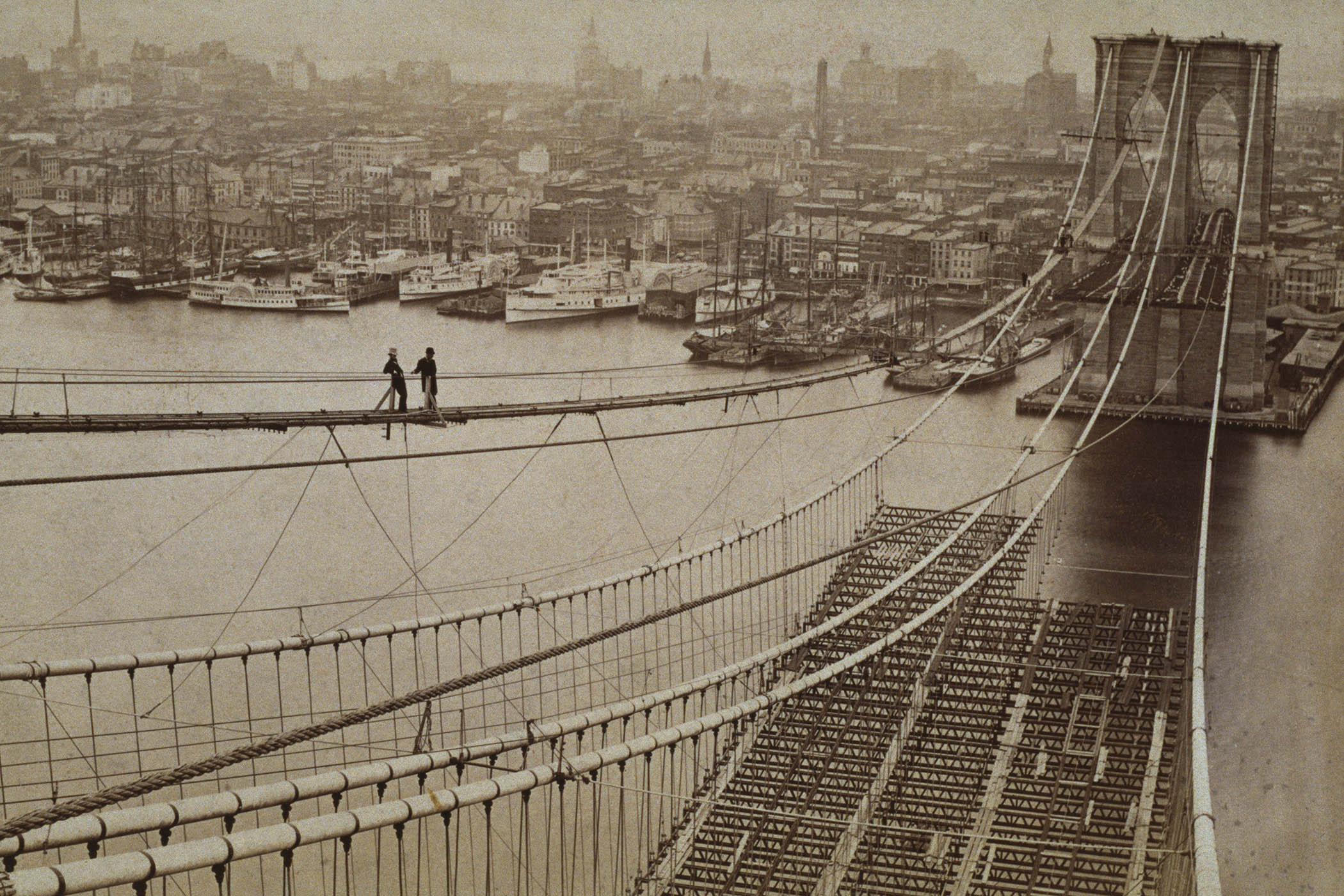
When Washington Roebling sat down to commemorate his father’s life in his middle age and as an older man – he had two goes at it, and nearly abandoned the project – he had a claim to be the greatest engineer of his day. He had managed the building of the Brooklyn Bridge, which was hailed when it opened on 24 May 1883 as the “eighth wonder of the world”. He lived in the grandest house in Trenton, New Jersey with his brilliant wife, Emily; the family business thrived. Yet what rises so often from his recollection is the vibration of a child’s fear and despair. “His domestic life can be summed up in a few words,” Washington writes of his father, John A Roebling. “Domineering tyranny only varied by outbursts of uncontrollable ferocity. His wife and children stood in constant fear of him and trembled in his presence.”
But it was more than just the violence. On top of everything else, John Roebling was a man who would put today’s wellness influencers to shame. That day in the library I read, for the first time, Washington Roebling’s account of what happened when his father installed one of his “fakirs”, as Wash had it, in the family home. The mountebank in question was called G Melksham Bourne, “a bankrupt picture dealer”, Wash writes, who had relaunched himself as a quack. He arrived at the Roeblings’ home when Wash, the eldest son, was about 12. He brought with him his wife and a son of Wash’s own age. He prescribed a diet of water, dried fruit – “full of worms which were considered a luxury”, Wash wrote – and raw wheat flour. Nothing else.
One Saturday, Bourne’s son vanished. There was no trace of him, though he was hunted for high and low. From the vantage point of his late middle-age, Washington finishes his story with ruthless economy. “I suggested he might have gone swimming & been drowned – So I stripped and dived for half an hour actually finding the dead body in the bottom of the canal – all efforts at resuscitation were in vain.” He then doubles down. “The subsequent funeral broke up the starvation diet for good & our lives were saved,” the story ends.
To believe that a person may be known – truly known – from what is left in written words, in grey cardboard boxes, on microfilm, is plain foolishness, though an edifice of publishing and historical discourse rests on this assumption. I cannot dismiss the endeavour, not least because I’ve undertaken it myself, more than once. And yet. We are breath and blood, and the tracks we leave are fossils only. If you have ever written a letter (email, text, whatever) and changed your mind later about what you said – and that is every single one of us – you’ll know what I mean. This is before we come to those whose lives are absent from archives entirely.
I shook when I read Wash Roebling’s acerbic little tale for the first time. I had spent much of my life thinking about this man; I’ve been fascinated by him since I was a teenager, and have carried his photograph in my wallet since those days. I used to believe I was in love with him, my handsome soldier – he served all throughout the American civil war – but I came to understand him as a second self. I was quite certain I knew what it had cost the writer to find the distance which enabled him to give this brief, bitter recounting. Furthermore, my own son, at the time, was the same age as Wash in this vivid recollection; and there in the library I had a vision – it is not too strong to call it that – of the body of a 12-year-old boy in a filthy industrial canal, dragging up the body, the dead body, of a child his own age. And then what? How to get the boy’s body home? How to break the news?
The great Dame Hilary Mantel once said that historical fiction comes in “at the point where the satisfactions of the official story break down”.
Another breath, down again, prepared this time, grabbing one of Peter’s arms in both his hands, gripping tightly just below the shoulder, soaked wool against his palms while he kicked as hard as he could, seeking some resistance against the water, which grew colder and colder by the minute. His chest burned as he held his breath. He thought he felt some movement but had to let go, breaking the surface once again, the air in his mouth the finest thing he’d ever tasted.
On his third descent the black silt released Peter’s body. It took hours, or so it felt, to pull it to the surface, the dead weight uncooperative, resistant. He had to paddle through the water, gripping the boy’s body by the wrist so it dragged below him, a sucking anchor.
He hardly knew how he got out of the canal. He cracked his chin on the stone edge of the path with the effort, and on his tongue foul water mingled with his own blood.
Newsletters
Choose the newsletters you want to receive
View more
For information about how The Observer protects your data, read our Privacy Policy
The above is an extract from the opening of Wash, my novel that lifts off from the life of Washington Roebling.
Where does truth reside? I must be plain, here: I believe in facts. I disapprove of lies, whether told by governments or individuals. I think history and biography should be deeply researched and accurate. And yet.
The biographer can never write “he must have felt” or “he would have thought”. As I worked on my book Chief Engineer (2017), the first full biography of this remarkable man, the emotional and spiritual absences in the story I was telling began to align, likes pearls on a necklace. Emily Roebling had not expected to give her life too, to the bridge, as she did when her husband became bedridden. What had it cost her? What was behind a letter, written during the darkest years of the war, that spoke of a young man who’d fallen in love with Washington Roebling, and appears to have died for that love? Most of all, over and over, what was it like? What was it like, to be far below the surface of the East River in a wooden foundation that was… on fire? What was it like to sit in the peaceful stillness of a beautiful morning, knowing a terrible battle would soon begin? What was it like to give everything, and fear, over and over, that it still might not be enough? What might it have been like if Wash Roebling had lived his own dreams instead of his father’s?
How we see and comprehend the world depends on who we are, where we are, when we are. Yet in this tangle, fiction, uniquely, allows a deeper truth to endure, and conveys a kind of absolute reality that facts, for all we treasure them, never can. Madame Bovary is true in every word. So is Beloved. So is Moby-Dick.
To my knowledge – and do write in and tell me if I’m wrong – I am the only author who has spent years on a serious biography and then set to work on a novel about the same person. Wash is therefore a kind of anti-biography, a work of art that hopes to open up how we think about what we know about ourselves, about those around us.
“How, then, she had asked herself, did one know one thing or another thing about people, sealed as they were?” Virginia Woolf wrote in To the Lighthouse. There is only one way: through the imagination.
Wash is published by Salt on 18 May (£10.99). Chief Engineer: The Man who Built the Brooklyn Bridge, is published by Bloomsbury (£10.99). Order either of the books from The Observer Shop for £9.89 (10% of RRP). Delivery charges may apply.
Photograph by Museum of the City of New York/Archive Photos/Getty Images