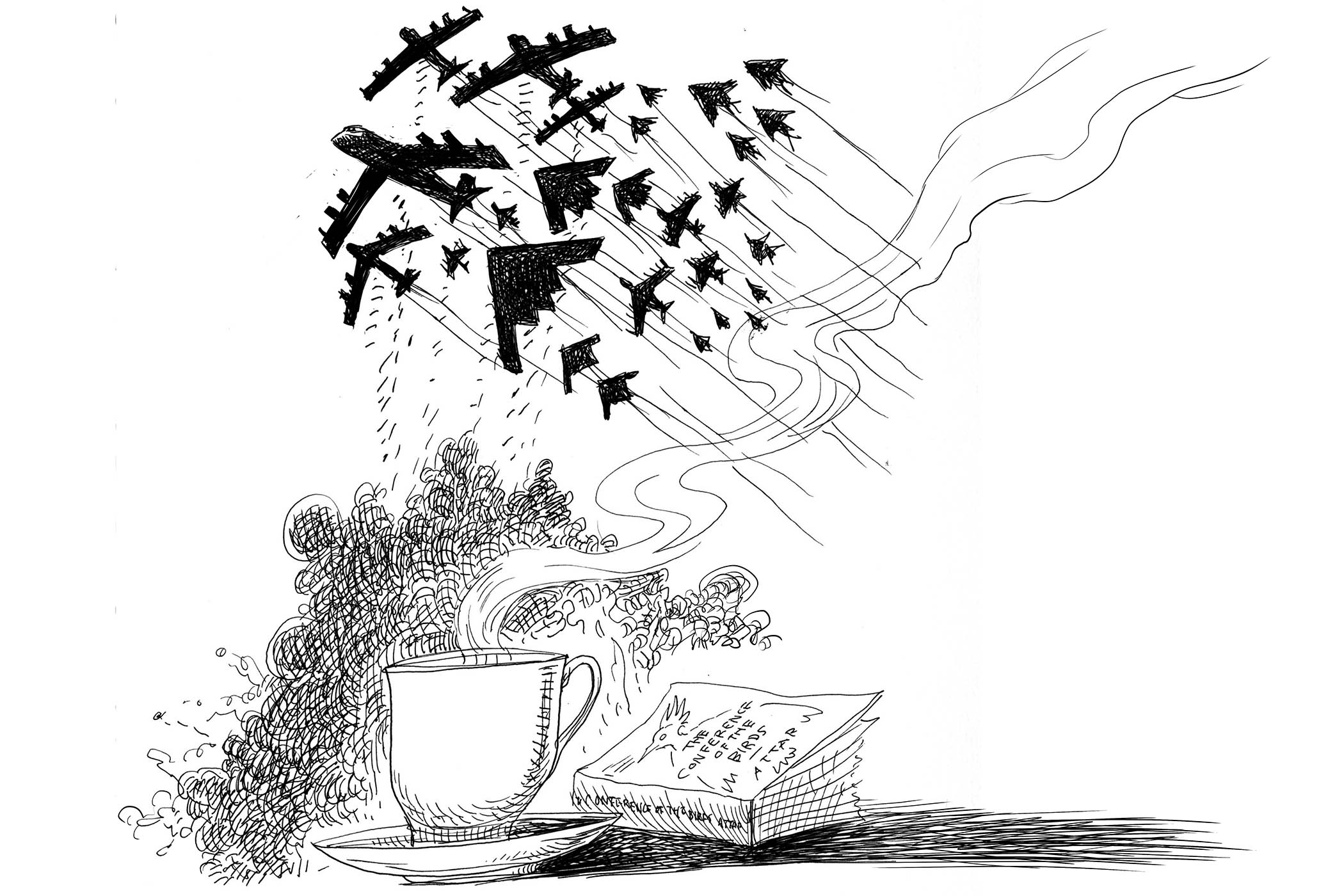

At the end Bolaňo made coffee just for the smell of it, holding it to his nose like a rare liquor. His liver – jigaram in Persian, but more of that in a moment – could not process caffeine, so he treated himself to the aroma. He timed it just so. At the completion of his epic, a note, found among his papers. And that’s it, friends. I’ve done it all, I’ve lived it all. If I had the strength, I’d cry. I bid you all goodbye... The heart is contingent to the mind, the body a shadow of the spirit. What drives the ancient compulsion to watch humans fight to the death? To smell bloodspill on mud? The sexual gratification of a public execution, loudspeakers affixed to trees, roasted peanuts in paper cones, a bound figure fighting the noose, smell in the air of sweat and perfume and testosterone, bodies pressing in on all sides. Black and white flicker of a market square obliterated in the crosshairs of a remote detonation. Now showing on a screen near you, on your lap, and that’s a wrap. This Easter Sunday, as the starred and striped bomber ships sail towards the Persian Gulf, and Jesus weeps in his violate cave, remember that there are fifteen Arabic words for love, beginning with Al Hawa, to fall, root of the Hindi word hawa, meaning the wind, meaning the wind of madness akin to love. Not one of the Arabic words for love has been imported into English, unlike algebra and algorithm and alchemy, not to mention giraffe or checkmate or gazelle or safari. Persian, the first language to break the monopoly of Arabic in Asia, and in the Ottoman and Mughal empires, has more than eighty words for love, including jigaram, translated as “my liver”, indicating that the loved one is as necessary for life as this most vital of organs. Persian was long the standard for a certain type of high poetry. Rumi’s ecstasy (the wound is the place where the light enters), the intricate God-drunk divans of Hafez, Omar Khayyam’s wine-soaked Rubaiyat, Saadi Shirazi’s Gulistan and Bustan, Attar’s fragrant Conference of the Birds. Tonight in Persia, it’s the devil’s poetry that gives new life to the tongue. Fire rains from Stratofortresses, Spirit Stealth Bombers, Thunderbolt Warthogs, Jolly Greens, Reapers, Growlers and Super Hornets. From Little Birds (better known as Night Stalkers) and Raptors and Black Hawks and Strike Eagles. Delivered by Hellfire, Sidewinder, Tomahawk and Patriot, and, when the lyric impulse dies out, by the Massive Ordnance Penetrator. A vernacular poetry that outlives the present and points us, tremblingly, toward the infinite. If I had the strength I’d cry. I bid you all goodbye.
Jeet Thayil is a prize-winning Indian poet, novelist and musician whose books include Narcopolis and The Elsewhereans
Illustration by Chris Riddell
Newsletters
Choose the newsletters you want to receive
View more
For information about how The Observer protects your data, read our Privacy Policy