

In June 1946 the Argentinian writer Victoria Ocampo arrived in Nuremberg. She had flown in on a Dakota, a US military transport aircraft, to the Bavarian city where Hitler’s terrifying rallies had taken place; where the laws stripping Jews of their German citizenship had been passed. In the autumn of the previous year, Allied leaders had signed an agreement establishing the International Military Tribunal (IMT), specifically for prosecuting war criminals. It was in courtroom 600 of Nuremberg’s Palace of Justice – intact despite relentless bombing – that many of these trials took place. Alfred Jodl, one of Hitler’s chief lieutenants, was on the stand when Ocampo first witnessed the proceedings, and one element in particular stood out.
“Everything in this room proves to me that this is a matter for men alone,” she wrote. “The process at Nuremberg reminds me of my Dakota, strictly designed for the transport of soldiers. I have not been able to count on a feminine presence in either case. This tribunal, that plane, did not foresee the presence of women. Both were built and organised with the intention of dispensing with them.”
In The Nuremberg Women, Natalie Livingstone draws attention to this observation in order to contradict it. It is certainly true that to look at the courtroom on any given day, one might draw the same conclusion. In London’s Imperial War Museum hangs an evocative painting, The Nuremberg Trial, 1946, which shows the accused sitting in rows, military police behind them and judges in front; the realism of the painting dissolves at its edges, where the walls of the chamber vanish to reveal the ruins of the war, the bodies of the dead. Not a single woman is depicted. But the painting itself is by Laura Knight, one of the most renowned artists of her era. Only the third woman elected to full membership of the Royal Academy, and the first to be given a full retrospective there, she had been appointed as a war correspondent for this commission and made a special BBC broadcast from Nuremberg.
Livingstone is skilful at building a rounded picture of the trials in the course of giving the reader a vivid sense of these women’s experiences
Livingstone is skilful at building a rounded picture of the trials in the course of giving the reader a vivid sense of these women’s experiences
Knight is one of eight women whose contributions to these historic trials Livingstone delineates in her fascinating and important book. While one could not say that in every case their work or their lives have gone unrecognised – besides Knight she includes Rebecca West and Erika Mann – taken in aggregate, Livingstone builds a vivid picture of the hidden figures behind this unprecedented endeavour.
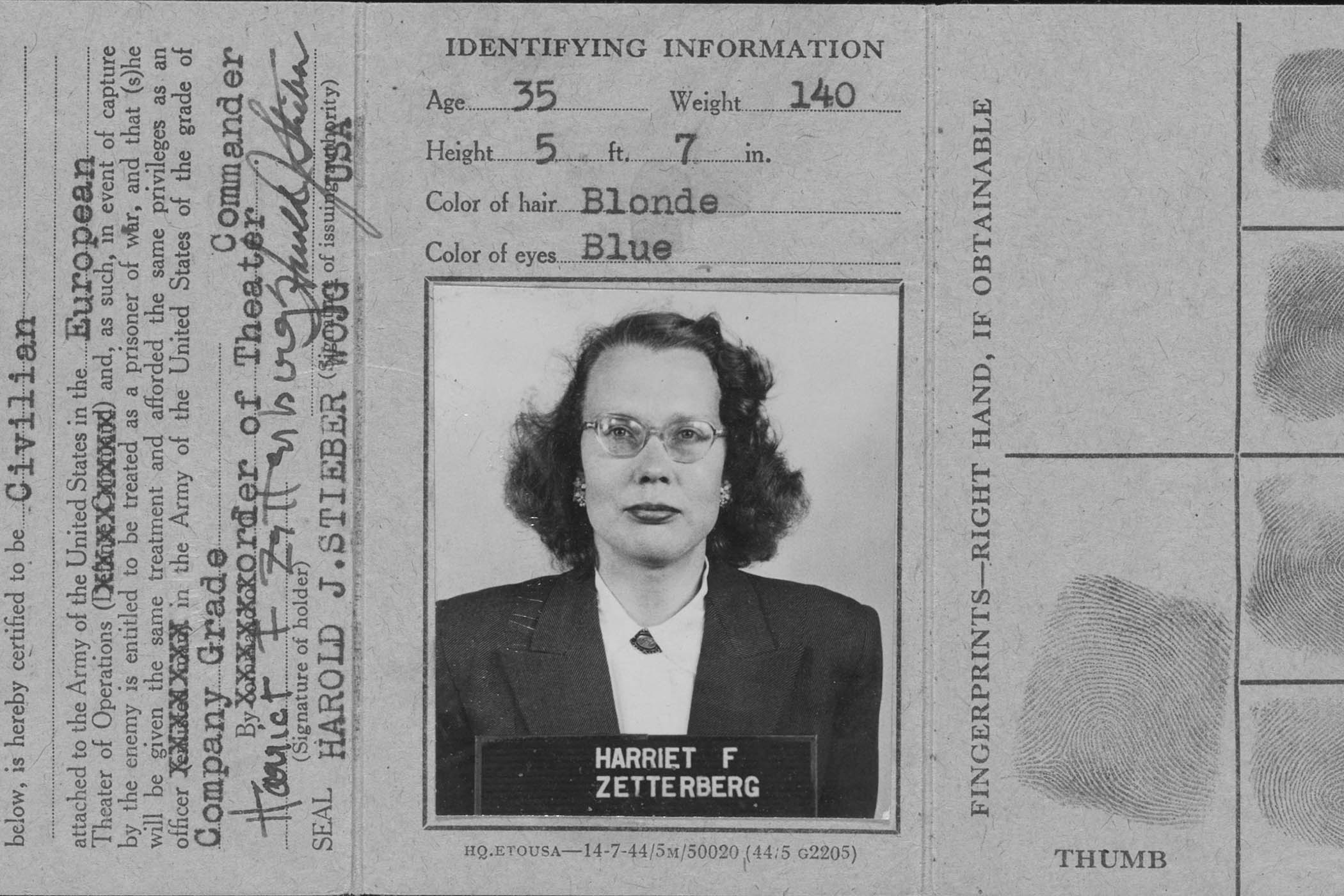
There is Harriet Zetterberg, for instance, a lawyer from Valley City, North Dakota, who had trained in the legal profession when the female to male ratio at her law school (the University of Wisconsin) was one to nine. When Hans Frank, known as the “Butcher of Poland”, stood in the dock, the argument against him was prepared by one Lt Col William Baldwin – but his brief had been prepared by Zetterberg.
Livingstone, the author of The Mistresses of Cliveden and The Women of Rothschild, is skilful at building a rounded picture of the trials in the course of giving the reader a vivid sense of these women’s experiences: it is in Harriet’s story we learn that 25 carbon copies of every document were required to make sure the legal teams had what they needed. That’s 25 copies of 4,600 documents; in addition, 16,793 pages of transcript were introduced as evidence. The typewriters commandeered by the IMT were unreliable: “Harriet’s typed letters sometimes stop abruptly as she switches to handwriting, complaining how impossible the machine is.” It’s details like this that bring the past right into the present.
Or there is the remarkable Countess Ingeborg Kálnoky, who was given the diplomatic task of looking after the “witness house” at 24 Novalistrasse, where – astonishingly – people giving evidence on both sides of the trial were accommodated. Heinrich Hoffman, “chief image-maker of the Führer cult and self-proclaimed friend and confidant of Hitler”, was a resident at the same time as survivors of the camps; Kálonky had to manage everyone at dinnertime, which would almost be funny if it wasn’t so utterly horrifying. Livingstone takes care to note that there was a dark undercurrent to Kálnoky’s recollections, published in a later memoir: she named the Nazis, but not their victims. It is Livingstone who gives Izrael Eizenberg, Leib Kibart, Chaim Kagan and Szlomo Gol the dignity of full personhood.
Newsletters
Choose the newsletters you want to receive
View more
For information about how The Observer protects your data, read our Privacy Policy
A book like this, comprised essentially of separate stories, has the potential to seem fragmentary: it is to the author’s credit that this is never the case. She works first through the women’s involvement with the trials, then comes back around to each of them to reveal their lives in the aftermath. The result is a text that feels remarkably three-dimensional, as the reader gets a different vantage point both on the events in courtroom 600 and the postwar world: Tatiana Stupnikova, a real-time translator for the Soviet Union, leads us into the cold war; Ursula von Kardorff offers a way to consider how the Germans were beginning to reckon with their own history.
On 1 October 1946, the verdicts were delivered and 12 men were sentenced to be hanged, including Joachim von Ribbentrop, Hans Frank, Julius Streicher and Hermann Göring; the last would escape the noose by taking his own life. “What did we see in the courtroom? Everybody knows by now,” Rebecca West wrote in the New Yorker.
During the second world war, 350,000 women served in the US armed forces; 640,000 women in the British military; and one in five of the French Resistance were women. As Livingstone writes, more so than any war before, it was “fought, suffered, endured, chronicled and … ultimately witnessed and prosecuted by women”. Here, of many hundreds of thousands, eight come vividly to life.
The Nuremberg Women by Natalie Livingstone is published by John Murray (£25). Order a copy from The Observer Shop for £22.50 (10% off RRP). Delivery charges may apply
Photograph by United States Holocaust Museum Collection/Gift of Mary DeForest