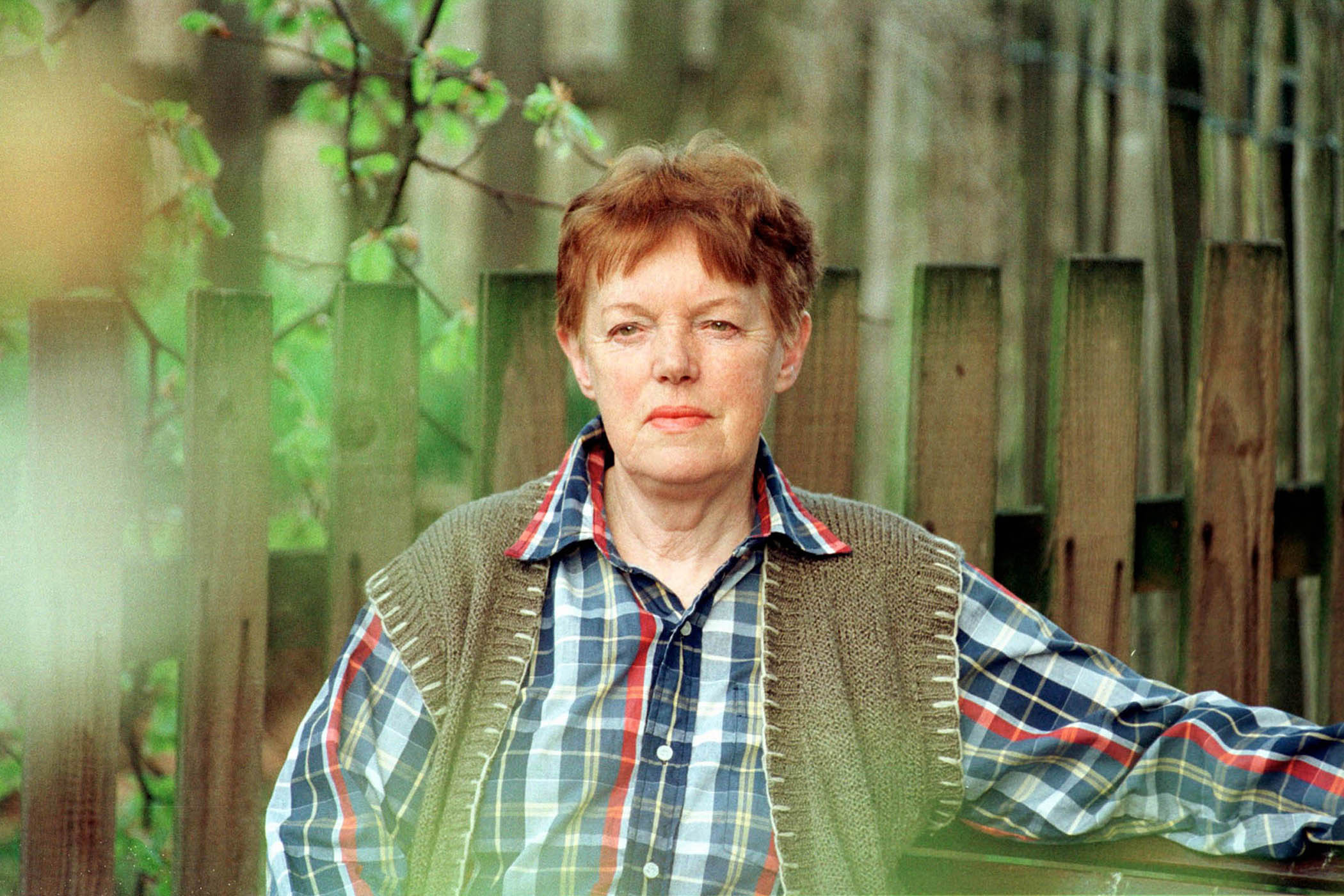


“I loved her the minute I read her,” Douglas Stuart tells me. “I felt she was a very vital missing piece from the voices of the time and the place.”
The Scottish novelist and short-story writer Agnes Owens was born on 24 May 1926, 100 years ago this week. During her lifetime she was admired by writers such as Ali Smith and Alasdair Gray, who called Owens “the most unfairly neglected of all living Scottish authors”. Yet for years her books have been out of print.
If there’s any justice, Owens’s centenary will spark a long-overdue renaissance. Back in January, an archive of her work opened in Glasgow, and between now and September, all of her books are being reissued by the independent Scottish publisher Polygon.
Between her debut in 1984 – aged 58 – and her death in 2014, Owens published six short novels and two collections of stories. In contemporary reviews she was likened to Muriel Spark and Beryl Bainbridge: her books thrive on the friction between comedy and sadness. As her archivist Sorcha Dallas puts it, Owens left “a concise body of work, but a substantial body of work too”.
Owens’s milieu was working-class urban Scotland: the building site, the tenement flat, the shop and, above all, the pub. Her characters were bricklayers, typists, shop workers, and non-workers. “I’m writing about strange people,” she said in an interview in 2008, “people on the edge, people that society doesn’t like very much.” Douglas Stuart, whose own novel of a working class family in 1980s Glasgow, Shuggie Bain, won the Booker prize in 2020, says Owens’s books are “the most faithful retelling of [working class life]. Get up, go to your work, come home, dinner’s terrible, go to the pub.”
Owens wrote about this world because she knew it. She started her writing career after decades of work and parenthood – and kept working throughout her time as a published author. “She is a working mother with seven children,” began the author biography for her first novel, and “typist, cleaner and factory worker” was added for the second.
Her debut, Gentlemen of the West (1984) – the best place for Owens newcomers to start – is about a 22-year-old bricklayer named Mac, inspired by her son John Crosbie, who was born in 1955, the fourth of Owens’s seven children. The book is a rich episodic comedy, where Mac gives his mother lip, observes the antics of his friends and colleagues (one former brickie pal “gave it all up to become a full-time alcoholic”), and sometimes joins in himself. “I’m not all that keen on a fight,” he tells us, “but if there’s one set out handy before me I have no alternative but to take part.” His capers are an escape from the dull repetition of his job.
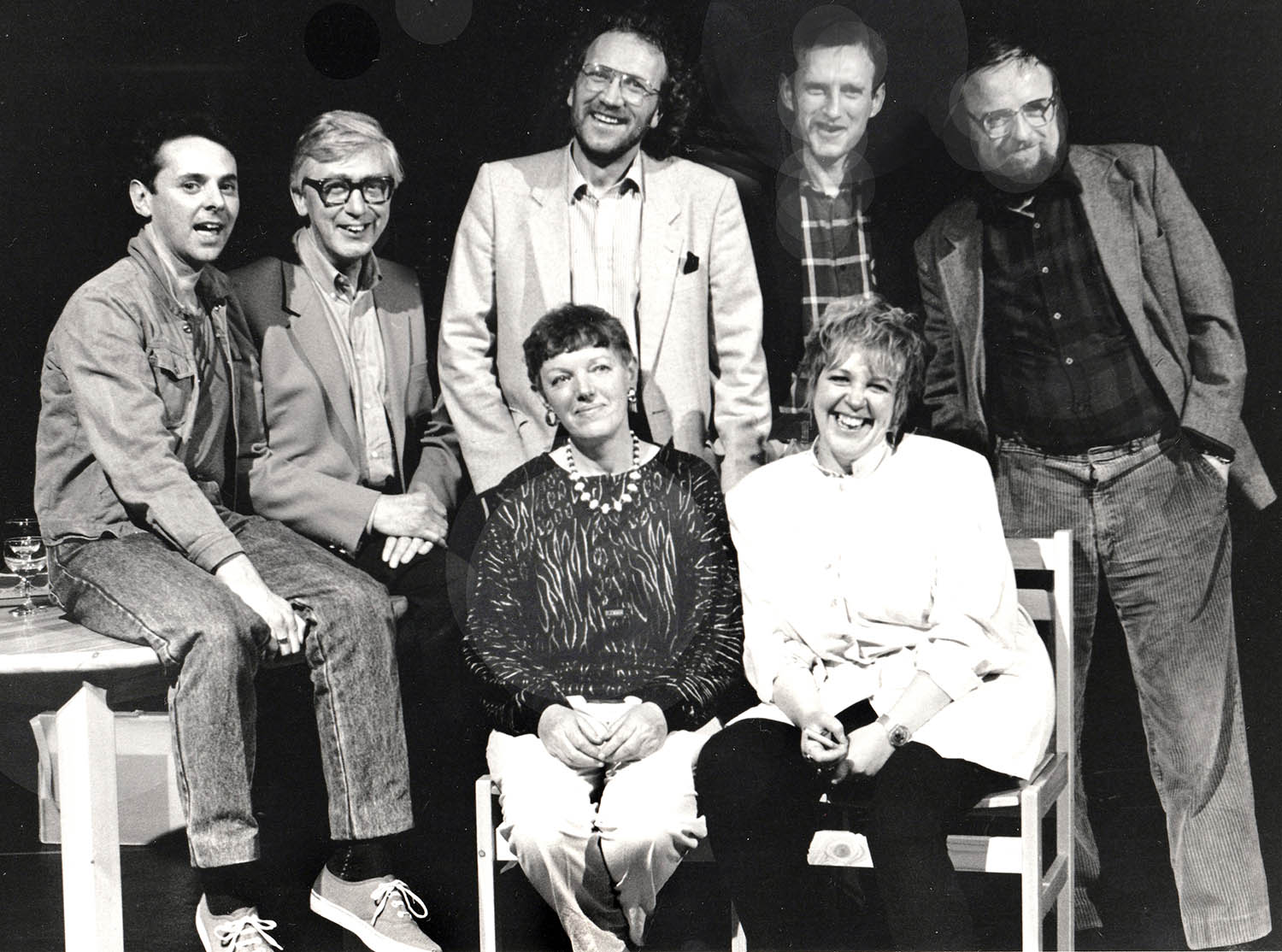
Agnes Owens (front left) pictured in 1987 with a group of Scottish writers including Liz Lochhead (front right) and James Kelman (back row, second right)
These days, Crosbie tends the flame of his mother’s work on social media. “I’m Mac, that’s true to say,” he tells me. “But the creation is my mother’s and it’s her art.” He adds that the combative relationship between Mac and his mother is “a bit exaggerated […] though I may be forgetting how cheeky I could have been as a young man”.
Crosbie explains that his mother “dabbled” in writing in the 1950s, but it was a writing class in the late 1970s that changed her life. The class was led by the writers James Kelman, Alasdair Gray and Liz Lochhead in the town of Alexandria – “a gloomy area outside Glasgow”, as Lochhead puts it to me. She recalls Owens as a “completely middle-aged woman in a woolly hat”, who didn’t stand out during the class – but had come armed with a neatly typed story titled Arabella.
Lochhead, a poet and playwright, read it on the way home. “You don’t really expect to see anything [remarkable],” she says of students’ work. “I didn’t expect to be: ‘What the fuck’s this?!’ Which is what I thought about [Arabella].”
Newsletters
Choose the newsletters you want to receive
View more
For information about how The Observer protects your data, read our Privacy Policy
It’s a reaction that anyone might have had. Arabella is about a woman who pushes dogs in a pram (she calls them her “children”) while battling her parents, preparing for a visit from the “Sanitary Inspector”, and mixing potions for her “regular clientele of respectable gentlemen” – all in seven pages. It’s very funny, strange and dark: quintessential Owens.
Lochhead was so bowled over by the story that she asked Gray for a second opinion. “Have I lost it altogether, or is this… I mean it’s wild… but isn’t it really rather good?” Gray concurred, and he, Lochhead and Kelman became lifelong friends and supporters of Owens. The group would associate with other Glasgow writers, such as Bernard MacLaverty, and Gray designed the covers for three of Owens’s books. But according to Douglas Stuart, Owens’s style was more “straightforward” than either Gray or Kelman’s, with their typographical flourishes and modernist inflections. “There’s an invitation in her work that I don’t feel in the others.”
Owens was a writer because she was a reader. “The library was a big part of her life,” says John Crosbie. A favourite was Flannery O’Connor, and an O’Connor-ish blend of the grotesque and the absurd runs consistently through Owens’s work: a southern gothic for the north-west of Glasgow.
After Arabella, Owens set about writing the stories about Mac that would become Gentlemen of the West. She worked in the Westclox clock factory in Dumbarton, where she was a typist and the union shop steward for the office staff. Sorcha Dallas tells me that Owens would type her stories at lunchtime. Viewing the typescripts, she notes: “You see the different [typefaces], which [suggests] that she didn’t own a typewriter, that she borrowed one at work and then moved jobs and then she had one from a different job.”
‘I don’t write about nice people,’ she said. ‘They’ve got to be sinners, with a wee touch of goodness’
‘I don’t write about nice people,’ she said. ‘They’ve got to be sinners, with a wee touch of goodness’
At home, she wrote in between the demands of running a household. Crosbie recalls how an audience member at Edinburgh book festival asked her: “How do you structure your writing, Agnes? How do you fit it in?” She replied: “Just in between making dinners and doing washes.”
But even when Gentlemen of the West was finished, publication was not easy. Alasdair Gray wrote in an essay that it was “returned by a publisher who said he might consider printing it if a famous Scottish comedian said something about it which could be used as advertisement”. Owens sent it to the comedian, and got no response. Later, she went to work for the comedian as a cleaner – and, according to Gray, “got [the typescript] back”. The story is true, according to John Crosbie, and the comedian was Billy Connolly. “She had fun working with Billy,” he adds. “He knew her and was good to her. I don’t know if he knew [the typescript] was there.”
Gentlemen of the West was eventually published in 1984 by Polygon in Edinburgh. According to the company’s then-editor, Peter Kravitz, the book was a difficult length – “A novella is a very hard thing. You have to be big to get away with it, and Agnes wasn’t big” – but publishing it was “a no-brainer”. It was “her writing about men” that appealed to Kravitz. “There’s probably about 35 men in that book, and one woman: Mac’s mother.” He also liked its “comedy and darkness together, and not many writers can pull that off”, as well as “her voice for men of restricted emotional range who nonetheless have emotions”. The book was “virtually without edits”, Kravitz adds. “Maybe because of the restricted time she had to write, she was editing herself.”
Owens was politically active – she served as secretary of the local branch of the Labour party – but there is nothing worthy about her stories. While they describe little-written-about corners of society, they remain energetic and entertaining. “I don’t write about nice people,” she said. “They’ve got to be sinners, with a wee touch of goodness here and there.”
The books that followed Gentlemen of the West – and its sequel, Like Birds in the Wilderness (1987) – have elements in common, but each has a distinct flavour. The bitterly bleak A Working Mother (1994) is about a woman who takes a job as a typist (“To get away from me, I suppose,” says her husband, correctly). For Douglas Stuart, it is Owens’s masterpiece. “She brings things that I hadn’t seen in the rest of her work, with sexual desire, a marriage coming apart.”
For the Love of Willie (1998) is about a schoolgirl who falls in love with a shopkeeper she works for, and who ends up in an asylum, writing a book about her life. It’s structurally clever and with a caustic wit. “If you do manage to write a book, who will read it?” asks a fellow patient. “They’re all simpletons here, including the staff.” And her last book, Bad Attitudes (2004), has a carnivalesque spirit in its multiple-viewpoints account of the chaotic lives of residents in a Scottish housing scheme.
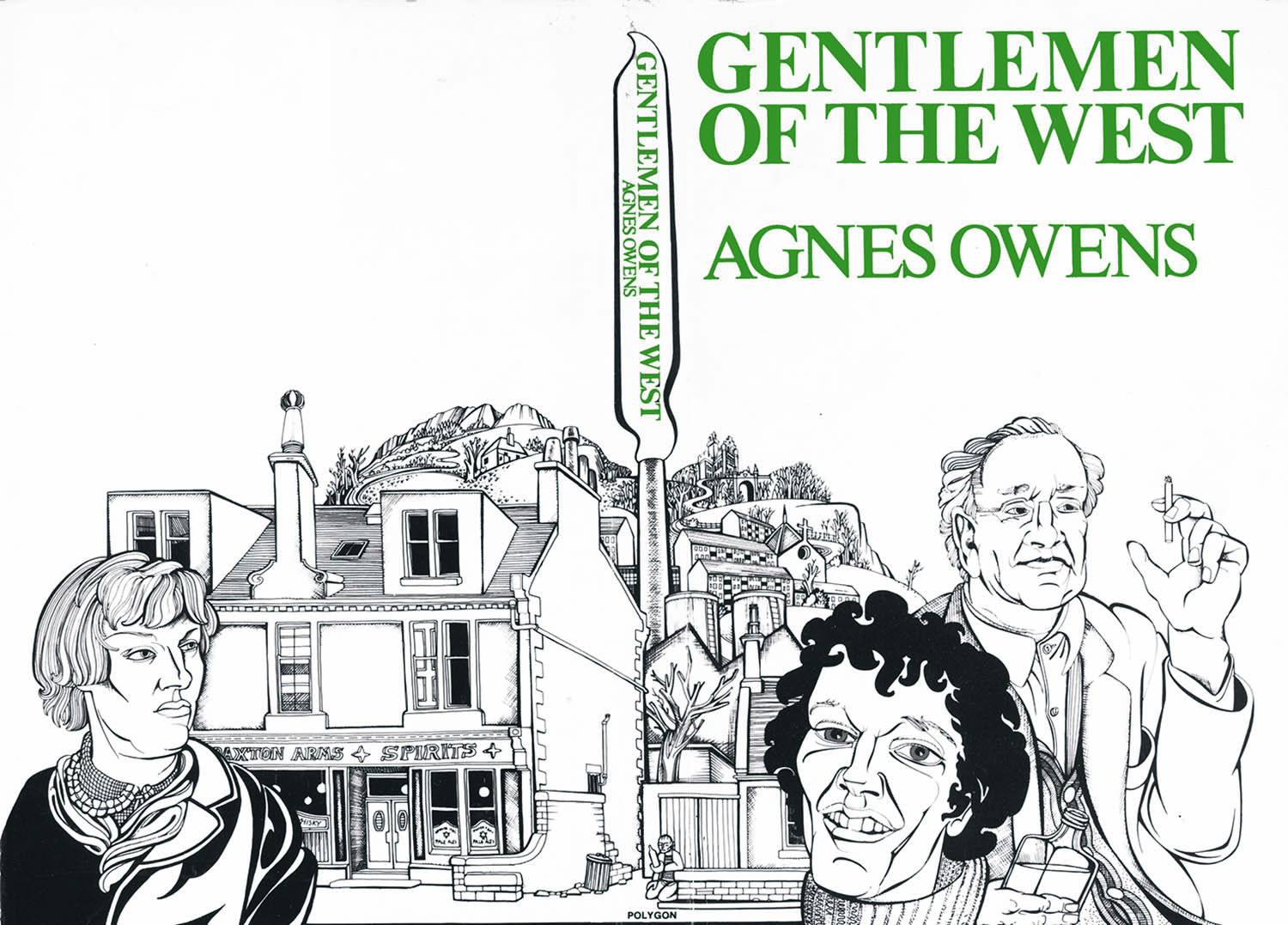
The original edition of Agnes Owens’s 1984 debut, featuring a cover illustration by Alasdair Gray
Owens was as funny in person as on the page. She had a “gallows humour”, says her son, and was very witty “in a deadpan way”, adds Liz Lochhead. “She would talk, and then retreat behind a smile,” says Peter Kravitz.
She did not write many books, but, as Kravitz observes, “the space she could write in was so concertinaed, it’s a huge achievement [even] to have got that out”. “[Her books] are all gems,” adds Douglas Stuart, “but they’re coming at the cost of a real life, of being a mother, of working as a cleaning lady. It’s a great loss that we never got to see her full [potential] output.”
Owens’s work is as relevant now as ever, suggests Sorcha Dallas. “It’s talking about systemic structures that grind individuals down, day by day. And I think that speaks to the current, politically unsettled climate.”
Owens was respected among her peers, but she never enjoyed the prize status that Kelman did, or the broad audience of Gray. All her novels (some of which didn’t even get paperback editions) fell out of print soon after publication. Why was she overlooked? “Straight up sexism,” says Douglas Stuart. “It was a man’s world.” Dallas agrees, and adds that classism played a part. “Some press articles we find from the late 80s and 90s, they talk about her [as] this sort of hobbyist woman.” Peter Kravitz concurs that “age, gender, subject matter come into it”.
As for Owens, her own take on the question was typically mischievous. As Crosbie recalls, she was once asked on stage by Alasdair Gray why she hadn’t received more recognition. “My mother replied: ‘Maybe it’s because I’m old and ugly!’ And Alasdair said: ‘No, Agnes, I don’t think it’s just that.’”
The first four Agnes Owens reissues – Gentlemen of the West, Like Birds in the Wilderness, A Working Mother and For the Love of Willie – are out now, priced £8.99 each. Order from The Observer Shop to receive a 10% discount off RRP. Delivery charges may apply
Photography by Camera Press; The Alasdair Gray Archive