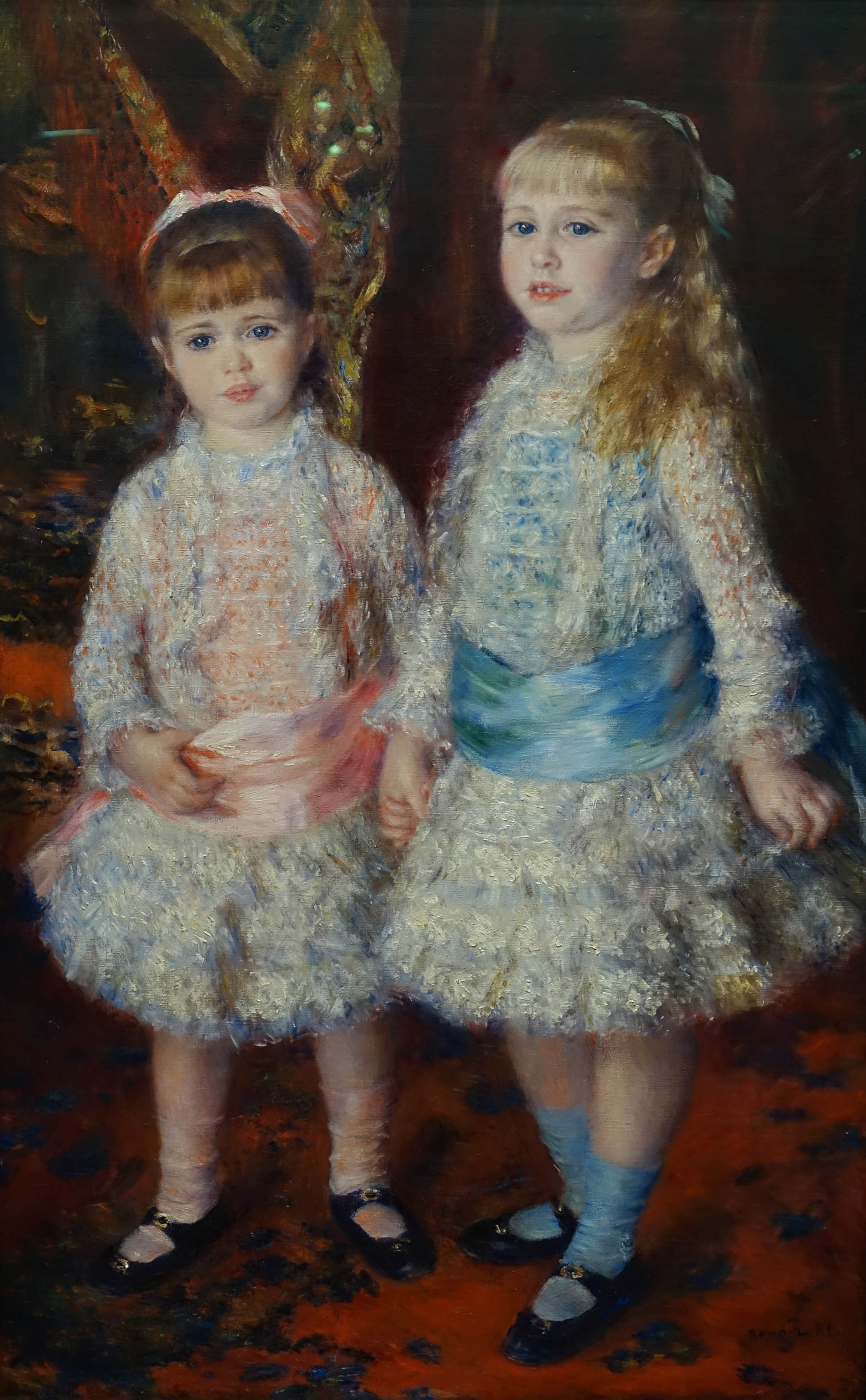

In Renoir’s 1881 masterpiece Pink and Blue, two blue-eyed little girls stare out of the canvas. The brown-haired one looks pensive and a little sad, while her blond-haired sister seems proud to find herself the subject of a work of art. Their dresses are a sumptuous mass of flair and frill – the ideal subject for an impressionist. Renoir paints the dresses as a dreamscape of soft brushwork in contrast with the sharp detail of the faces. There’s no doubt that these girls are the subject of love and care, or that the richly ornate room is upholstered by dynastic wealth. It is unthinkable that 63 years later, the blond-haired girl will die at Auschwitz.
Catherine Ostler’s new book tells the story of Alice and Elisabeth Cahen d’Anvers, from their belle époque childhood immortalised by Renoir to their brutally divergent experiences in a France destroyed by fascism and war. The girls’ parents, Louis and Louise Cahen d’Anvers, were part of the circle of rich, cultured Jews who could seem fully integrated into aristocratic Paris, and The Renoir Girls begins in their world of salons and parties. If this sounds like a story that could be out of Proust, then it’s because it was indeed told by Proust. Louise was the lover of Charles Ephrussi, the brilliant aesthete collector who was a model for the author’s protagonist, Charles Swann – and Ostler reveals that brown-haired Alice, favourite daughter of Louis, has been proved by DNA tests on their descendants to be Ephrussi’s biological child.
Ostler throws not just Alice and Elisabeth but their three sisters and wider family into a novelistic melee. One of those sisters, Irène, dutifully marries into her parents’ Jewish circle, while Elisabeth (who was nursed by nuns after a near-fatal accident) converts to Catholicism and marries a gentile diplomat. Both marriages end in divorce – shortly after it is reintroduced in France in 1884 – and Irène then marries her glamorous riding instructor. Ostler asks: “Was France a Catholic society with liberal divorce laws, or a liberal Republic with an overlay of Catholic morality?” Alice meanwhile marries the English aristocratic military hero Charles Townshend in what emerges as the most passionate love affair of the book. Even after their daughter is born, Alice leaves her behind to join her husband in India, going shooting with him in the jungle.
Large stretches of the book are more about shimmering surfaces than inner feelings. It often feels like Ostler knows more about the exact fabric sourced by the dressmakers than about the difficulties in these marriages. But these are people who may not have been especially interested in their own inner lives, preferring to commit themselves to socialising until, as in Proust’s novel, their world is shattered by a war that reveals how much cruelty there was all along. Alice frantically tries to bring her husband back from India to prove his heroism in the first world war. “It will be his one great chance in his life,” their daughter, Audrey, loyally writes in her diary, alongside accounts of sewing dressing gowns for the wounded soldiers billeted in the drawing room. It’s not: Townshend is best known now for leading the disastrous Siege of Kut in 1916. Meanwhile, Irène’s son is killed behind enemy lines in France.
Ultimately, this is a story about the antisemitism that was already haunting France when Renoir painted his picture and would reach its efflorescence in the second world war. “I really give up with the Jews,” Renoir himself wrote, struggling to get a Jewish client to pay. Casual antisemitism turned into a full-scale movement with the publication of Édouard Drumont’s frighteningly popular 1886 book La France juive (reprinted 140 times in two years). “The only person whom the Revolution benefited is the Jew. Everything comes from the Jew; everything goes back to the Jew,” Drumont wrote. And then the Dreyfus affair fissured the nation for a decade after Jewish captain Alfred Dreyfus was falsely accused of spying for Germany and charged with high treason in 1894.
Antisemitism receded from view in the first world war, when the Cahen d’Anvers family was typical in sending all available sons to risk their lives for France. But it was taken up again when fascism re-energised antisemitism internationally. Ostler reminds us that Pétain’s government passed the Statut des Juifs laws willingly rather than under duress. Tragically, Catholic Elisabeth was betrayed by the local mayor, whose wife she’d grown up dancing alongside at parties. He insisted that she was labelled as a Jew in an act of bureaucracy that was a knowing step towards murder. Ostler describes her deportation unsparingly yet with consistent tact.
This book is an epic tale of a changing world that ends up all too close to our own. There have been previous books written about this family – notably Natalie David-Weill’s about Irène and Alice Legé’s meticulous scholarly history – but this is the first published in English, and the first to centre on Alice and Elisabeth. For the most part, Ostler stays in the background, but she engages in judicious speculation when the story becomes perplexing. Some scenes will live with me for a long time, in their tragedy but also their revelations of courage. Widowed Alice came into her own yet again in the second world war when she made her way to France to rescue her grandchildren, sleeping with them in a ditch near Bordeaux before they made their way to England on a British navy destroyer. On arrival, they went straight to the Ritz to meet some cousins for lunch.
Looking at Renoir’s picture after reading Ostler’s book, I find myself wondering if Alice’s heroism is already there in that diffident brown-haired girl, and Elisabeth’s dogged faith in the world to be better than it is visible in the blond girl’s proud defiance. Ostler’s book shows that we are at once subject to contingency and fate, and reminds us that we must never stop taking responsibility for the course our world takes.
The Renoir Girls: A Hidden History of Art, War & Betrayal by Catherine Ostler is published Simon & Schuster (£30). Order a copy from The Observer Shop for £27 (10% off RRP) with free P&P
Lara Feigel is the author of Custody: The Secret History of Mothers (William Collins)
Newsletters
Choose the newsletters you want to receive
View more
For information about how The Observer protects your data, read our Privacy Policy
Photography courtesy Museu de Arte de São Paulo