
A young Canadian researcher, Harlow Donne, uncovers fragments of a lost classical epic and sets out to reconstruct it and share it with the world. Meanwhile, his unhappy personal history weaves itself in and out of alignment with this ancient narrative, and its chronicle of raw suffering becomes a vehicle for processing his own anger and grief. The labour of reconstructing this ancient text also provides a prompt for thoughts about the nature of fiction itself – how we come to tell stories that render “facts” redundant.
The narratives of the Greek heroes are, like the Babylonian Epic of Gilgamesh or the Christian gospels, stories that both preserve and break the link with bare fact. They carry meaning in a way that makes it impossible to strip them back to history and no more. We could say that imagination becomes the most important element in adequately – truthfully? – telling what has happened to us, individually and collectively.
Readers of Yann Martel’s earlier work – especially the wildly popular 2001 novel Life of Pi – will recognise some familiar themes here: the instability of narratives, the development of symbolic or allegorical stories to deal with (or displace) traumatic memories. Martel has never been afraid of taking formal risks, and this book’s shape is ambitiously innovative. His invented epic poem – the Psoad, named after Psoas, a common soldier in the Greek armies besieging Troy – is presented at the top of the pages, with copious footnotes offering both learned discussion of details in the text and links to an agonising and humiliating set of personal recollections from Harlow. The formal parallel with Nabokov’s Pale Fire – a novel consisting of a poem and a commentary spiralling out of control, written by another hand – has been noted already, but Martel is in fact doing something rather different.
As in Life of Pi, the narrator/commentator very clearly signals his own untrustworthiness. Harlow announces that he is editing a rediscovered text – but also that he is “the lone author and sole translator” of the fragments. His “classical” epic trails its coat outrageously, with giraffes and gnus (not to mention bananas) turning up in a text from Mycenaean Greece; and it begins from the impossible premise of treating Homeric narrative as if it were claiming eyewitness origins, rather than being the deposit of five or six centuries of professional bardic performance.
Donne’s daughter is named Helen, in a bit of heavily overdetermined clue-dropping
Donne’s daughter is named Helen, in a bit of heavily overdetermined clue-dropping
Harlow’s senior research director at Oxford dismisses the Psoad as “pseudo-Homerica”; and he is, of course, indisputably right, both within and beyond the world of the novel’s narrative. Harlow’s obsessive fascination with a text that purports to give an account of the experience of the “ordinary man” at the Siege of Troy is impossible to disentangle from his desperate need to find a story that will allow him to make sense of his own failures and betrayals: his disintegrating marriage and his poignantly fragile relationship with his daughter (named Helen, in a bit of heavily overdetermined clue-dropping).
Does it work? Not very well, alas. The writing is – so often – brilliant, both in the pseudo-epic and in the pseudo-academic apparatus, with small and electrically charged details and episodes: Harlow’s wife whispering in his ear “Don’t come back”, as she gives him a farewell hug on his departure for his research stint in Oxford; the brief, icy, heartbreaking exchanges between the couple as the story builds towards their daughter’s death; the characterisation of Hades, God of the underworld, as the only classical deity who seems able to experience pain and also to feel some sort of commitment to the good of human beings.
But just as often there is simply too much going on: too many slabs of information for the reader with limited classical knowledge, not to mention the sometimes very opaque philosophical meditations on truth and story, with some eccentric correlations being made. The Trojan war narrative includes, right at the start, Agamemnon’s sacrifice of his daughter Iphigenia to secure favourable winds for the army’s voyage. In Martel’s novel this is somehow to be mapped on to Harlow’s searing guilt about abandoning his daughter and refusing to return home when her life is in danger, and on to the theological story of a Christian God abandoning a child to death in order to secure a future of triumph or resolution. This feels not really worked through.
There are other weaknesses. Harlow’s Oxford supervisor, cold, snobbish and autocratic, is straight from the property basket of half a century ago. The savage mutual cruelty of Harlow and his wife needs some hinterland that is never even sketched. And just how Harlow’s obsession has become so overwhelming that he is capable of ignoring the urgency of his family’s claims remains unclear.
Martel’s novel is intelligent, sporadically impressive, never boring. But it seems not quite to know what it most wants to do, and its considerable imaginative and verbal energy ends up drifting in too many directions to make successful landfall.
Son of Nobody by Yann Martel is published by Canongate Books (£20). Order a copy from The Observer Shop for £18. Delivery charges may apply
Newsletters
Choose the newsletters you want to receive
View more
For information about how The Observer protects your data, read our Privacy Policy
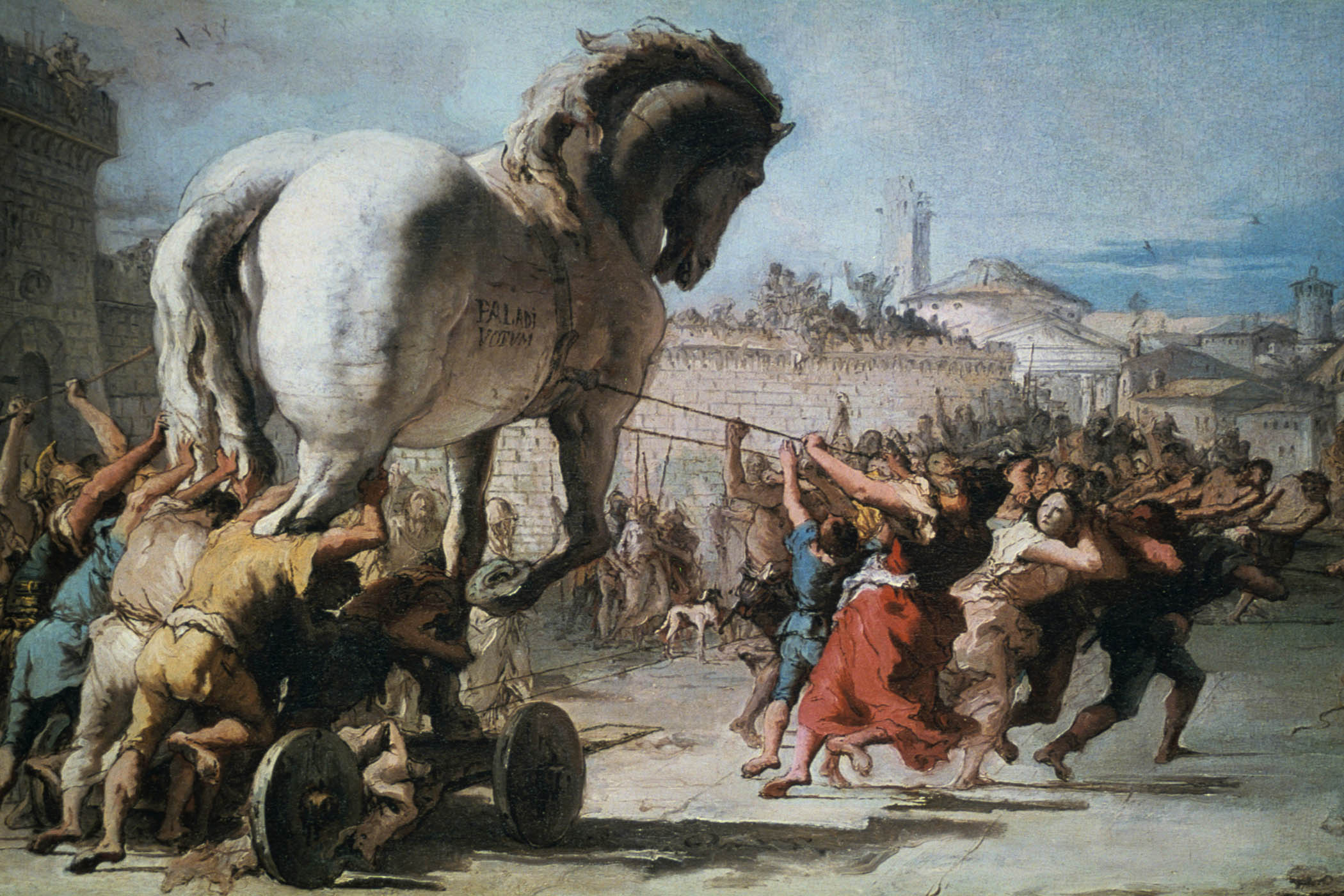
The Procession of the Wooden Horse Into Troy by Giovanni Domenico Tiepolo (circa 1760) by Universal Images Group/Getty