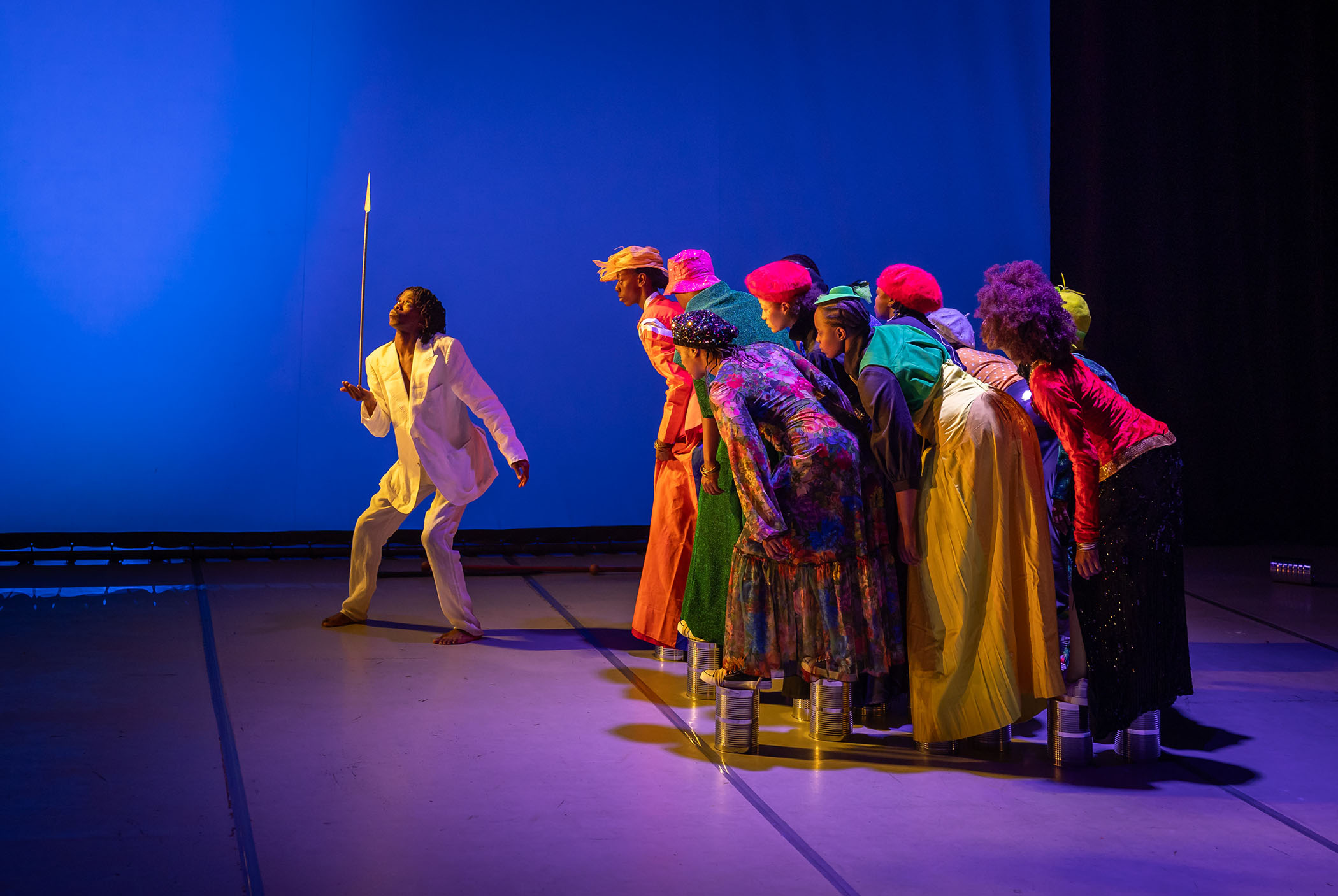


It’s the sound that comes first: a fierce, rhythmic, metallic stamping in strict unison. As the dancers emerge from silhouette, you realise that the noise comes from the large tin cans, used to hold the basics of a family diet, strapped to their feet.
The same cans, hanging overhead, are the only decoration on a bare stage, filled with shifting patterns of rich light by Thabo Pule. They restrict movement, define the space. Like stilts, they mean the dancers, in richly varied costumes – a bright red military jacket, billowing yellow trousers, a jaunty pink hat – can only move from the hips, preserving their balance as they swing their arms and march.
The South African choreographer Mamela Nyamza, who won this year’s Silver Lion at the Venice Dance Biennale for her powerful career of making striking work against the odds, is playing with ideas of individualism and conformity. The Herd/Less follows on from her most famous piece Hatched, which set the constraints of ballet shoes against the freedom of gumboot dance.
Here, the dancers are led by a man balancing a ceremonial spear, presumably representing authority, while another woman – in an orange and blue crinoline and boater – initially breaks out of the lockstep, raising her arms in delicate curves, before being absorbed by it. A whistle constantly calls the dancers to attention or demands they change direction.
The movement is relentless, fascinating, finding subtlety and nuance within its deliberate constriction. The point about the difficulty of breaking free is clear. At one point nine of the dancers swarm over the spear carrier, covering his ears, mouth and pelvis with the cans, but he reasserts control.
To the wailing sound of a string pulled through a can, they slowly limp away, holding sticks aloft like grave markers
To the wailing sound of a string pulled through a can, they slowly limp away, holding sticks aloft like grave markers
By the close the dancers are mainly standing balanced on one can, still unable to express themselves freely. The song Paradise Road by Joy fills the air with sweetness; they listen but do not move. To the wailing sound of a string pulled through a can, they slowly limp away, holding sticks aloft like grave markers.
The Herd/Less is coming to Sadler’s Wells as part of this year’s Dance Umbrella festival in October. In November, the London theatre will also host Emanuel Gat’s Five Days in the Sun, another haunting piece, as expansive as Nyamza’s is spare, and just as clearly heartfelt. Set to Leonard Bernstein’s recording of Mahler’s Symphony No 5, this is a work of striking images, and sensuous, luxuriant movement.
Its opening section, to the stern brass of the funereal first movement, is full of frozen poses, broken by great runs. The dancers, in gauzy costumes by Inez Vicher that float in the air, look like something out of Walpurgis Night as they rush around the space. Gat’s own lighting fills the stage with orange mist. In repose, the action feels classical, sculpted, like a painting of a court by Lawrence Alma-Tadema.
As the symphony moves on, Gat introduces other notes and references. Citrus-bright contemporary clothes appear among the robes; a woman in a black dress begins to disturb the action. An Isolde-like figure of tragedy bends slowly backwards towards the floor, as the modern dancers move frantically around her. At one point, the grouping has the formality of Raphael’s The School of Athens.
That tug between thought and emotion, between flowing steps and detailed, tight articulations of muscles and limbs, is at the heart of this thoughtful but exhilarating work. The overall effect is sumptuously lovely.
Newsletters
Choose the newsletters you want to receive
View more
For information about how The Observer protects your data, read our Privacy Policy
Photograph by Kim Stevens/Limelight foto