There’s a point in Channel 5’s feature-length documentary Boris Johnson: Into Ukraine’s Kill Zone when the former British prime minister is compelled to don a balaclava to avoid being recognised.
Usually politicians are kept to the capital Kyiv. The documentary tracks Johnson, four years after leaving Downing Street, as he spends 72 hours on an unprotected journey through part of the “kill zone” frontline near the city of Zaporizhzhia. It’s dangerous for anyone – soldier, citizen, journalist alike – but for a former world leader who is a supporter of Ukraine’s President Volodymyr Zelensky and outspoken critic of Vladimir Putin, the risks are extreme.
So, the balaclava is pulled over the face and famous flaxen hair. In an instant, he’s de-Boris-ed, divested of the features that, love or loathe him, loom so large in British life. (How many column inches have been devoted to that strategically ruffled hair.) All that’s left is the distinctive voice, incongruously booming out of the mouth hole, like Bertie Wooster on a reconnaissance mission.
The project came about when Johnson, who started out as a journalist and now writes a column for the Daily Mail, contacted the paper’s war correspondents, Richard Pendlebury and Jamie Wiseman – heading a team delivering Daily Mail World YouTube reports since Russia’s 2022 invasion – to ask if he could join them. Johnson says to camera: “That meant going to see the frontline for myself and talking to the Ukraine soldiers fighting a war they did not choose. I was heading into what is known as the kill zone.”
Thereafter, as much as possible, the film functions as a war report. It opens by outlining the bombing of a passenger train bearing the relatives of soldiers, including children. Early on, an apartment block is bombed disturbingly close to where Johnson and the crew are staying. The former PM is informed about drones, KABs (controlled aviation bombs; several thousand are dropped on Ukraine a month), and visits the mobile anti-aircraft gunners standing guard during sub-zero temperature nights: “I should have put on those bloody long johns,” Johnson winces.
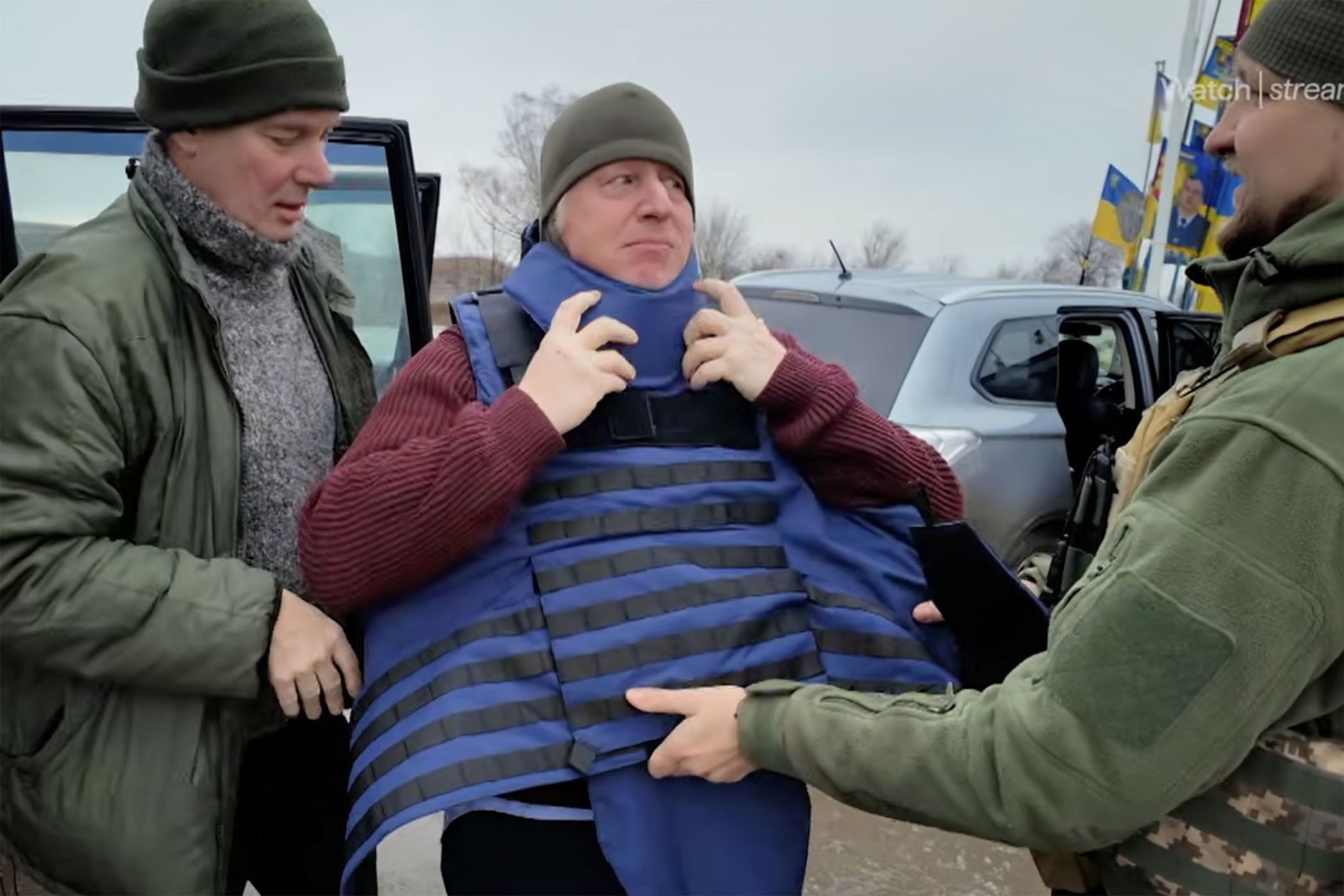
Wearing a flak jacket, he is driven through hazardous regions, where he stops at a supermarket kept open in a bombed-out area, prays with a chaplain from the Ukrainian Orthodox Church, discusses the conscription of military personnel, and looks in on an improvised medical centre. He also visits a bomb factory making “toe-poppers”(devices designed to blow off the bottom leg) using 3D printers and sewage pipes. Pretty much everyone Johnson meets is exhausted, despairing, displaced, missing their families, and wishing the war would end.
I’m not sure how many other war reports would give space to someone slumped on a bed blinking like a dazed Winnie-the-Pooh
I’m not sure how many other war reports would give space to someone slumped on a bed blinking like a dazed Winnie-the-Pooh
With his balaclava on, Johnson helps to give a Ukrainian soldier’s clapped-out car a shove to get it going. When his identity is known, there’s no doubting the Johnson Effect. I’m not sure how many other war reports would give space to someone slumped on a bed blinking like a dazed Winnie-the-Pooh or hungrily watching hotdog sausages boil in a saucepan. His interactions with Ukrainians are mainly lively and informal. “You shot the arse off that one,” he says approvingly to soldiers of shattered drone debris.
Johnson is instantly recognisable to Ukrainians, and they love him. There, he’s the Churchillian man of the people he always wanted to be. Straight to camera, he speaks up for Ukraine – “They’re heroes but it’s a disgrace that we’re not doing more to help them” – outlining how the invasion is in violation of a key 1994 treaty and declaring: “It’s Vladimir Putin who started this war. He’s the only guy who can end it.”
In text on the screen, the Russian Federation’s sniffy response to the documentary begins: “We note the documentary relies heavily on the views of Boris Johnson… ”
We could argue all day about what looks suspiciously akin to Johnson’s “war correspondent” cosplay; whether the indulgence is irresponsible showboating – increasing the danger for everyone around him – or understandable in the context of drawing attention to a conflict for which media and public attention has waned.
Newsletters
Choose the newsletters you want to receive
View more
For information about how The Observer protects your data, read our Privacy Policy
The documentary itself is a multifaceted oddity. It is both the latest round (ding!) of the Johnson versus Putin grudge match (it would take a stronger woman than me to resist pointing out that, with Brexit, Johnson thrilled and empowered Putin), and a character study of a man mourning the power he once wielded on the global stage. The documentary is also what it says it is: a valuable reminder that, for Ukraine, the war and the suffering go on. There’s just far too much… Boris.
On ITV1, the bleak six-part Scottish thriller, The Dark, continues to creep and pulse beneath the skin. Based on GR Halliday’s From The Shadows, the first novel in a series, Laura Donnelly plays inscrutable DI Monica Kennedy tasked with hunting a serial killer who’s taken to dumping the naked corpses of young male victims, posing them in ritualistic positions in the Highlands grass.
The story is a melange of rural nastiness, burner phones, drugged drinks, masked intruders and emotionally vulnerable young people. Helen Baxendale of Cold Feet appears as a wild-eyed bereaved parent, while Emun Elliott portrays her glowering partner. As Kennedy’s deputy, Mark Rowley bursts out of some bizarrely tight shirts, while a subplot concerning Kennedy’s daughter, and some recurring business with a cult, becomes a tad over-complicated and wearisome and threatens to derail the main plot.
Earlier this year, the Welsh-set Under Salt Marsh, starring Kelly Reilly, Rafe Spall and Jonathan Pryce evolved into a stormy smalltown tour de force, proving what UK crime thrillers can achieve when let off the leash. The Dark isn’t quite in that league – it’s stylistically OTT and there are too many convenient flukes and hammy jump scares.
Still, it holds its own, and Donnelly delivers a TV cop who definitely doesn’t get results with her innate feminine charm. In her hands, stony-faced DI Kennedy’s chilly retorts are to be relished.
Photograph by Channel 5