
Commissioning new work in dance is the hardest thing, just as likely to end in failure as success, but the Sadler’s Wells Composer series has had a good hit rate down the years, prompting rich collaborations with Mark-Anthony Turnage and Thomas Adès, using live music by living composers to inspire choreographers and audiences.
Now it is the much delayed term of the prolific Nico Muhly. The programme Marking Time, with premieres from Jules Cunningham, Maud Le Pladec and Michael Keegan-Dolan, was in its final rehearsals when theatres closed five years ago because of Covid. It has been worth waiting for.
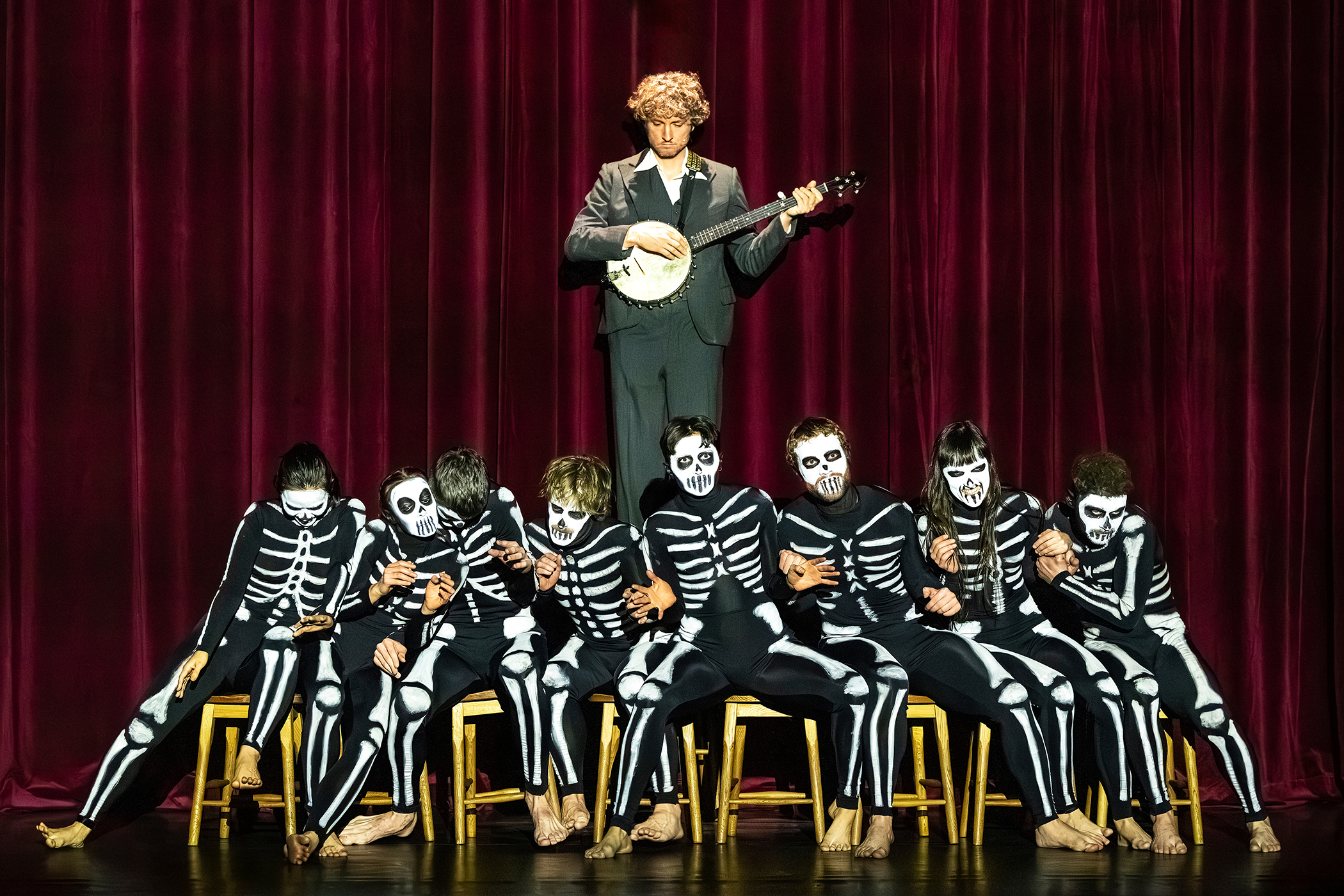
Muhly says he loves working with dance because he learns so much about his own compositions, and all these creations unlock something in his wide-ranging and engrossing back catalogue. The most striking piece is by Keegan-Dolan to Muhly’s The Only Tune, specifically written in 2007 for the US folk singer Sam Amidon.
This haunting song in three parts is Muhly’s version of a Scottish murder ballad, an old tradition shaped by him into an entirely modern idiom. The words tell the story of a sister murdering her younger sibling and then marrying her lover; the devil makes a fiddle from the corpse’s bones to be played at the murderer’s wedding.
When the lights go up on Keegan-Dolan’s dramatic interpretation, Amidon is standing on a stool in front of rich, purple curtains, a noose above his head. One by one, eight dancers appear, dressed like skeletons, their faces ghastly painted approximations of skulls; each carries a stool and makes a good deal of comic fuss about setting it down, before adopting the wide-armed, bent-kneed, mocking pose of a vaudevillian tableau.
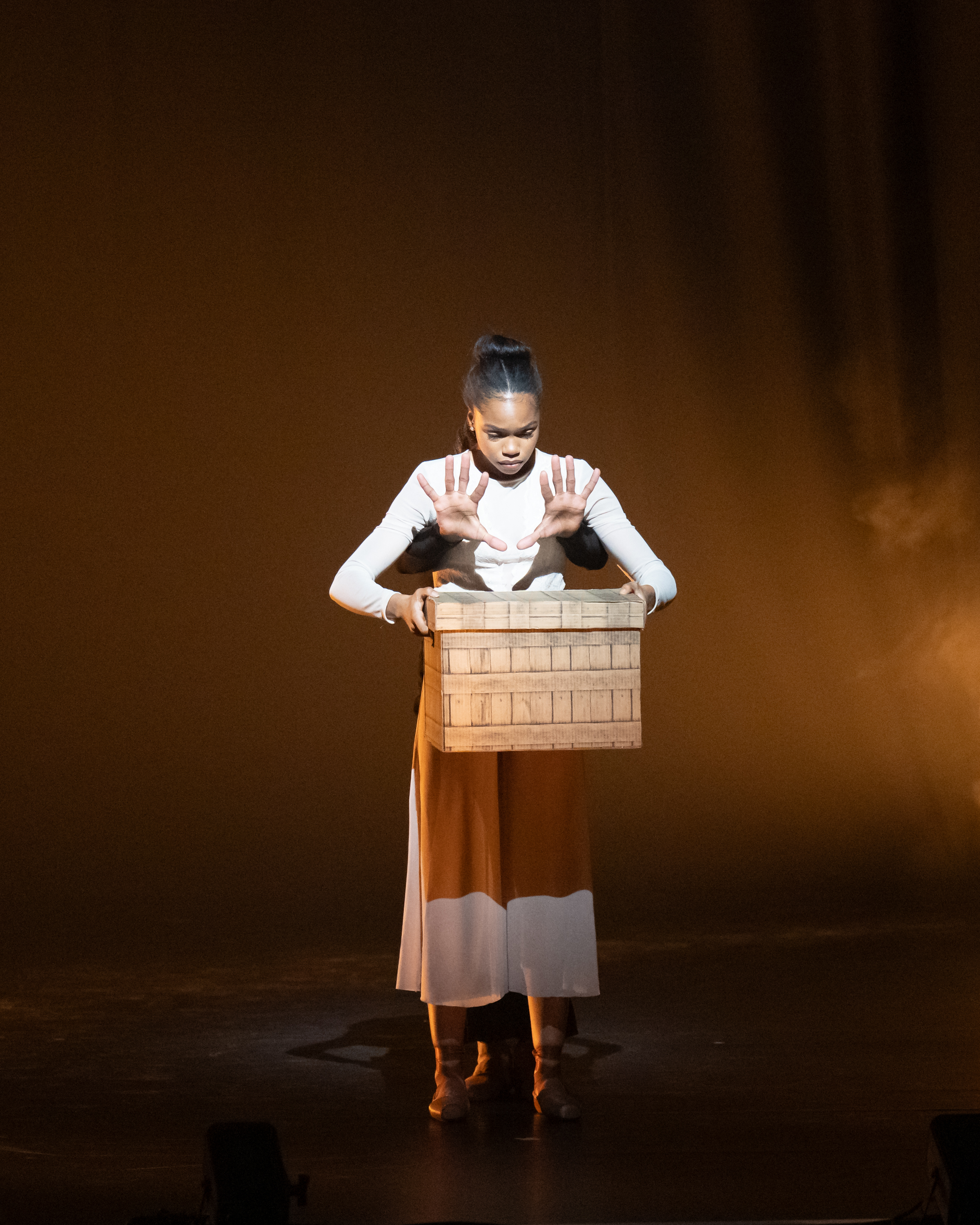
Taraja Hudson’s white-clad heroine in Ballet Black’s A Shadow Work
When Amidon starts singing, plucking a tune on his banjo, his voice high and keening, the curtains draw back and the Britten Sinfonia are revealed on a platform, also dressed like skeletons. The resulting dance, of shuffling, rhythmic feet and splayed jazz hands, circling around Amidon’s central figure, is punctuated by screams. It’s both vaguely funny and utterly macabre, a dramatic evocation of the darkness of life, performed with the lightest of touches.
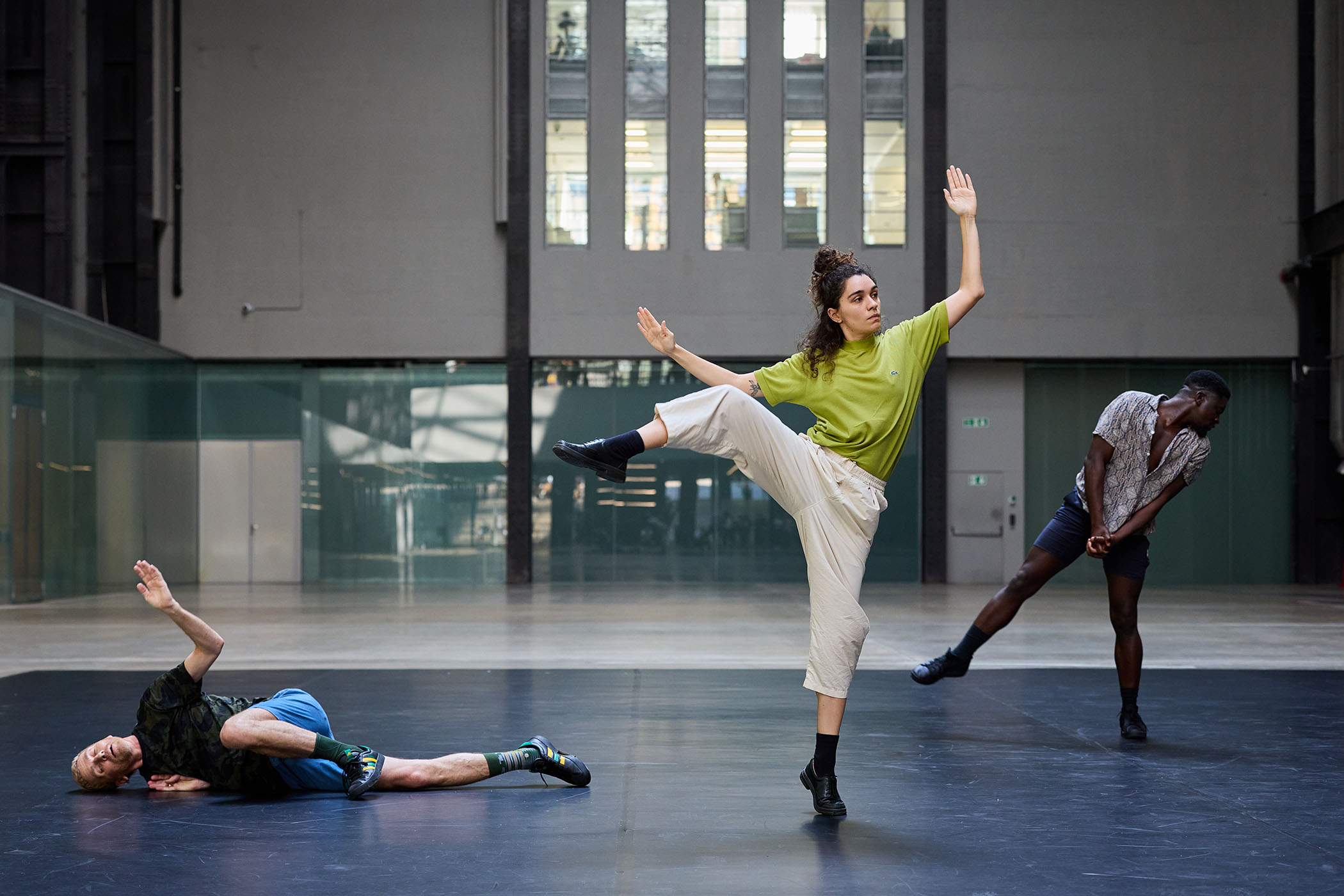
Cunningham’s Slant inhabits a different world. Choreographed to excerpts from Muhly’s unsettling Drones compositions, played in the pit, and with light, bright and brilliant light by Clancy Flynn, its six dancers float quietly around a space that is lined with a gantry of coloured, collaged cloths (design by Tim Spooner).
They unwind a spool of coloured thread, sit side by side, try out arabesques and jumps, their movement clean and stark, conditioned by the sustained notes in the music or picking out those that rise and fall around it. There’s a pensive sense of exploration, of game-playing, of discovery. The dancers – Harry Alexander, Cunningham, Ellen van Schuylenburch, Yu-Chien Cheng, Nathan Hamilton, Archie McCourt – range in age and each has their own distinctive style. The overall impact is cool but intriguing.
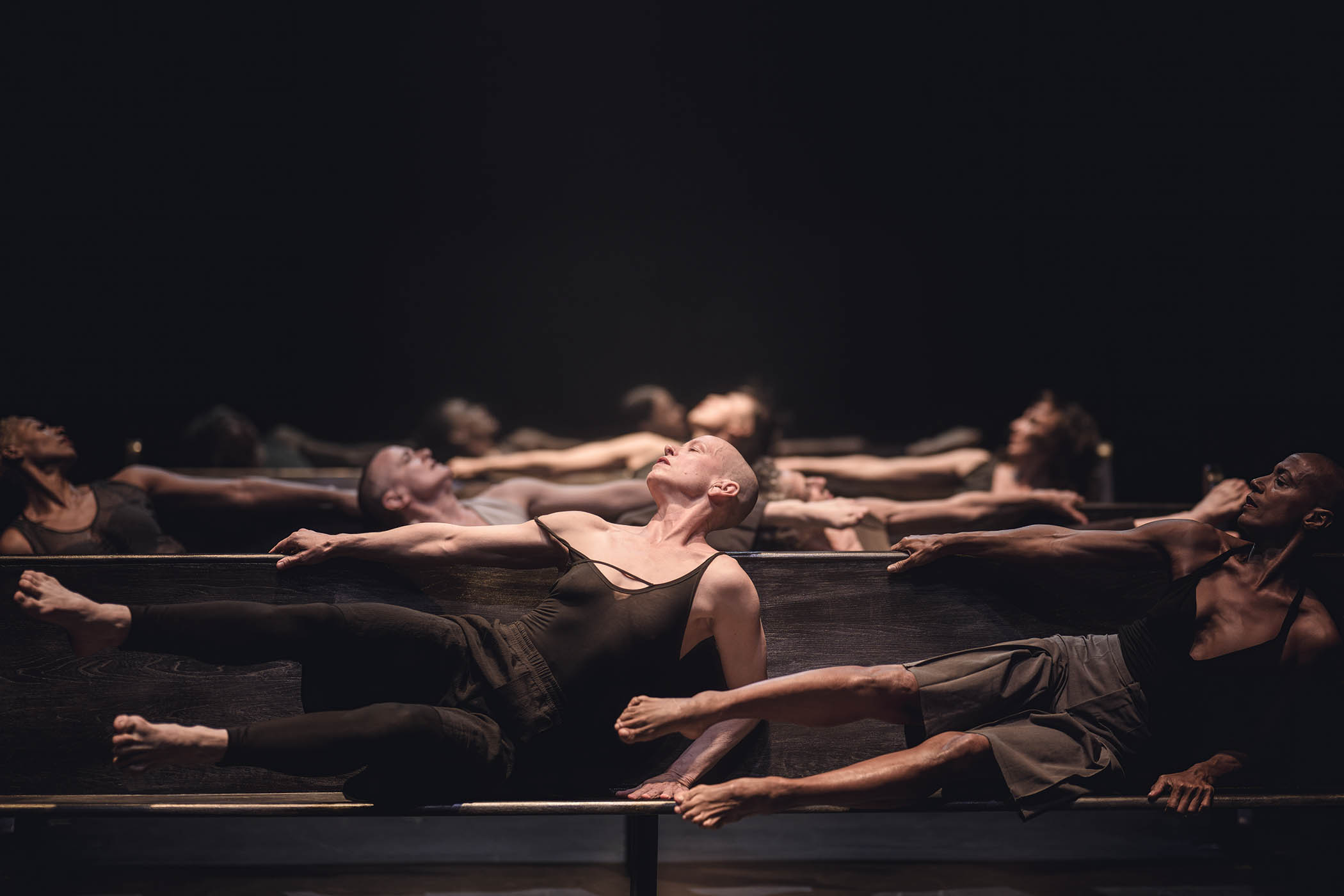
Le Pladec’s Veins of Water, which sits between these pieces, has its own high energy and thoughtfulness. It sets three mermaid-like women (Siaska Chareyre, Alexandra Fribault, Loeka Willems) in shimmery tops on a relentless disco dance of slinky synchronicity. The music is called Drown, inspired by a strange timepiece carved by a stranded sailor, and there’s a salty quality to the choreography; a sense of water and mystery as well as of complicity and seduction.
Just how hard it is to commission new work of this quality is revealed by Ballet Black, whose programme Shadows followed Muhly into Sadler’s Wells. My Sister, the Serial Killer is an adaptation of Oyinkan Braithwaite’s bestselling novel, choreographed by artistic director Cassa Pancho, assisted by Jacob Wye and with contributions from the entire company.
Newsletters
Choose the newsletters you want to receive
View more
For information about how The Observer protects your data, read our Privacy Policy
It’s strongly dramatic and offers leading roles for the outstanding trio of Isabela Coracy, Helga Paris-Morales and Ebony Thomas, but it doesn’t give them quite enough to do. It loses the wry, complicit tone of the book – yet only at moments solves the question of how to translate its emotions into dance.
A Shadow Work, by the young American choreographer Chanel DaSilva, is also hampered by a theme – the Jungian concept of a shadow self – that feels bigger than the choreography can tackle. The dancers are again superb, and there are occasional sections of inspiration as Taraja Hudson’s white-clad heroine is both attracted and repelled by the figures in black around her. But the piece, though long, never seems to get anywhere.
Photographs by Ash/Foteini Christofilopoulou