
Dance and football have got surprising amounts in common. In a recent edition of L’Equipe, the French paper blissfully entirely devoted to sport, the former Paris Opera Ballet étoile François Alu called the supremely graceful French footballer Michael Olise an artist.
The ex-Crystal Palace player (now with Bayern Munich) is one of the French national team currently illuminating the World Cup with a rare sense of joy. That accolade for the play-maker sprang from Alu’s analysis of the 360-degree turn in the air that Olise executes – feet neatly together – as part of his warm-up on the pitch. This entirely balletic airborne leap is part and parcel of his supremely graceful playing style, but it’s also an assertion of his ability to jump higher and perform better than the normal mortals around him.
Olise is 24 years old and at the top of his game. This also links him with dancers who train hard as children, come into their prime in their 20s and then often have to stop dancing in their 30s and 40s, at exactly the moment they have understood their art. Dancers at the Paris Opera Ballet faces a mandatory retirement age of 42; look at the careers of Sylvie Guillem, Marianela Nuñez and Diana Vishneva to understand what a loss that is.
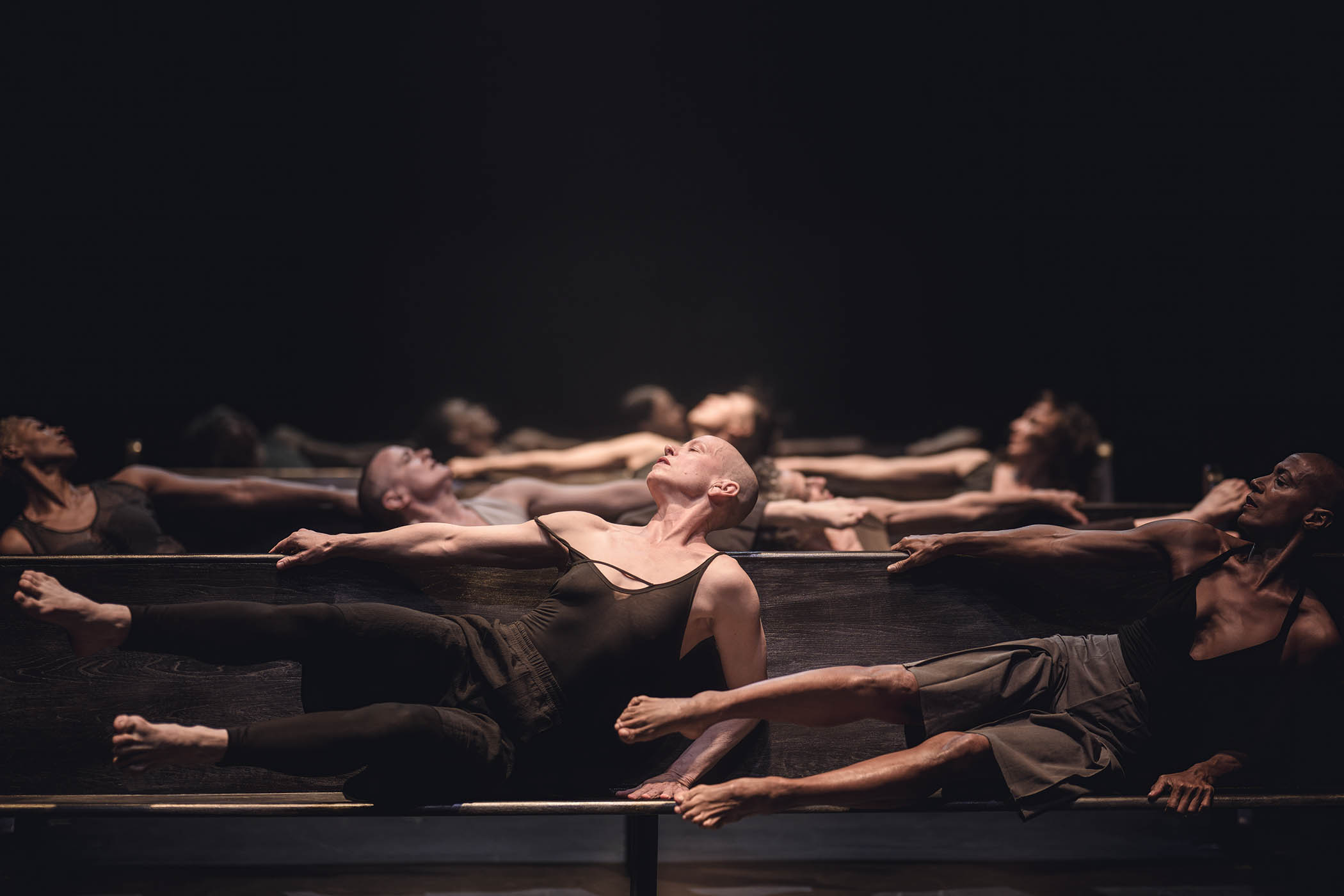
Football is still a young person’s game; the prominent exceptions (Ronaldo, Messi, Kane) are all under the POB’s retirement age. But in dance, fortunately, this is changing. One of the most appealing and exciting qualities of The Surge, a co-production between Factory International in Manchester and the Joyce Theater in New York, is that it features 10 dancers with a combined age of more than 500, lending their skills to a show in honour of Sinéad O’Connor, who died age 56 in 2023.
Seeing these older women move with fluency and grace is quite something, and entirely appropriate in a show built on the words and music of an activist and musician who never did things in a conventional way. You can feel the weight of lives lived as they celebrate and mourn a woman whose voice soared and whose courage was renowned, but who battled with her own mental health as she took on the shibboleths of the Catholic church, of child abuse and of injustice, at considerable cost to her career.
Her songs and words from her audiobook reading of her autobiography form the soundtrack and hearing them is a reminder of just how distinctive and bold she was. The choreography by Sonya Tayeh, best known in the UK as the choreographer of Moulin Rouge! The Musical, is quite something too; textured and rhythmic, haunted and haunting. Tom Visser’s shapeshifting light seems to hold the dancers in a dreamlike space, suddenly broken by sharp shafts of white, as the dance unfolds in great waves of surging movement, punctuated by smaller, more direct encounters.
There’s a ritualistic quality to it, emphasised by an opening where the women sit in lines in pews, as if in church, listening to O’Connor tell a story about a piano that in her imagination confided: “I am a very tender thing.” As the work develops, they move those benches around the space, using them as props for their movement. Sometimes they bend over the backs, sometimes vanish beneath the seats and then rise mysteriously, sometimes hook their legs over the seats and lie on the floor, curved arms raised like an embroidered border.
At one moment, as a pensive solo unfolds at the front of the stage, one group of dancers slides along the benches, while another walks behind, arms cutting the air as if swimming, like a contemplative Busby Berkeley chorus line.
Tayeh’s use of the pews gives a constant sense of layering and structure to the piece, but it is the performances that give it force. Sometimes the dancers lip-sync to the words or enact tableaux that respond to the lyrics. More often, they simply react to the emotion O’Connor conjures with that raspy, powerful voice soaring over a great range of settings.
There are lots of mournful solos, and desperate, vaguely erotic couplings, but the most arresting moments are those when the movement seems propelled by the defiance in the music, in songs such as Troy and Red Football, and the dancers respond as a wild, whirling ensemble of empowered women, shoulders back, heads raised, images of glorious individuality. Just like O’Connor.
Newsletters
Choose the newsletters you want to receive
View more
For information about how The Observer protects your data, read our Privacy Policy
Photograph by Manuel Harlan