One of the best sentences in a Charles Dickens novel – a moment that proves he could do much more than vivid capering and dark tumult – comes in Hard Times. “I think,” says the ailing Mrs Gradgrind, “there’s a pain somewhere in the room, but I couldn’t positively say I had got it.” Very much my experience of Rajiv Joseph’s Archduke. I could hear squeaks of irony, without knowing exactly what was being ironised. I could make out political metaphors without fully unfurling their significance. I could sense glimmers of identity crises without being made curious as to what the identities might be. There was, I suppose, a play somewhere in the room but it eluded me.
Joseph’s subject comes laden with promise. Archduke focuses on the assassins of Archduke Franz Ferdinand, whose shooting in Sarajevo triggered the First World War. It encompasses Serbian patriotism and Slavic unification; it floats the possibility of current echoes. Its plot pivots on a buccaneering officer – boasting of regicide and disembowelling – who recruits as gunmen three woeful innocents, made vulnerable by poverty and hunger.
There is a kernel of historical fact. Details of the youths being groomed to kill correspond to the real-life assassins. The successful shooter, Gavrilo Princip, was, as here, 19 when he fired at the archduke and conscious of being small. He had TB, though he seems to have contracted the disease in prison: Joseph shows him arriving with a fatal cough and silently declaring his hopeless condition in the way people always do on stage, by coughing into a white hankie and then looking at the contents, appalled. Stanley Morgan plays the under-weener convincingly. Their recruiter, Dragutin “Apis” Dimitrijević (Marc Wootton), was indeed the founder of the Black Hand gang. Much else is imagined – and deliberately inconclusive.
No one familiar with Joseph’s earlier work would expect a straightforward historical account. He specialises in reimagining historical events, shaking them into the shape of a big idea. His Iraq War drama Bengal Tiger at the Baghdad Zoo featured the ghost of a talking tiger prowling through the devastated country. Guards at the Taj conjured the bloody legend behind the Taj Mahal to show that killing people does not obliterate ideas. Both plays were oblique but both evoked a large theme behind the detail. Archduke has the obliqueness but little sense of a pressing purpose.
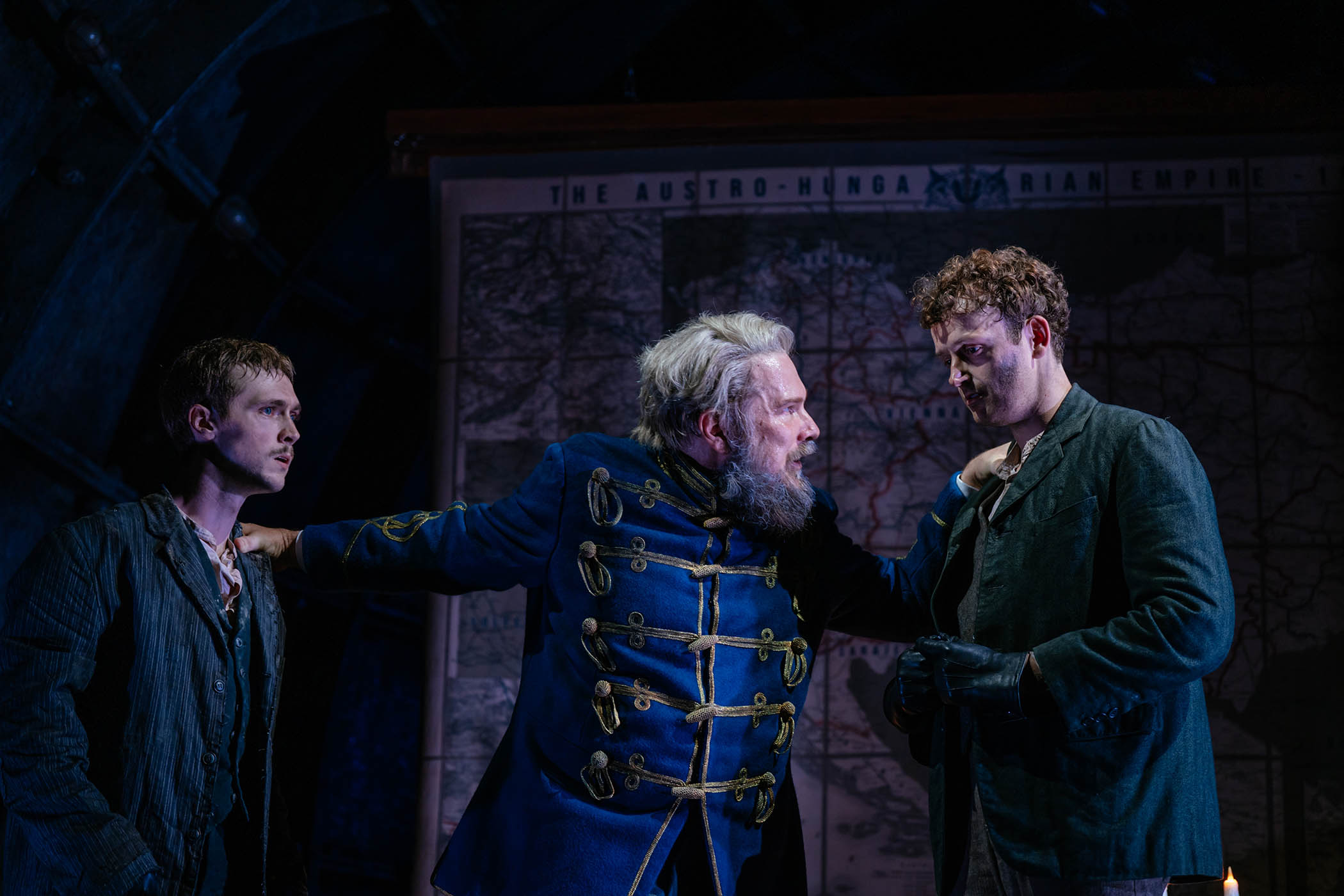
The three young chaps are plausible as nonpolitical tousle-heads; hollowed out with illness, their sickness a reflection of an ailing Europe
The three young chaps are plausible as nonpolitical tousle-heads; hollowed out with illness, their sickness a reflection of an ailing Europe
Undercutting ideas of destiny, Joseph presents the arbitrariness, and the near-misses of history as farce. The three young chaps – Morgan, Abraham Popoola and Chris Walley – are plausible as nonpolitical tousle-heads; hollowed out with illness, their sickness a reflection of an ailing Europe. Ripe for indoctrination, they would kill for a sandwich. Their preposterous recruiter is played at full bellow by Wootton, who roars through the history of the Austro-Hungarian empire – “A twisted Siamese piglet, forever defecating into the mouth of its unfortunate twin” – and gives the formation of the Black Hand a lubricious tinge as he dispenses black surgical gloves to his acolytes.
Meanwhile, Janice Connolly shuffles in as an elderly housekeeper, doling out bean stews and elaborate puddings – “Her meals contain Serbia itself” – while apparently working a sideline as a witch: oh those mysterious eastern European places. She peddles potions and suggests that the syrupy cherries with which she treats her boys may actually be kitten’s eyes; she is not a fan of cats.
Director Lyndsey Turner, who recently had a deserved triumph with Ava Pickett’s crackling 1536, is well placed to steer a play showing characters unwittingly swept up in cataclysm, but heavy whimsicality obscures Joseph’s points. Es Devlin’s sets are impressive but they do not actually prise the play open. The first scene takes place in what looks like a beer barrel – dark, ribbed, round – allowing for a hint of Beckett and some capering slapstick involving collapsing crates. It converts smoothly into a sinister chapel and then a trimly appointed railway carriage, in which the details – the little lamps, the shelves, the buttoned upholstery – are so precisely rendered it might have been a Poirot thriller.
The precision is at odds with the slipperiness of the action, and with its absurdity – save that, on press night, absurdity broke in when a door failed to open at the back of the carriage (its waggling at first looked like a joke) and the actors were obliged to steal around the sides and enter from the front. Given the uncertainty of the drama’s action, the mishap might almost have been intentional. This duke is too arch.
Archduke is at the Royal Court, London, until 25 July
Photograph by Helen Murray
Newsletters
Choose the newsletters you want to receive
View more
For information about how The Observer protects your data, read our Privacy Policy