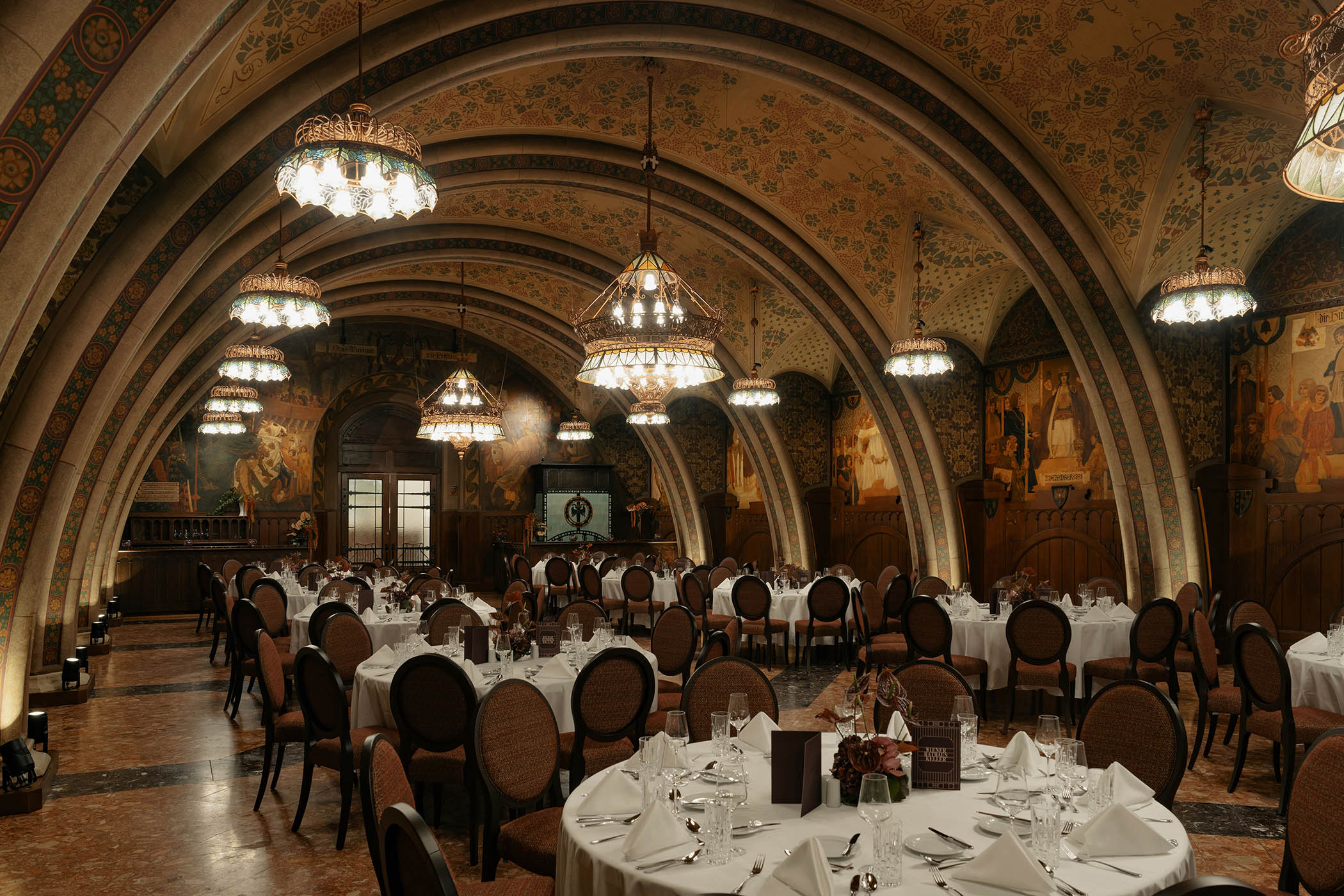

Subterranean hospitality comes in many forms: a raucous student pub dishing out pretzels and beer, a vaulted wine cellar, a conspiratorial alcove tucked behind a grand chamber. Vienna’s Rathauskeller somehow contrives to be all of these, the clandestine note all the stronger for the fact that its entrance sits, almost hidden, to one side of the Rathaus, the city hall.
“The cellar was added later, that’s why,” says Erich Bernard, one of the co-founders of Viennese architecture practice BWM. Bernard, who has just arrived by bicycle, takes off a shiny helmet and smooths down his long hair tied back in a bun. His firm is among Austria’s most celebrated, with a list of achievements that includes the Austrian pavilion at Expo 2025 in Osaka. Earlier this year he oversaw a wholesale makeover of the Rathauskeller.
We enter together and, as we descend the stone steps, Bernard explains the building’s unusual history. The Rathaus was built between 1872 and 1883 in the neo-Gothic style that mimicked the great cathedrals of the Middle Ages. It reflected the growing confidence of the city’s middle classes. “The Viennese bourgeoisie was becoming stronger, especially in opposition to the church,” he says, speaking with the enthusiasm of a tour guide. “This was like a cathedral of the bourgeoisie.” The Rathaus’s central clocktower was meant to rival the spires of Vienna’s St Stephen’s Cathedral.
Similar statements were being made across Europe around this time, including London’s Houses of Parliament. Typically, these civic buildings would incorporate not just offices but also ballrooms and, crucially, drinking halls. In Vienna, however, budget constraints meant that, although provisions for a cellar tavern had been made, the Rathaus initially opened without it.
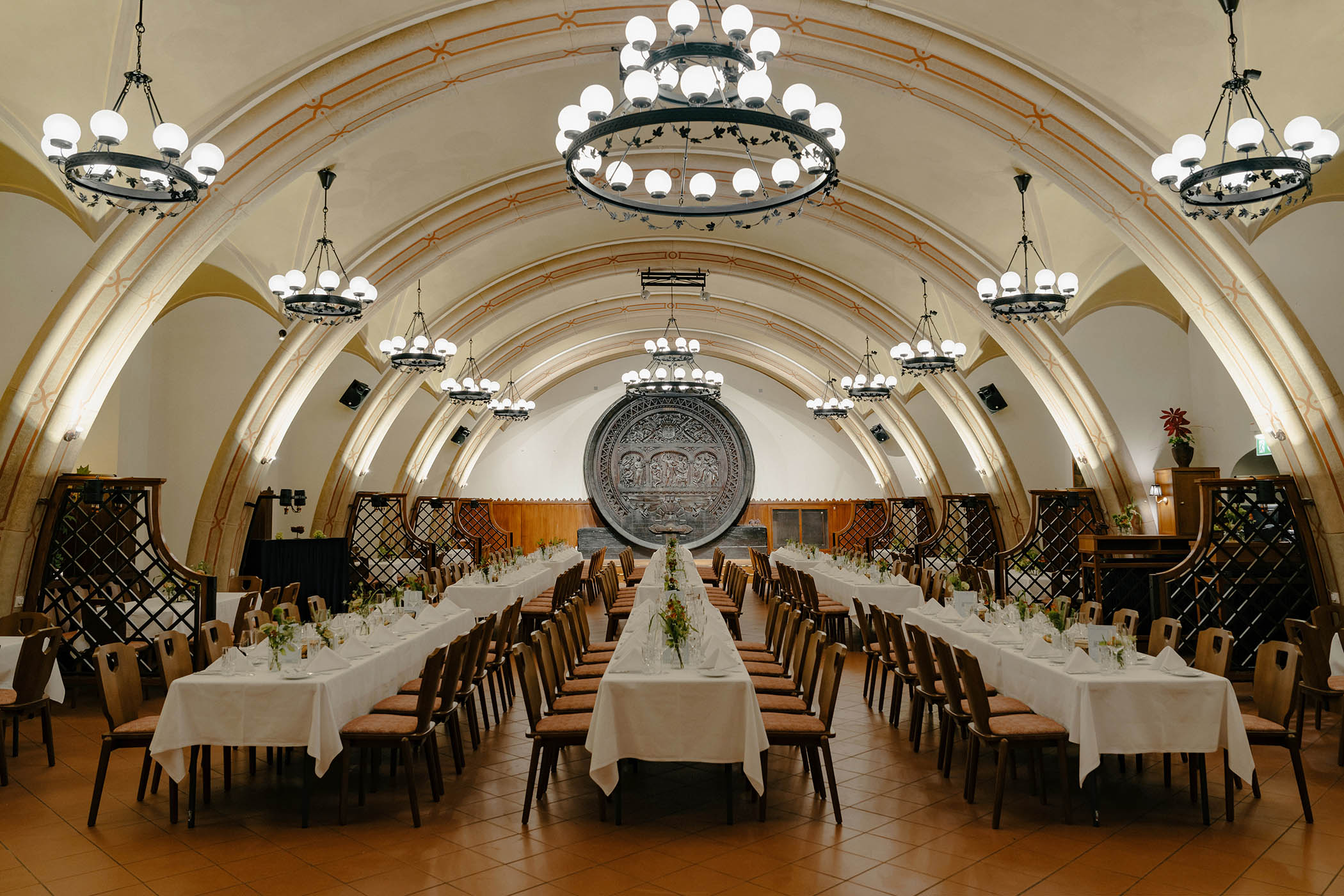
Raise the roof: the Augustinstüberl, dedicated to beer-drinking
Then, in 1897, Karl Lueger became mayor. Now remembered for his virulent antisemitism and demagoguery, he was also a moderniser, laying down the city’s tram network and bringing gas, electricity and heating under municipal control. A true populist, Lueger could not abide the idea of his city hall lacking a space for carousing, so he commissioned the architect and set designer Joseph Urban to create one. “Urban understood the concept of atmosphere, and how to intensify it,” says Bernard.
Since its opening in 1899, the Rathauskeller has been redone several times. By the time BWM began its own renovation in January this year, it was a jumble of cheap materials and bad taste. “It was just ugly,” says Bernard, swiping through “before” photographs on his phone showing unnecessary TV screens and walls in a nasty yellowish colour.
BWM began as Urban might have, with atmosphere. Throughout the cellar’s six halls and the long corridor linking them, floors have been retiled, the lighting rethought and wall paintings carefully restored. The renovation, which was completed in October, has breathed new life into the original features of Urban’s design, while modernising the spaces, facilities and furniture.
Today, wandering through the various different rooms is a treat for the eyes. In the Rittersaal, or Knights’ Hall, with its high arches, one wall is covered with frescoes depicting medieval damsels and knights set against a background of gold leaf. In another hall, an oversized, richly ornamented wooden wine barrel stands on a sort of stage, like a portly performer. Now purely decorative, it once held wines from Vienna and the surrounding regions. Yet another hall, the Augustinstüberl – named after Vienna’s semi-mythical 17th-century street singer – is dedicated to beer-drinking.
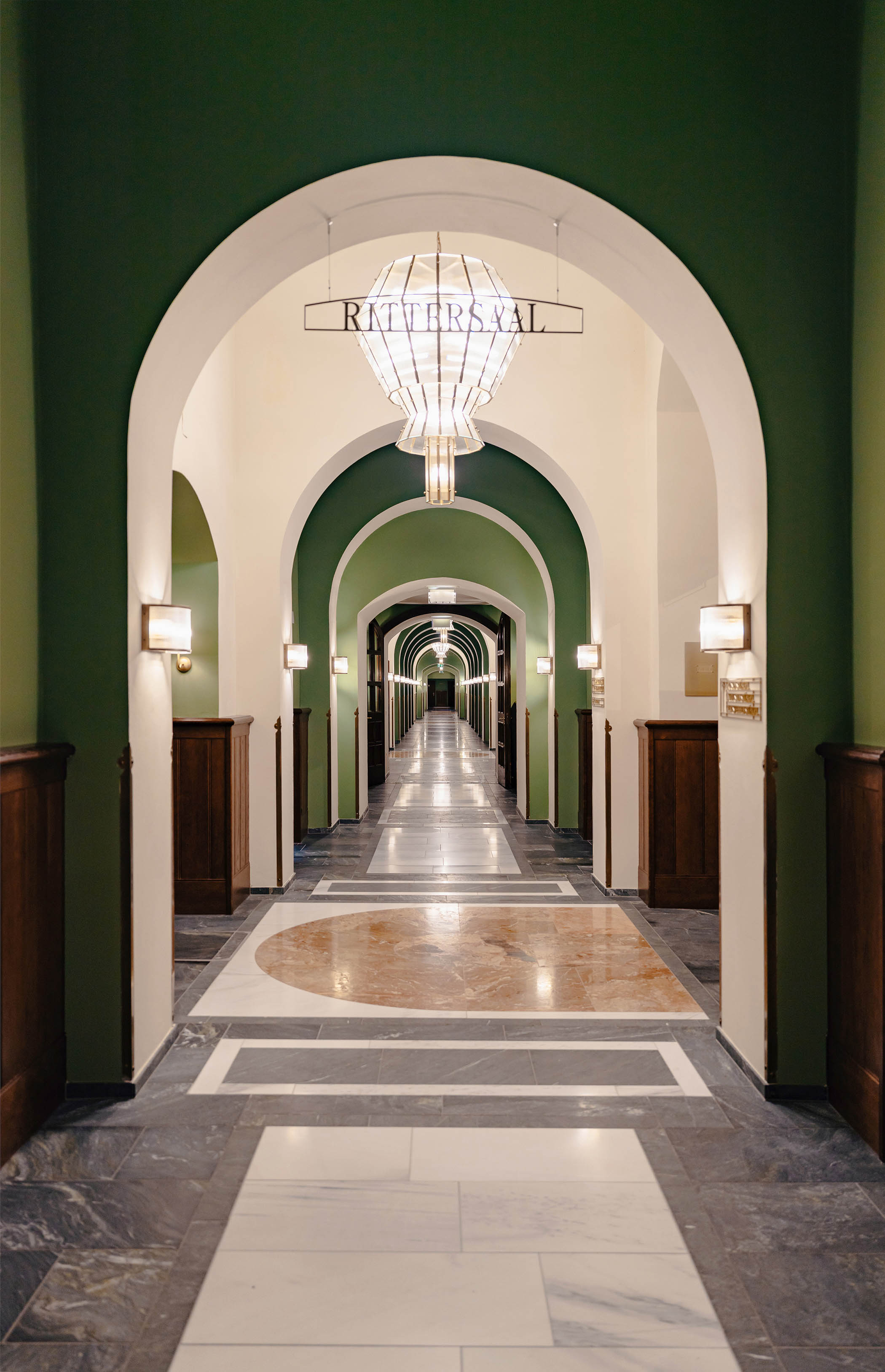
Underneath the arches: the 110m-long corridor
Perhaps the most striking feature is the cellar’s 110m-long corridor, which has been repainted a gentle green and beige. “This is the only place anywhere in the Rathaus where you can see the whole length of the building,” Bernard says. Here, patterns of differently coloured marble create a rhythm and indicate the way to each of the halls. Chandeliers inspired by Urban’s aesthetics, shaped like oddly angular pears, hang above. They were among the few new objects created for the project. In the end it is Urban’s original vision that is being upheld. “Our goal was not to present ourselves,” Bernard says, as we retrace our steps back to the street. “Our goal was to re-intensify Urban’s atmosphere.”
Back outside, the architect reflects on the renovation. “This is a small project for us in terms of what we did,” he explains. “But it’s a large project in terms of its importance for Vienna, because it poses a big question: what is the future of our past?” Thanks to this year’s work, that past has been restored to its former glory.
Newsletters
Choose the newsletters you want to receive
View more
For information about how The Observer protects your data, read our Privacy Policy
We can all raise a glass to that.