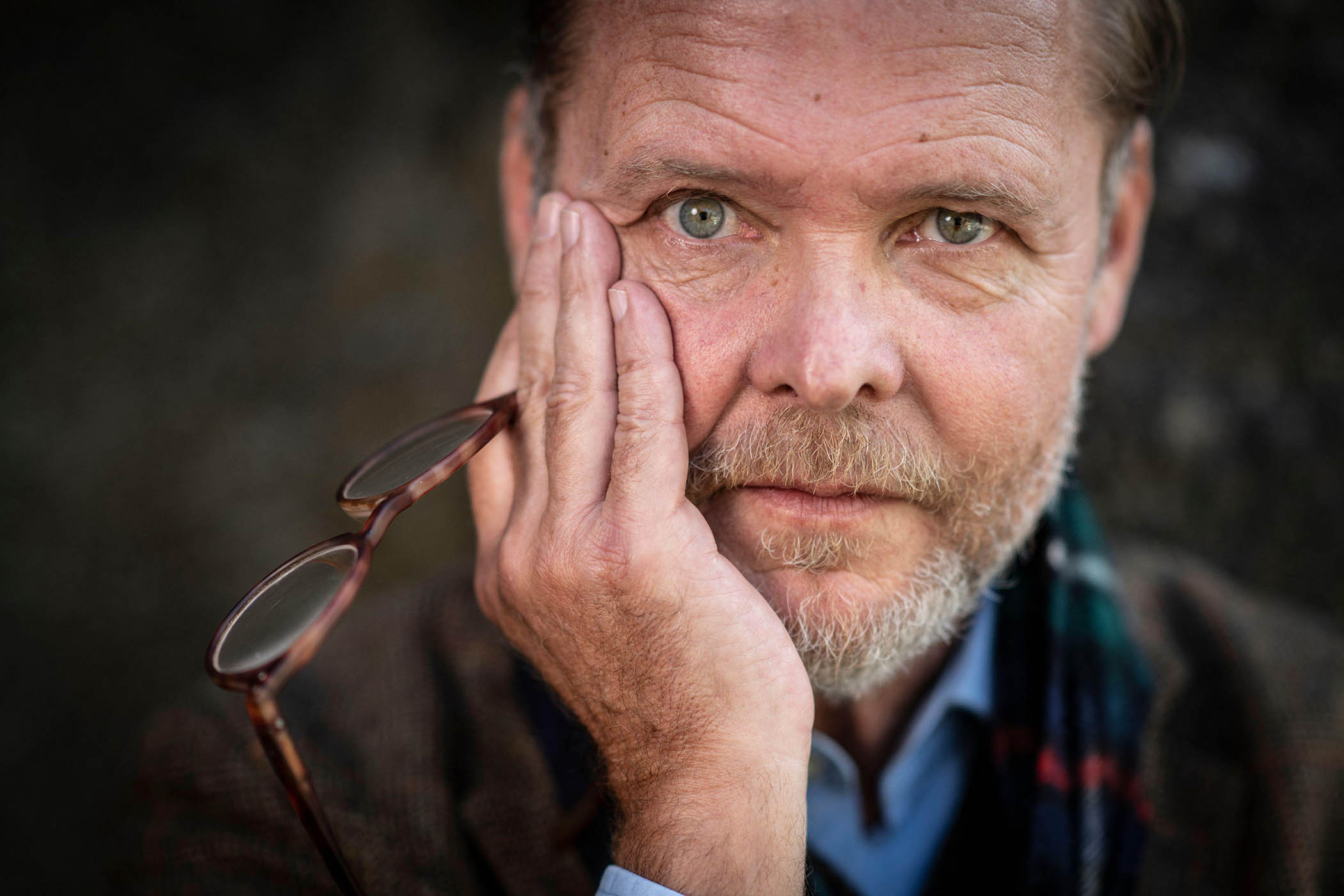

Christian Kracht, who leapt to international fame with his 2021 novel Eurotrash, has been described as the “enfant terrible” of German-language writing. The Swiss author, who published his first novel in 1995, appears to have the gift of never writing the same book twice. Certainly Eurotrash – which takes the form of a riotous road trip around Switzerland, its protagonists a man and his alcohol- and pill-addicted elderly mother – is little preparation for Kracht’s latest tale. Air melds a semi-Arthurian quest in a medieval world that predicts today’s climate crisis with the very 21st-century story of a designer hired by a lifestyle magazine to paint the subterranean interior of a data centre entirely white. These two improbable-seeming narratives are at first contrasted, then converge to make an engrossing work that is part science fiction, part parable.
As the novel opens, Paul, a sought-after Swiss creative, lies asleep on a sofa in his minimalist cottage on Stromness, Orkney. He is dreaming. “It was a time when many things were bought and just as quickly forgotten,” Kracht writes. Paul’s dreams are filled with an empty Antarctic landscape, half remembered, but yet to be discovered. On a nearby wall hangs a painting by the artist James Archer of Merlin in a hooded white cloak leading Lancelot, exhausted, on a black horse, through a mountainous terrain. (The painting is real and will become highly symbolic as the book’s odyssey unfolds.) Paul is successful but listless. On waking, he accepts an emailed commission from a leading magazine, Küki, whose earnest articles centre on disappearing artisanal traditions and foraged food repackaged as hygge-type comforts for the wealthy – “a subtle shift from highbrow modernist monthly to a mildly eccentric décor magazine that was very intentionally bringing about its own irrelevance”. Paul is to paint an “immense dark hangar in Norway … with hectoliters of white … there would be a great deal of money”. After travelling to Stavanger to meet Cohen, the enigmatic and nervy editor of Küki, “for whom cleaning up the reservoirs of collective memory seemed the only logical thing to do”, Paul undertakes his mission, where, during a solar eruption, he disappears.
A sudden switch of time and tone then takes us to a forest in a medieval European country. Here, a nine-year-old girl, Ildr, is fending for herself after her mother has succumbed to a plague known as the Yellow Death. Out hunting deer, she accidentally shoots a strange man with her bow and arrow, drags him to her nearby hut and heals him under his instruction, aided by a strange powder he carries with him. When soldiers from the court of the Duke of Tviot, tyrannical ruler of this northern place, come to look for the man, he and Ildr begin a tremendous journey south to find the Frozen Sea and safety, not before killing prodigious numbers of enemies along the way (the man, considered a “mage”, has a very un-medieval like gun) and subsisting on food items that, in the 21st century, are marketed as luxuries. Back in Stavanger, Cohen, distressed by Paul’s vanishing, takes an overdose of sleeping tablets and himself enters this medieval world but much further south in a place of ice floes and seabirds.
Kracht has great fun with Air. There are sea battles, portentous comets, solemn exchanges and any number of tropes and archetypes employed in accounts of the present and past (which gradually coalesce towards a shared utopian future). Yet in its predictions and preoccupations, it is a deadly serious work about the sheer precarity of existence. Cohen looks ahead in horror to “no seasons, no trees, no people, no life”. Sudden time jolts and relocations recall the quantum transpositions of Alan Garner’s 1973 masterpiece Red Shift. The prose is translucent, in a mesmerising translation by Daniel Bowles, with the whole enterprise neatly underpinned by Kracht’s poignant emphasis on the very old-fashioned bonds of fealty and friendship.
Air by Christian Kracht, and translated by Daniel Bowles, is published by Serpent’s Tail, £12.99. Order a copy from observershop.co.uk for £11.69 (10% off RRP)
Photograph by Staffan Löwstedt / Alamy
Newsletters
Choose the newsletters you want to receive
View more
For information about how The Observer protects your data, read our Privacy Policy