Portrait by Sophia Evans
When Chloé Zhao was making her latest film, Hamnet, she was going through “what they might call a midlife crisis”. Before and during, she experienced “waves and waves and waves of loss and grief”, including the end of her relationship with her long-term partner and collaborator, the British cinematographer Joshua James Richards. “When you arrive halfway through your life, sometimes the foundations start to come apart – and that’s a good thing,” she says now. “I think, from a Jungian perspective, you spend the first half of life trying to build an ego and then the second half trying to deconstruct it, so who you are can come through. That’s what was happening to me.”
Hamnet is a story about grief. It’s based on Maggie O’Farrell’s 2020 novel about the short life of William Shakespeare’s son Hamnet, who died aged 11 (his twin, Judith, survived). The book suggests he was killed by the plague, and is told non-chronologically from the perspectives of the boy, Shakespeare (known as “husband” or “father”) and Hamnet’s mother, here named Agnes.
Zhao’s film takes a linear approach, foregrounding Jessie Buckley’s witchy, feral Agnes and Paul Mescal’s tortured, silent Shakespeare, and expanding its scope to take in the making of Hamlet, which was written a few years after Hamnet’s death. Part love story, part tragedy, part portrait of the artist, it examines how a family comes together – and how it can be taken apart. It is an intimate film, shot in damp English fields, full of potent symbolism – birds, dirt, blood – and grounded by Buckley and Mescal’s performances.
We are meeting in a central London hotel in October, two days after Hamnet had its premiere at the London film festival. Zhao, wearing a rust-coloured jumper over a white silk and lace dress, seems tired and relieved. “It was the most nerve-racking one,” she says over an austere breakfast of a boiled egg and a plate of sliced mango and kiwi. “It’s coming home: this whole audience is Shakespeare.”
When we discuss the film, she speaks in a soft voice, but her tone is one of calm, focused intensity. At the premiere, she used this same quiet force to lead the audience in a breathing exercise. The film earned the festival’s audience award, voted for by attendees, for best feature – one of several it won on the festival circuit.
In 2021, Zhao became the second woman, and first woman of colour, to receive the Academy Award for best director for her 2020 film Nomadland, which also won best picture, and best actress for Frances McDormand. With Hamnet, Oscar buzz surrounds Zhao and her cast once more.
At first, Zhao was reluctant to take on a project about motherhood. “I was hesitant because I’m not a mother, but also because the mother figure has always been a sensitive topic for me. I have quite a deep mother wound,” she says. “Unfortunately, what we do for a living is to open up those wounds … This film came to me a little bit before I was ready.”
She met Buckley and Mescal at the Telluride film festival in Colorado, and Mescal urged her to read the book. “It could be mainly focused on that: the loss of a child, and motherhood,” Zhao says. “But the book is existential. It’s about love. It’s about death. It’s about metamorphosis.”
Mescal and Buckley signed on to the project before the script, co-written by Zhao and O’Farrell, had been developed. Buckley tells me Zhao “immediately felt familiar. We swim in similar waters. We both are looking to discover something from the shadows ... We were speaking the same language.”
Newsletters
Choose the newsletters you want to receive
View more
For information about how The Observer protects your data, read our Privacy Policy
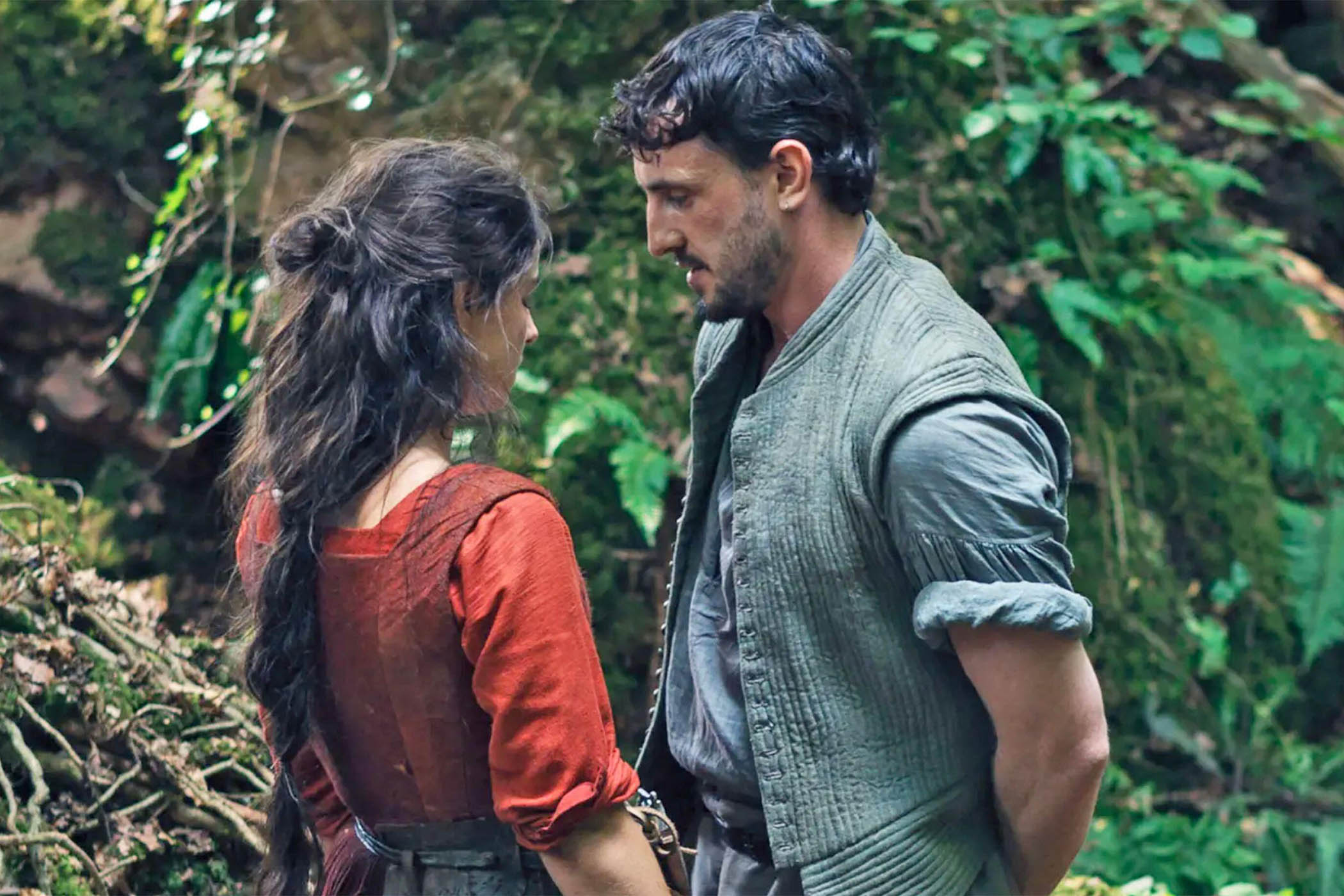
Jessie Buckley as Agnes and Paul Mescal as Shakespeare in Hamnet
In November 2023, five months before Zhao started working on the script, she and Buckley met in New York for a “dream work” session. These workshops, which many of the actors in the film participated in at different stages, were led by coach Kim Gillingham and designed to help artists “drop into the collective unconscious”: Zhao would then incorporate elements that emerged from their dreams into the script. “It was a very, very powerful session,” Zhao says of her and Buckley’s workshop. “I feel like she and I are still unpacking that one session now.”
Buckley describes the process as “a whole soup of instincts, private explorations, dreams, unknowables … Chloé created a safe and fluid space to allow whatever was asking to come through to come through.” It was: “Something very alive. Not in the head. A state of ‘being’, not acting. It’s a risk to work and be seen in that place. I don’t know if I would have gone where I did if it wasn’t for her.”
Emily Watson, who plays Shakespeare’s mother, subsequently tells me: “I’m always nervous of discussing the inner workings of acting. It sounds so ludicrous to an outsider – it’s like showing somebody your underwear.” But she explains that, as part of her own dream work process, she was asked to write a letter to her inner self about her character, just before she went to sleep. That night, she says: “I put my head on the pillow [and] literally, in about 10 minutes, I had five very vivid dreams – one about the movie.”
In January 2024, Zhao returned to New York to see Buckley again. “I had some personal issues, and [she] just happened to be there to catch me. It was like a tsunami of emotion hit me,” Zhao says, as if her body couldn’t “handle the amount of energy bubbling up after what Jessie and I experienced in New York”.
Zhao told her team she would not be flying back to Los Angeles. She would take the train. The journey would take four days and she would have little phone reception. During that time, as images from her and Buckley’s dream work surfaced in her mind, she wrote most of the script, sending voice notes back and forth with O’Farrell whenever there was signal. “It was so intense,” she says. “Hamnet, the way it came to me, was biological … That doesn’t mean it’s not painful, of course. Kind of like giving birth, you know?”
If the mother figure was a distant one for Zhao, Shakespeare – at least as he is conceived in this film, as an artist who retreats into imagined worlds – was one she could relate to. “I understand him more,” she tells me. “Many artists escape … I think for many of us, where that came from is this deep discomfort with the present moment, because the present moment was never quite safe. That ranges from not being safe physically, emotionally, but also sometimes, when you do express yourself from that deep place … it’s shamed.” She pauses. “There’s a whole range of that, and I’ve experienced the entire range.”
She was born Zhao Ting in Beijing in 1982. Like nearly all children of her generation in China, she was an only child. Her mother worked in a hospital and her father was an executive at a state-owned steel company. (Zhao has said she is “not close” with her parents as an adult.) I ask about her childhood: was she solitary? What was her relationship with her parents like then?
Zhao looks at me warily. “Hmmmm,” she says. “Going for it, aren’t you? Was that earlier answer” – about her mother wound – “too symbolic? Not detailed enough?” She pauses for a while, deciding how to answer. “I was quite solitary. But I also went to boarding school at a very young age.”
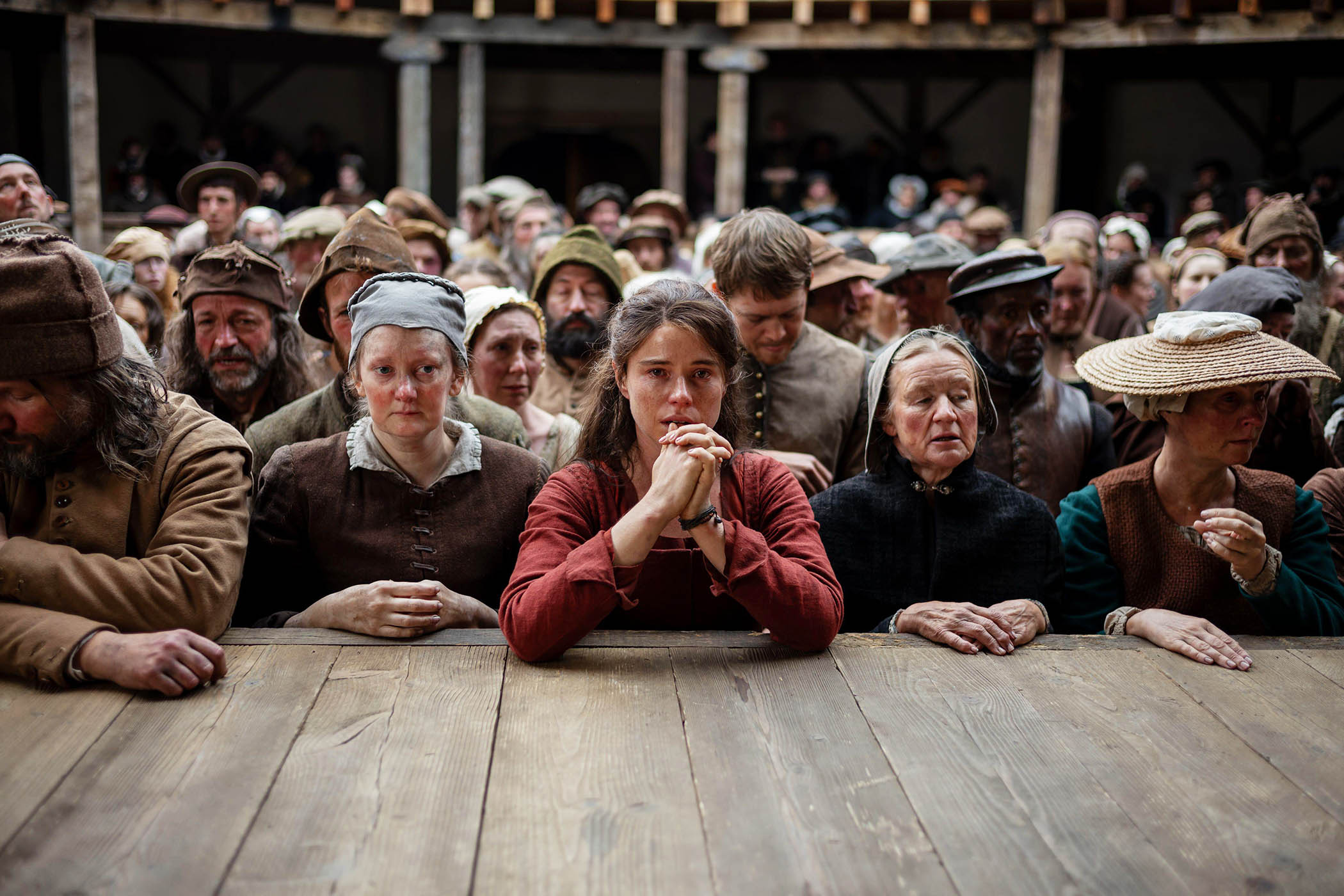
Buckley’s dream work session helped Zhao write most of the script for Hamnet in four days
Zhao was four years old when she started at boarding school in China. She enjoyed the surrogate family of schoolmates and teachers (that sense of immersion in found family is something she rediscovered later on film sets.
Still, she spent a lot of time by herself reading Chinese wuxia fantasy and Japanese manga. Characters from these worlds – and characters she had invented – became a source of comfort. At night, she would make up conversations and storylines with them to lull herself to sleep. “I had full relationships with fictional characters,” she says. “Every night, different scenarios … I would be in the environment with them. I’d tell scenes and get a story going, and then I’d fall asleep. And next night, I’ll pick up the story, keep cooking. I wasn’t able to sleep without it. I’m OK now. I don’t need to do that any more – thank God.”
Zhao was developing her storytelling ability from a very young age – under a pseudonym, she was once a “pretty well-known” fan fiction writer in China and finds traces of childhood fantasies in her work to this day – but she sees the habit as “not healthy”. She adds: “But it was necessary, and I’m very proud of that little girl because she managed to go to sleep. I wish I could [go back and] be there and say: ‘This is actually OK. You’re meant to go through this.’”
I ask about the characters she made up. “There were two of them who, I think, all the way up to my late twenties, I was with all the time. I always know …” She pauses and her eyes fill with tears. “I get quite emotional thinking about this,” she says, her voice wavering. “When I die, I will be saying goodbye to them. But I’ve recently said to them: ‘I don’t need you as much as I used to. I don’t. You can just chill over there, because I actually feel safe enough to sleep.’”
When she was 14, Zhao moved from China to the UK by herself to board at Brighton College. When she arrived in Brighton in 1996 she learned that her favourite band, Suede, would be playing a concert there: unable to persuade anyone to go with her, she bought a ticket and went alone, pushing to the front, staring up at the band, awestruck. “That summed up how I felt. I was seeing them in life, alive, real. It was crazy. At the same time, I was by myself.”
As with so many experiences she had as a teenage immigrant, her life felt “both like a dream come true: characters you don’t think you’d ever meet exist; places you’ve only seen movies are all real”. And yet, “because I didn’t speak the language, because I didn’t know anyone, I also felt an isolation,” she says. Her lack of English made her sensitive to nonverbal communication: as an adult, she is very aware of “any dissonance in people, what they say [versus] how they feel”. Zhao first encountered Shakespeare then, but the language barrier meant she found his work difficult. By 19, she had moved to the US and was studying at Los Angeles high school: in drama, Zhao performed Lady Macbeth’s “unsex me here” soliloquy, which felt “amazing”.
“Because you don’t quite understand what they’re saying – but, at the same time, you do – you enter a state of both known and unknown, conscious and unconscious … You allow your consciousness to chill for a moment and allow something else to come through,” she says. “Paul [Mescal] was the one who told me if Shakespeare is performed well, you don’t need to know the language. You will feel it.”
I had full relationships with fictional characters. Every night, different scenarios
I had full relationships with fictional characters. Every night, different scenarios
After high school, Zhao studied in politics and film in Massachusetts, then enrolled at film school at New York University, where she studied under Spike Lee. Through the support of the Sundance Institute labs, Zhao made her 2015 debut feature, Songs My Brothers Taught Me, which was filmed using nonprofessional actors she discovered on the Pine Ridge Native American reservation in South Dakota, as was her breakout second film, the critically acclaimed modern western The Rider, a painfully moving story of a young rodeo star who suffers a life-changing brain injury. Both films blended fiction and nonfiction; so, too, did Nomadland, her documentary-like depiction of people living in vans in Nevada. The low-budget movie, with its portrait of the gig economy poverty line, revealed the bleak trajectory of American capitalism; released during Covid, it also seemed to capture a collective experience of alienation. Many were surprised by Zhao’s next move – a $270m-plus Marvel film, Eternals, which was met with mixed reviews.
Did she have any ambivalent feelings about the Nomadland Oscar? She smiles at the question. “I’m very happy that I got this recognition. I definitely don’t regret it! But it was part of the foundation falling apart.” As a young girl, and even at film school, she never seriously thought she’d win – but it would be a lie to say she never thought about it.
“People say: ‘I never dreamed …’ Come on! Maybe there are five people like that, but most of them are lying. So of course I wanted to and I dreamt of doing so. But then … It’s a cliche to say, but all my film-maker friends had the same experience. Once you get there, it’s great … And then what? That’s when the midlife crisis starts.”
Zhao contains, she says, “two types of creative force”. “The masculine one is very linear: get shit done, there’s a goal, working towards it. The feminine one is cyclical and spiral and totally chaotic. It just comes and you don’t quite understand why.” As the script for Hamnet poured out of her, mid-midlife crisis, she was in thrall to that “feminine” force. “When the film is greenlit, the masculine one kicks in for a period. And then, when I start shooting, the feminine one becomes so interesting.”
Buckley uses the word feminine to describe Zhao’s style on set. What does she mean by that? “It’s just open,” she tells me. “What doesn’t serve and nurture the landscape of the scene, story, heartbeat of the character, she lets go of.” Watson, meanwhile, describes Zhao as “a witch, a spell-maker”.
Hamnet enacts something of the dichotomy Zhao feels within herself: Buckley’s character represents the feminine, Mescal’s the masculine. Zhao – who doesn’t rehearse scenes with actors – worked with them both for two weeks before filming, improvising using “tantric polarity play” to explore their masculine and feminine “energies”. “The idea is to create a safe space to allow Paul to go as far to the edge of masculine energy as he could and for Jessie to embody as far to the edge of the feminine polarity.”
Zhao says she would guide the actors to reach these extremes “somatically”, which involved a heavy emphasis on consent and the use of safe words. During the session, Zhao says: “I watched Jessie transform in the most beautiful way. I start crying and she starts crying, and he starts kissing her ... I go: ‘That is the movie.’” It led to the two actors improvising Zhao’s favourite scene in the film: when Shakespeare returns to London after the death of his son, leaving his grief-stricken wife behind with the children. Agnes rages, and the two engage in a physical altercation – are they hugging or fighting? – that ends with her sobbing on the floor, her husband holding her.
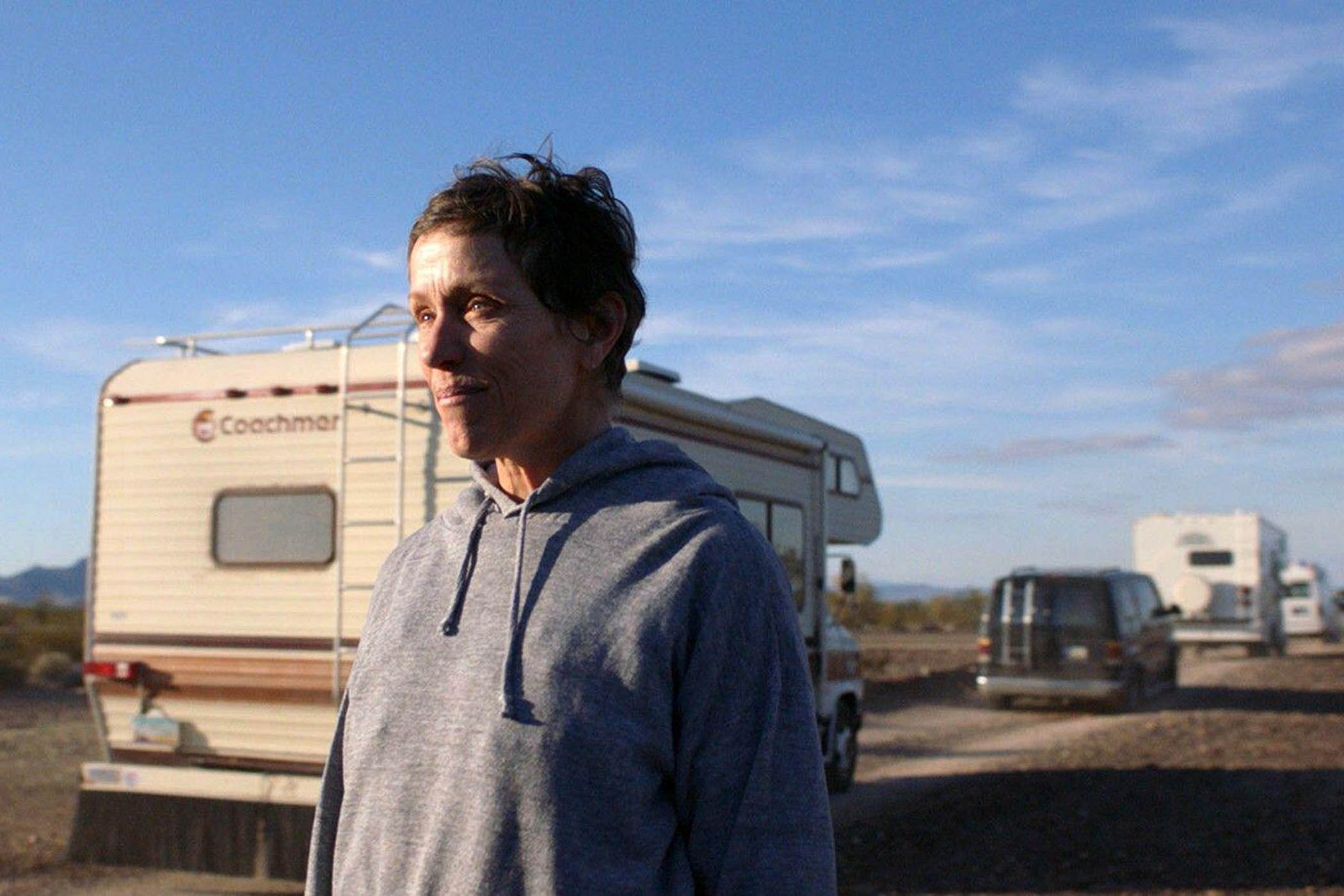
Frances McDormand won the best actress Oscar for her role in Zhao’s Nomadland
Zhao is influenced by Carl Jung’s ideas of ending the “inner civil war” through an awareness and acceptance of one’s unconscious, opposite gender archetype. “That gives me hope, because it’s something I can control,” she says and laughs. She says she loves masculinity: “I love everything about it. I love learning about it, tinkering with it.” What does she make of so-called toxic masculinity? “I feel so much pain, but also deep love, for men whose own feminine sides – femininity, feeling functions, ability to express their emotions, ability to even identify their emotions – are so destroyed: as destroyed as the rainforest being burned, as the wolves being killed, as the ocean being polluted, as the women burned at the stake.
“My attempt to try to understand and love and be loved by men like that is part of my passion for ending this inner civil war. It’s not just about silencing the inner masculine tyrant I have internalised through the dark side of patriarchy. It’s also about trying to empower and deepen and nurture this locked-away feminine side inside men.
“There was a time we shamed wailing women: now we shame repressed, silenced men. More than ever, men need women to see the wounded boy inside them. If we don’t do that, then we are fucked. We have gotta go first … because we are powerful like that. It’s up to us.”
If making Hamnet was as painful as being in labour, Zhao depicts it in detail. The film is anchored by two gruelling scenes: Hamnet’s birth, in which Agnes, frightened for her and her twins’ lives, screams in fear and agony; and his death, when Agnes’s screams return. “She made it feel safe,” Buckley says. How did Zhao manage the emotions of everyone on set, including the then 11-year-old actor playing Hamnet, Jacobi Jupe?
“It was about a month and a half into the shooting,” Zhao says, so “the groundwork was done. Everyone on that day shows up with their own heartbreak in their pocket. So the actors did not feel alone. We held it together as a community … I actually think the young actors are easier. With children, when something happens to them, they shake it off … It’s the adults I worry about.”
Zhao insisted on “dance takes”. Once a week, she would make everyone on set – “cast, crew, parents: it’s required” – dance to a euphoric pop song, on camera. On one of the last days of filming, more than 500 people danced to Rihanna’s We Found Love in their recreated Globe theatre. She’d do this even on the heaviest days of the shoot: “Particularly on those days,” she says. “My job is to help them to discharge all that emotion. If that stuff is bottled up – it’s not good for your health.”
The night before Jupe filmed Hamnet’s death, he told Zhao: “Just so you know, I’m gonna break your heart tomorrow.” That morning, he said: “I’m ready. I’m prepared. And I was wondering if we could do a dance take today?” It wasn’t the assigned day for one, but Zhao agreed. The song Jupe chose was the Bee Gees’ Stayin’ Alive.
“There was a combination: a real sense of high seriousness [and] so much fun,” Watson says. “The set would be very quiet, Max Richter’s music would be playing; it was a little bit like going into church. It was allowed to be quite profound … But when we’d done a scene and we needed to find joy, she would put on music, and we’d dance it all out. It felt like a family party.”
The hardest part of finishing a film, Zhao tells me, is returning to a “normal state”, away from “the ecstatic experience of channelling art”. “It’s about gently, gently bringing your body back down: cooking, organising your sock drawer. Gillingham literally said to me: ‘Chloé, buy five types of beans, dry beans, mix them up. And every day, spend an hour just sorting them.’” She really did this, she insists, every day, to bring herself back to earth.
Now Zhao is working on two new projects: she has just wrapped the pilot episode of the rebooted Buffy the Vampire Slayer. It was a dream for her: she and an old college roommate watched the show every Thursday; she loved it for its depiction of young people finding new communities at school, and she dressed up as Buffy every Halloween.
The second project is a feature film and a simultaneous documentary of the process of making it. (“Then we don’t have to do this again!”)
But she is also focused on the everyday: “If you live a life where daily little rituals like making a cup of tea are as exciting as winning an Oscar, isn’t that a life that’s bulletproof?” As I leave, she hugs me. “I might spend a little time with my two characters tonight,” she says. “I’ll tell them you said ‘hi’.”
Hamnet is in UK cinemas from 9 January.
Photographs by Alamy