

It’s safe to assume that Thomas Pynchon won’t be present at the Oscars on 15 March – although how would we know if he was? The most stubbornly reclusive of all American novelists, he makes the late JD Salinger seem positively gregarious in comparison. Only three images of him circulate – a couple of high-school pictures and a headshot from his naval service. CNN filmed him in the street against his wishes nearly 30 years ago; he insisted through lawyers that the footage was deleted. Very rarely, he’ll pop up out of the blue in print – he wrote to the Daily Telegraph to defend Ian McEwan from plagiarism allegations in 2006 – but you won’t hear him on Front Row; we know what his voice sounds like only from two cameos he agreed to play on The Simpsons in which his cartoon self appeared with a bag over his head.
Still, Pynchon will very much be there in spirit at the Academy Awards. His 1990 novel Vineland, about a knot of Richard Nixon-era subversives gone to ground in Ronald Reagan-era California, is the inspiration for Paul Thomas Anderson’s movie One Battle After Another, nominated for 13 awards, including best film and best adapted screenplay. A breathless action thriller – car chases, gunfights, hostage drama – it centres on a washed-up revolutionary whose mixed-race daughter is pursued by a hard-right military officer, the terrifying comic villain Col Lockjaw, who is obsessed with her mother, Perfidia, with whom he once had a sexual relationship. That main setup comes straight from Pynchon’s novel, although the names are changed, and in the book, Perfidia’s character and her daughter are white. Ian Rankin, who had once planned to do a PhD on Pynchon, before abandoning the idea, posted recently on X that he had managed to watch One Battle After Another without once realising it was based on the novel.
Anderson started working on the idea of a film of Vineland around the millennium year. Given its pot-hazed blur of timelines, and digressive and often surreal structure – several characters are part of an underground community of the undead known as Thanatoids, something One Battle After Another avoids –the book was a daunting proposition to adapt. But what drew Anderson to it, by his own account in interviews, was wondering what a novel about the afterlife of the 1960s, written in the 1980s, would have to say about George W Bush’s America.
Two more decades on, his film has been hailed as a scathing commentary on Donald Trump’s unhinged administration, its paramilitary war on immigration and its strains of white supremacism. But if Anderson had an intuition it would capture this moment, it was the loosest kind of prophecy. When he started working on the adaptation, he had other threads of stories in his mind – a more conventional car-chase thriller, and a character who was a female revolutionary. He nagged at it every couple of years until the story started to cohere; at one point the draft screenplay ran to 600 pages. “I stole the parts [from Vineland] that really resonated with me,” Anderson has recalled. All of his stealing was done, he said, with Pynchon’s express blessing.
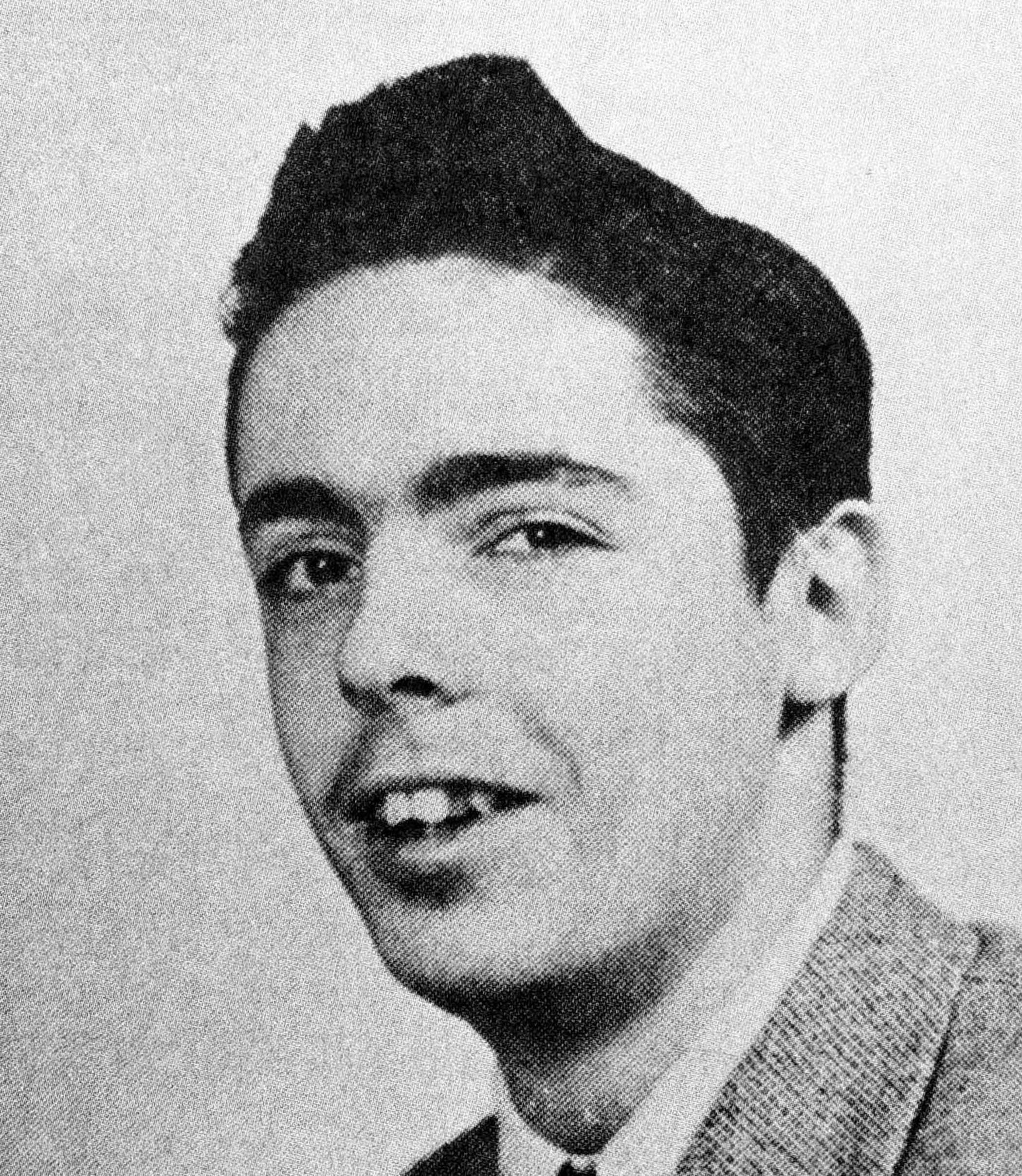
One of only three circulating pictures of Thomas Pynchon, from his 1953 high school yearbook
Lockjaw, Anderson’s version of Pynchon’s character Vond, is played in the film by Sean Penn. (It is typical of the uncanny experience of reading Pynchon – always 20 steps ahead of his nation – that the actor is also actually mentioned in Vineland.) In the book, Vond arouses amused suspicion as “a federal prosecutor carrying the torch for some third-generation lefty who’d likely’ve bombed the Statue of Liberty if she could” – but the relationship is torqued in the film by Anderson, who has said: “I wanted audiences to feel like, this is really a movie about a Black revolutionary.”
Other elements that feel as if they must be lifted from the book are Anderson inventions or riffs on Pynchon’s themes. The white supremacist cabal that Lockjaw aspires to join, the Christmas Adventurers, is one such addition, but it’s very Pynchonesque – tapping into his rich seams of conspiracy that hint at the unseen forces shaping the US. If some of the particulars of the plotting change, the emotional drama comes straight from Vond’s desire to get in with the ruling class at any cost. “Though his defects of character were many,” Pynchon writes, “none was quite as annoying as this naked itch to be a gentleman, kept inflamed by a stubborn denial of what everyone else knew – that no matter how much money he made, how many political offices or course credits from charm school might come his way, no one of those among whom he wished to belong would ever regard him as other than a thug whose services had been hired.”
Ultimately, Anderson has used the ingredients of the novel for a different dish in the film. The scene near the start in which Perfidia holds Lockjaw at gunpoint, demanding his visible erection, reworks a moment in Vineland in which Vond visits the Perfidia character – called Frenesi – in a detention centre: “She looked in his eyes, then at his penis – yep erect all right, creating pleats in the front of the pale federal trousers.”
Before Anderson, most people had previously assumed Pynchon’s novels to be unfilmable. But the director has plenty of previous with the novelist. Pynchon’s son, Jackson, was an intern on Anderson’s 2012 film The Master. The director went on to adapt Pynchon’s 2009 novel Inherent Vice, a detective narrative at the lighter end of the writer’s output, which in 2014 became a black comedy in the manner of The Big Lebowski.
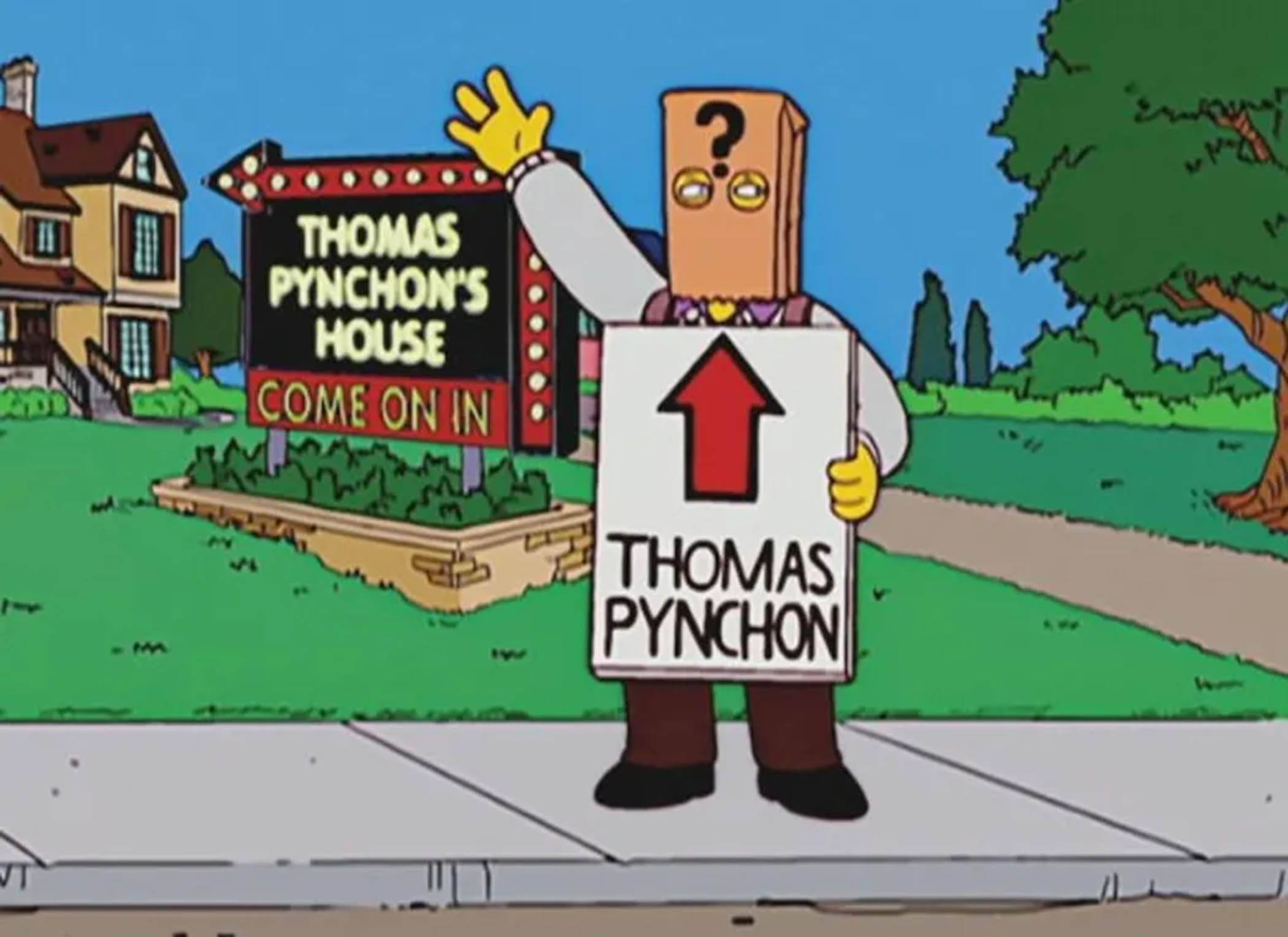
Pynchon’s appearance on The Simpsons
Pynchon himself is best known for his 1973 book, Gravity’s Rainbow. More than 750 pages of run-on sentences toggling between a vast cast of characters spread out over five continents, it set the stylistic template for much that followed. The book centred on a sex-mad US soldier’s quest for a mysterious German rocket during the blitz. Surreal interludes included a custard-pie fight and an octopus attack. When the plotting cut you adrift – as it often did – the verbal invention spurred you on. Pynchon’s writing has always grappled with the horrific violence of history – particularly American history – but has also frequently been liable to break into song.
Many of his contemporaries were not sold on Pynchon’s wayward vision. John Updike, for example, admired his sentences but once observed: “Give me the [Henry] Jamesian summer afternoon tea and a few almost impalpable love triangles and that’s all the information about life I can stand.”
To a later generation, however, Pynchon often represented the acme of literary ambition. The British novelist Philip Hensher was so enthused by his Mason & Dixon (1997) that he vowed to physically eat any American novel that “came near this marvellous, proliferating thing this decade”. The quirky acronyms, dizzying lists and labyrinthine plots left an imprint on the fiction of generation X, most notably David Foster Wallace’s Infinite Jest. Zadie Smith’s White Teeth was hailed as the authentic voice of north London but its presiding influence came from across the Atlantic, as a multigenerational comedy of empire, war and genetic engineering, written – Smith has said – with a passage from Gravity’s Rainbow pinned on her door. The role White Teeth gives to a fundamentalist youth group, “Keepers of the Eternal and Victorious Islamic Nation”, or Kevin, is a touch of pure Pynchonesque tomfoolery.
Pynchon’s most recent novel, Shadow Ticket, which is set partly in the “Semi-Military Entity Greater Milwaukee Area”, or Smegma, shows he hasn’t grown out of those touches, which have an air of laughter in the dark. Shadow Ticket is a novel partly about the rise of US fascism, a spectre that looms continually in his work.
The novels have gone in and out of fashion. The New Yorker literary critic James Wood chided Zadie Smith for maximalist excess influenced in part by Pynchon, calling it “hysterical realism”; by Smith’s third novel, she was looking to EM Forster as a model instead.
Newsletters
Choose the newsletters you want to receive
View more
For information about how The Observer protects your data, read our Privacy Policy
Wood argued that maximalist writers knew “a thousand different things – how to make the best Indonesian fish curry! The sonics of the trombone! The drug market of Detroit! The history of strip cartoons! — but [not] a single human being.” And a single human being is what much recent fiction has come to be about. For a couple of decades, fiction has tended to have an autobiographical grounding and a premium on velocity over complexity; publishers want novels you can read without a dictionary to hand. The encyclopedic girth of Pynchon and his followers was seen as a kind of literary manspreading; in some circles, Wallace’s Infinite Jest became a joke.
But it could well be that we’re in a maximalist moment again. One Battle After Another heralds something of a revival for those digressive fictional high jinks. The recent 30th anniversary of Infinite Jest was greeted with a mea culpa by some critics. The year’s most hyped American debut, Lost Lambs by Madeline Cash, shows that gen Z is rediscovering the antic style anew. And the master himself is still going. Pynchon turns 89 in May; Shadow Ticket, published last year, features a strikebreaker turned gumshoe using telekinesis to track a runaway heiress to a cheese fortune (it’s always a fool’s errand to summarise a Pynchon plot). The verbal pizazz is undimmed: witness the line about “a former city cop obliged to retire early after his enthusiasm with the dizzy-stick finally dishevelled a hairdo too well-connected to be squared that easily”.
It can seem, too, that we have once again entered a recognisably Pynchonesque world; a place in which, for example, in Vineland, federal police forces might be “terrorising the neighbourhood for weeks, running up and down the dirt lanes in formation chanting ‘War-on-drugs! War-on-drugs!’ strip-searching folks in public, killing dogs, rabbits, cats, and chickens, pouring herbicide down wells that couldn’t remotely be used to irrigate dope crops, and acting, indeed, as several neighbours observed, as if they had invaded some helpless land far away, instead of a short plane ride from San Francisco”.
When reality is too terrible to contemplate, readers may once again turn to Pynchon for a surreal mirror to make sense of it all. A – possibly – Oscar-winning movie is a good place to start.
Key facts
Thomas Pynchon was born on Long Island, New York, in 1937. He will be 89 in May.
His 10 novels include The Crying of Lot 49 (1966), Vineland (1990) and Shadow Ticket (2025).
He worked as a technical writer for the Boeing missile programme between 1960 and 1962.
Famously publicity-shy, in 1973 he sent a comedian, “Professor” Irwin Corey, to accept his national book award for Gravity’s Rainbow.
He had a cameo appearance on The Simpsons in 2004, appearing with a paper bag over is head, shouting at passing motorists: “Hey, over here, have a picture taken with a reclusive author!”
Photographs by 2026GG/Penske Media/Getty Images, Wikipedia/Oyster Bay High School, The Simpsons