

I thought that my biggest psychological battle as a classicist would be my 2015 exam schedule, which entailed 33 hours of exams in 10 days. It turns out it is keeping my cool at the array of nonsense being peddled about film director Christopher Nolan’s new adaptation of The Odyssey.
To get the easiest stuff out of the way first. Homer describing Helen of Troy as “white-armed” does not mean that she was white, in the same way that describing Odysseus as “black-skinned” does not mean that he was Black. The ancient bard used colours metaphorically (hence the “wine-dark sea”), not to conform to the racial categories that we use today. So it doesn’t betray the source text to cast Lupita Nyong’o as Helen nor Matt Damon as Odysseus. Not that this has any reason to be a point of focus, given that Helen was also hatched from an egg.
This discourse is frustrating because it tends to be perpetuated by people who cannot translate a sentence of ancient Greek, but also because it distracts from more interesting issues. There are several reasons why The Odyssey may turn out to be a flop at the box office – and none are to do with the racial make up of the cast, as has dominated social media.
The Aeneid, The Odyssey and The Iliad are foundational texts of western literature. And yet, like the Bible and the Epic of Gilgamesh, they have largely resisted adaptation. They have, of course, been fodder for film-makers. Watership Down (1978) is The Aeneid with rabbits, O Brother, Where Out Thou? (2000) is a take on The Odyssey, and Troy (2004) is a godless version of The Iliad. But direct retellings are scarce.
That’s largely because The Odyssey contains a daunting number of challenges. The first emerges in the poem’s opening lines: “Tell me, Muse, of the man of twists and turns, who wandered far and wide after he sacked the holy citadel of Troy.” The Odyssey, which covers the title character’s journey home to the island of Ithaca, is gargantuan in scale. It covers 10 years and sweeps across the Mediterranean. There are discrete battles with six major monsters, even if you exclude the Lotus-Eaters, Calypso, the cattle of Helios and the 108 suitors trying to charm Odysseus’s wife in his absence. Even at 2h 52m, Nolan’s film may feel like it is in a rush.
The second relates to language and structure. The Odyssey is written in dactylic hexameter, a musical rhythm associated with epic poetry, which poses a dilemma for Nolan. He will have to decide whether to stick close to the original text at the risk of am-dram, or modernise and risk janky anachronism. It is believed that Nolan, famous for his non-linear storytelling in Memento (2000), Inception (2010) and Tenet (2020), has relied on Emily Wilson’s translation, but her excellent rendering is not a panacea. Odysseus is talkative enough for a protagonist, but Homer is a lover of extended similes, more than 100 of which are used in The Odyssey. If overlooked, the emotional texture of the original could be lost. If they are included, it will be hard to maintain the momentum necessary to sustain a film of nearly three hours. The fact that The Odyssey is made up of building blocks, with repeated stock scenes, parallel plotlines and a protagonist who does not appear until nearly a quarter of the way through, causes more problems.
A third is what to do with the gods. They were excised from The Return (2024), a Ralph Fiennes version which begins when Odysseus washes back up in Ithaca, but are essential to the complete story. Athena is the deus ex machina character who tries to protect Odysseus, while Poseidon is determined to thwart him. Divine beings can be tricky to depict in a serious movie without creating unintentional comedy, especially when Nolan generally eschews CGI, but it is a mistake to think that the story would make sense if the gods are reduced to symbols of nature. There is nothing symbolic about the nymph Calypso, daughter of Atlas, offering Odysseus an immortal life.
The fourth, and arguably biggest challenge? Odysseus. Nolan’s hero is a flawed character, defined largely by his wiliness and deception, which becomes problematic when he narrates his own adventures to persuade the Phaeacians to help him. He is also merciless. After he returns to Ithaca, he does not discriminate between any of his wife’s suitors during his rampage, nor does he spare the 12 enslaved women who have been sleeping with them. A Hollywood movie culminating in mass slaughter may test viewer’s sympathies for the protagonist.
These obstacles speak to the reality that The Odyssey, for all of its contemporary resonances, is nearly 3,000 years old. Homer’s story is complex, introspective and, because of the online right’s interest in the ancient world, now heavily contested too. Nolan has an almighty task on his hands to balance faithfulness to the original with pleasing a modern audience, some of whom have shown a distinct lack of acuity when it comes to the source material. But like Odysseus, the director has chosen struggle over comfort, so in that sense he willingly faces his own Scylla and Charybdis. Veer too far either way and he will be dashed against the rocks.
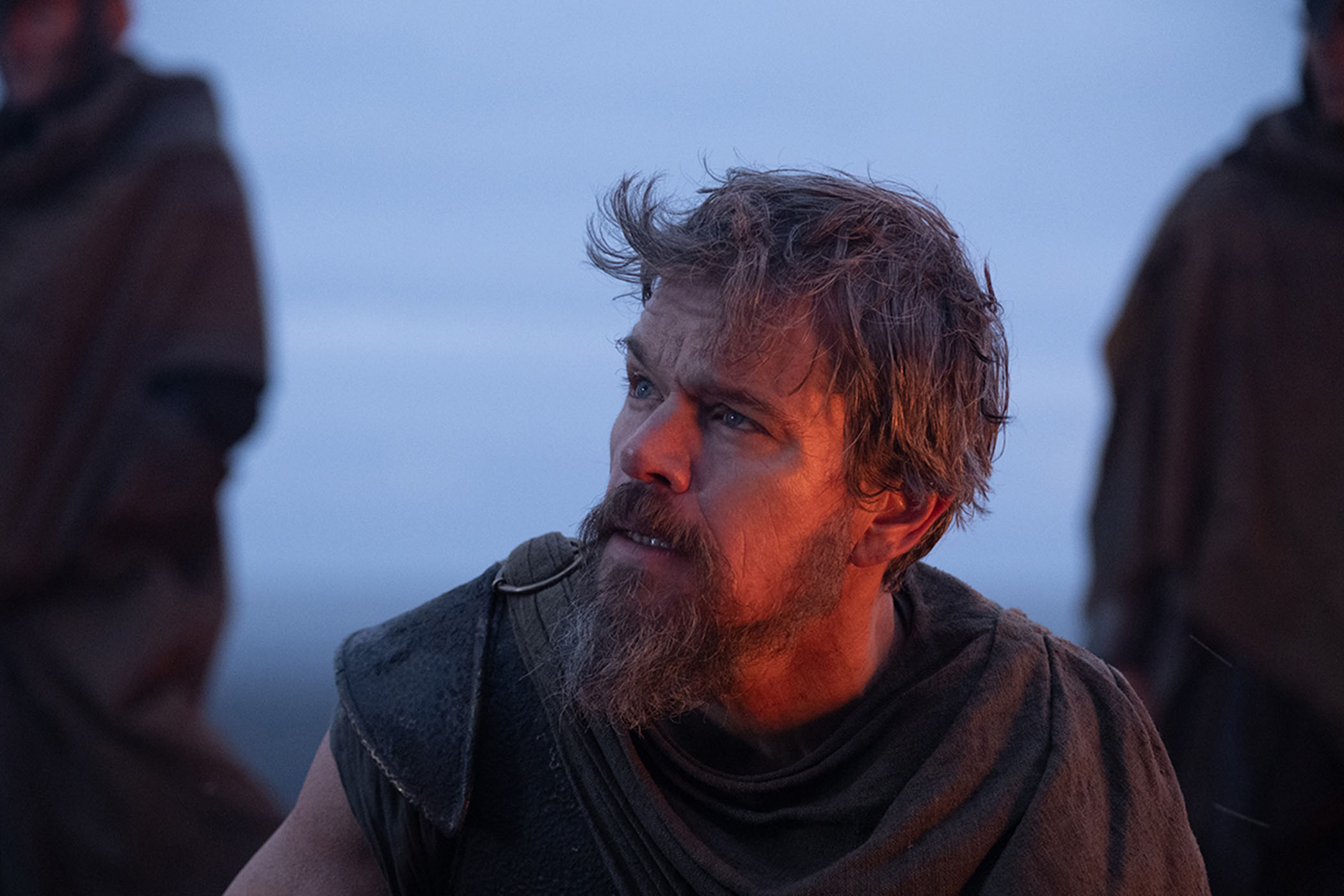
Photograph by Universal Pictures
Newsletters
Choose the newsletters you want to receive
View more
For information about how The Observer protects your data, read our Privacy Policy