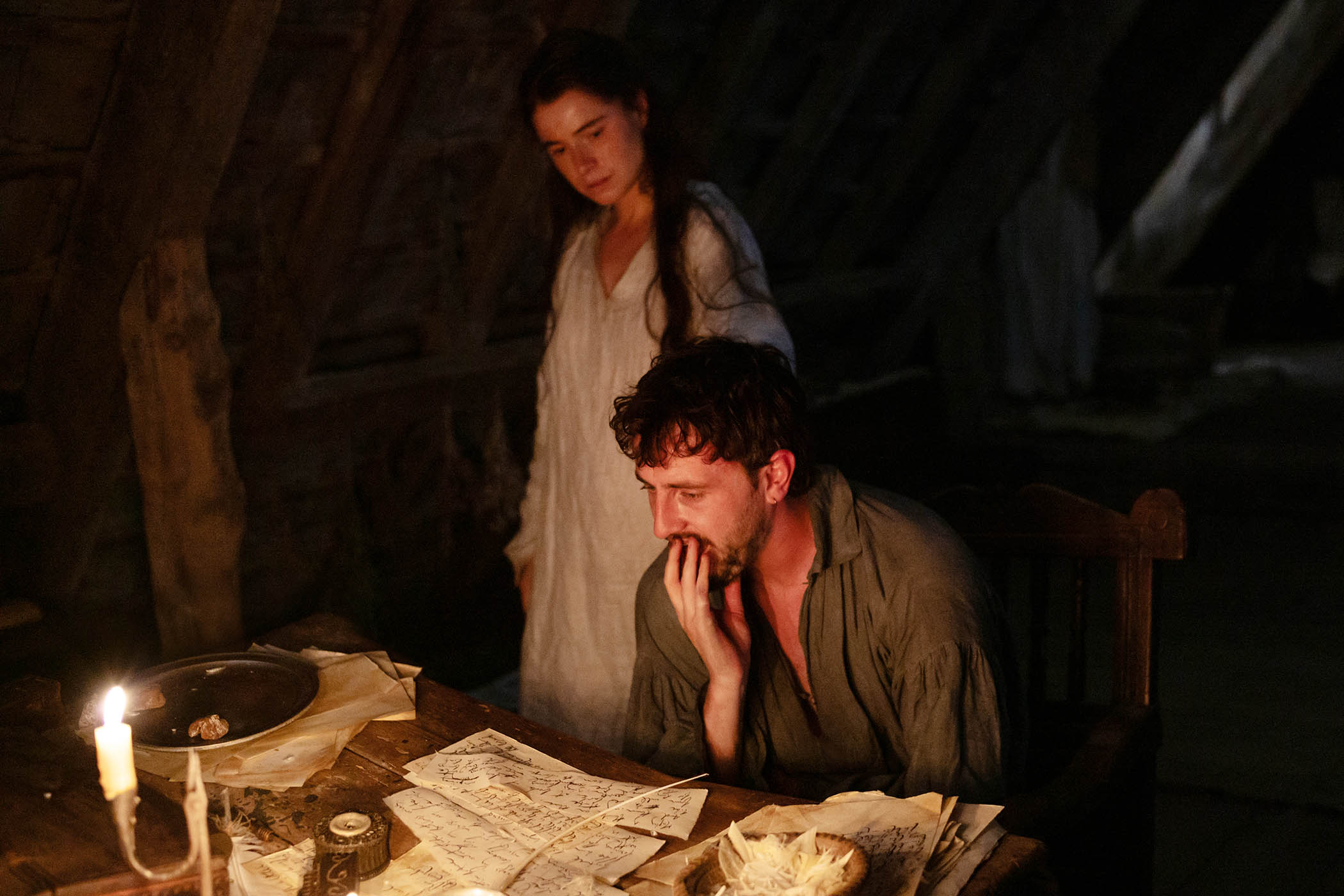

For a story about the marriage and family life of William Shakespeare, it’s striking how little of Hamnet’s considerable power is drawn from the written word. Co-adapted from the award-winning novel by its author Maggie O’Farrell and the Oscar-winning director, Chloé Zhao, the film foregrounds the bride rather than the Bard. It’s a story of fierce, feral loves and anguished loss, channelled through Shakespeare’s wife Agnes (Jessie Buckley), a woman with the gift to tap into instinctive, ancient knowledge. She is a seer who can read the life force of those whose hands she grasps; a healer whose cures are foraged from paganism.
Her primal magnetism is such that even a wordsmith such as Shakespeare (Paul Mescal) is rendered clumsy and inarticulate in her presence. The film’s potency is derived as much from the physicality of the performances – Mescal’s restless, questing agitation, Buckley’s open book of a face – as it is from the dialogue.
O’Farrell’s novel fictionalised the domestic details of the Shakespeare household, fleshing out the character of Agnes (more commonly known as Anne Hathaway and about whom there is very little on historical record) and suggesting a link between the death of the couple’s son Hamnet (heartbreakingly played by the cherubic Jacobi Jupe), and the writing of Shakespeare’s tragedy Hamlet.
Some of the book’s scope, richness and complexity is lost in the journey to the screen, but we do get a series of glimpses of home life that sets us up for the picture’s devastating climax. The film strips the novel down to explore a simple, sparse story: of an initial passion and a union tested, first by geographical distance and the obligations of Shakespeare’s burgeoning career, then by the devastating grief and guilt over the loss of a child.
Will is beguiled by her: she has the look of a tree sprite, with twigs in her hair, a hawk on her arm and dirt under her fingernails
Will is beguiled by her: she has the look of a tree sprite, with twigs in her hair, a hawk on her arm and dirt under her fingernails
The setting might be the bubonic plague-blighted Warwickshire and London of Elizabethan England, but the tensions and agonies that Agnes and Will must negotiate are unexpectedly timeless. The story’s main focus is on the family in Stratford-upon-Avon rather than the drama of Shakespeare’s London-based career, a decision that hinges on the fascination we feel for Agnes. For the film to succeed, we must fall for her as quickly and as helplessly as Shakespeare does. It’s quite a weight for an actor to carry, but Buckley, channelling witchy allure and folk wisdom, is up to the task.
Our first glimpse of the character gives a sense of the wild otherness that makes her a figure of suspicion in her local community. She’s asleep, cradled by the roots of a tree, curled up in a foetal position in the womb of the woodland. She is, according to gossip, the child of a forest witch. Will is beguiled by her: she has the look of a tree sprite, with twigs in her hair, a hawk on her arm and dirt under her fingernails. And she sees something in him that, as yet, nobody else does: Agnes’s steady, penetrating gaze reads his every last secret and story. Always a thrillingly open and uninhibited screen presence, Buckley is tremendous here. Each caressing shot of her face invites us into an interior landscape.
Zhao’s most successful films – The Rider, about a rodeo cowboy, and her Best Picture-winning Nomadland, following itinerant gig economy workers in the US – have an earthy, grounded quality. The same is true of Hamnet, which rejects the period-picture prettiness of something such as Shakespeare in Love in favour of production design that feels ripe and weathered. Clothes, and the people wearing them, are authentically grubby; Agnes is literally shovelling shit when Will asks for her hand.
Not everything works. The immense literary legacy of the husband and father at the heart of the story for the most part exists outside the frame, but attempts to incorporate Shakespeare’s words unbalance the picture at times. The screenplay adopts a greatest hits approach to its selection of Shakespearean quotes. A sequence in which three children perform an ad hoc version of the witches exchange from Macbeth has an appealing, unpolished charm. But a later scene, which appropriates Hamlet’s “To be or not to be” soliloquy for a grief-stricken Will as he contemplates chucking himself into the Thames, feels rather crude.
But there’s no denying the impact of the film’s climactic resolution, which unfolds at the Globe theatre during a performance of Hamlet that we view through the mirror of Buckley’s mobile and endlessly expressive face. She rediscovers her kinship with her husband as she watches the play he wrote in their son’s name.
It’s a shattering ending, and a testament to the power of art to mend, move and unite.
Newsletters
Choose the newsletters you want to receive
View more
For information about how The Observer protects your data, read our Privacy Policy
Photograph by Agata Grzybowska