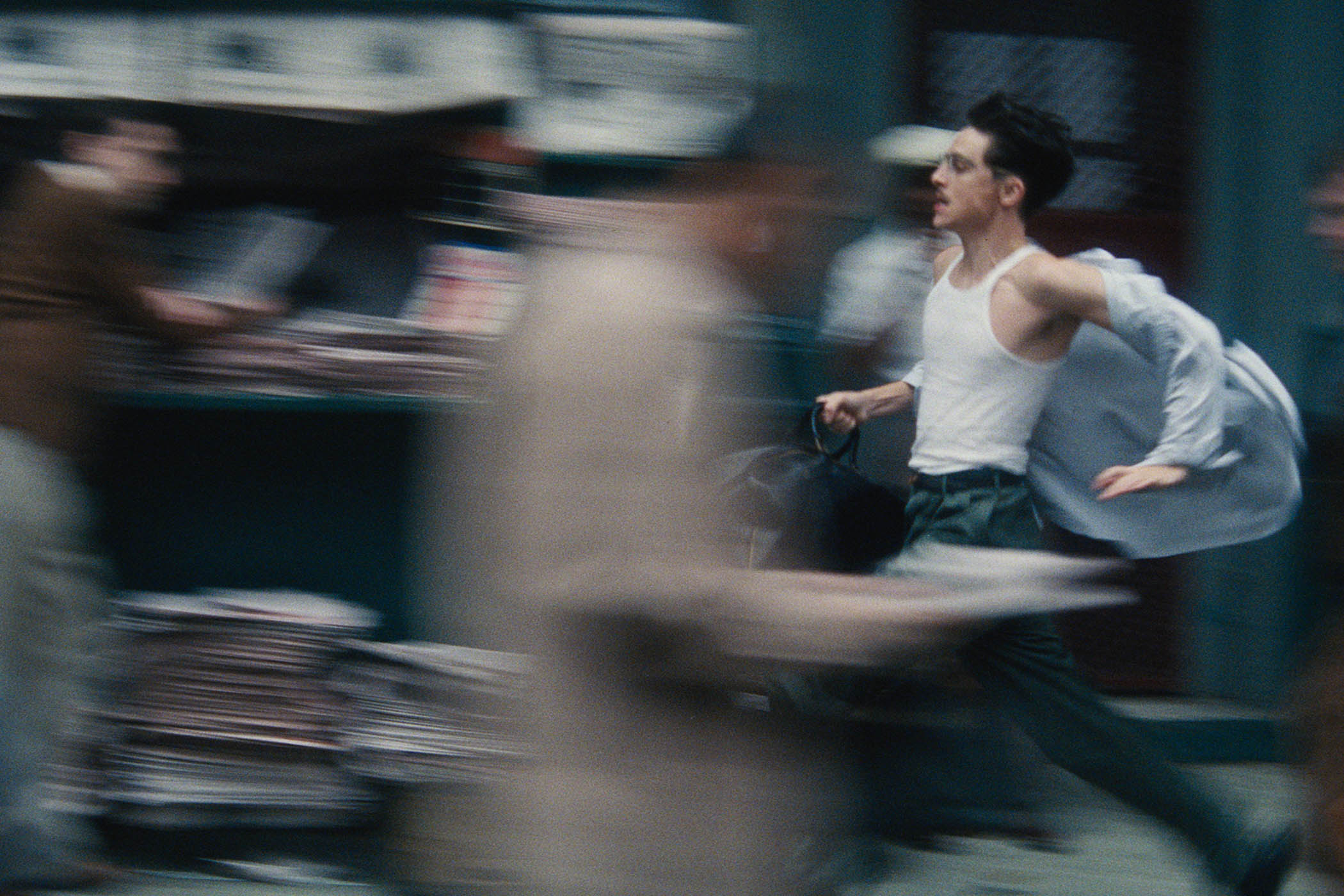


Part sportsman, part showman: Marty Mauser (Timothée Chalamet) is on a mission. It’s 1952. The game of table tennis, already a craze in Asia and Europe, is poised to take off in the US. Marty, a ping-pong prodigy and self-promotion genius (at least as he sees it), is perfectly placed to be the face of the sport in America. He certainly puts the work in. From the moment he steps up to the table, he makes every second of the game exciting, every shot a brash, showboating performance.
And director Josh Safdie takes exactly the same approach. Marty Supreme is a thrilling visual onslaught, a rattling cacophony of ideas and images so intense that for two and a half hours you barely have time to catch your breath. It’s utterly exhausting and I loved every jangling second.
Chalamet drives the picture with a fizzing, hyperactive performance that’s in constant motion. Even in moments of comparative stillness, the lens in his face as Marty calculates his next move, Chalamet’s expression flickers; his lip, with its light dusting of a post-adolescent moustache, twitches into a quizzical sneer.
Marty is the kind of character who can slip effortlessly out of all obligations – to his manipulative mother (Fran Drescher); to his married fling Rachel (Odessa A’zion); to his best friend and fellow ping-pong grifter Wally (Tyler Okonma, AKA Tyler, the Creator); to his sad-sack business partner Dion (Luke Manley); and to the fading Hollywood actor he has charmed into bed (Gwyneth Paltrow)
But you can only outrun your debts and responsibilities for so long, even when you move as quickly as Marty does. The accumulated weight of bad decisions has to come crashing down at some point.
Marty Supreme is Safdie’s first period piece and his first solo directing project, after his long-term collaboration with his brother, Benny (whose own solo directing debut, the Dwayne Johnson-starring wrestling biopic The Smashing Machine, was released two months ago). But Josh Safdie has retained other key collaborators, notably Ronald Bronstein, producer, co-writer and co-editor on this project, who also co-wrote all of the Safdie brothers’ projects from Daddy Longlegs (2009) onwards.
Half the supporting cast look as if they were just hauled out of a gutter brawl
Half the supporting cast look as if they were just hauled out of a gutter brawl
Safdie also reunites with cinematographer Darius Khondji, who shot the brothers’ nerve-shredding thriller Uncut Gems. Khondji’s electric, kinetic camerawork is one of Marty Supreme’s main assets; there’s an atmospheric grubbiness to the photography, as though the lens were perpetually covered, like the character himself, with a thin layer of sweat and grime. There’s an unpolished authenticity, too, in the casting. While most Hollywood films are filled with a narrow range of innocuous prettiness, the faces that populate Marty Supreme are fascinating and flawed. Half the supporting cast look as if they were just hauled out of a gutter brawl.
Of all Safdie’s previous pictures, Uncut Gems is the one with which Marty Supreme has the most in common. Both have New York in their DNA; both follow sharp-witted, smart-mouthed hustlers with a terrible tendency towards self-sabotage. Both rattle along in an assault of noise and image. They even share title sequences with granular-level detours. In Uncut Gems we travel deep into the molecular structure of an opal; in Marty Supreme we get intimate with the fertilisation process of a human ovum. But this latest film, with its tangential structure, period setting and globetrotting storyline, is his most ambitious to date.
It’s also his boldest, in terms of direction and structure. Marty might be driven and single-minded, but the storytelling is intriguingly digressive. In one gloriously unexpected segue, the film loops back to the 1940s as Marty’s friend and ping-pong rival Béla Kletzki (Géza Röhrig) tells an anecdote about his time in Auschwitz. In another, a freak accident involving a dog, a bath and a shady character (Abel Ferrara) sets a chain of events in motion. The use of music is equally unexpected: chafing against the expectations of the 50s setting, the soundtrack mixes period blues with 80s pop needle-drops (two bookending tracks by Tears for Fears are particularly notable). Elsewhere, the original score, by Daniel Lopatin, is assertive, punchy and overbearing. Like so much in the film it shouldn’t work. But it does.
Photograph by A24
Newsletters
Choose the newsletters you want to receive
View more
For information about how The Observer protects your data, read our Privacy Policy