
You wonder what the late Jean-Luc Godard would have made of Richard Linklater’s Nouvelle Vague. Deeply researched, with a level of attention to detail that borders on obsessive, Linklater’s picture restages the unconventional filming of Godard’s groundbreaking feature debut Breathless (À Bout de Souffle), a breezily stylish crime drama about a petty thief turned cop killer (Jean-Paul Belmondo) pursuing an American girl (Jean Seberg) in Paris.
Linklater’s movie captures something of the maverick spirit and ineffable coolness of Godard’s debut: it’s filmed in a black and white that’s as crisp as the French auteur’s shirt collars, accompanied by a loose-limbed jazz soundtrack and infused with the peppy, youthful audacity that made Breathless a shot of punk energy into the cinematic landscape. Nouvelle Vague is more than just an in-joke for cineastes – it’s an invitation to make something alive and radical that pisses off the right people.
But in other ways, the feature is the antithesis of everything Godard stood for. It gives us a sense of the outlaw unpredictability of his film set, but here the atmosphere of creative abandon is carefully manufactured. This degree of immaculate, achingly chic period detail couldn’t have been achieved without a sizable budget, an extensive, well-trained crew and plenty of CGI.
Breathless, meanwhile, was an agile, shoestring operation, shot with a skeleton crew, no formal screenplay and scant attention to the rules of cinema: Godard might well have disdained Linklater’s conventional film-making methods and bourgeois insistence on linear storytelling. And yet a man as fond as Godard was of proclaiming his own genius might have viewed this love letter as his due. Of course, the truly Godardian approach would be to not give two hoots about what anyone else thought – even Godard himself.
The film is an invitation to make something alive and radical that pisses off the right people
The film is an invitation to make something alive and radical that pisses off the right people
There’s much to admire in Linklater’s ridiculously good-looking picture, which – after Blue Moon, his portrait of the lyricist Lorenz Hart – is his second in 12 months to deal with the artistic struggles of a historical figure. The casting is stellar: the picture is populated by a sprawling roster of French New Wave luminaries, each character introduced with fourth-wall-smashing eye contact with the camera and their name on screen. Even the briefest cameo performer looks uncannily similar to their real-life counterpart.
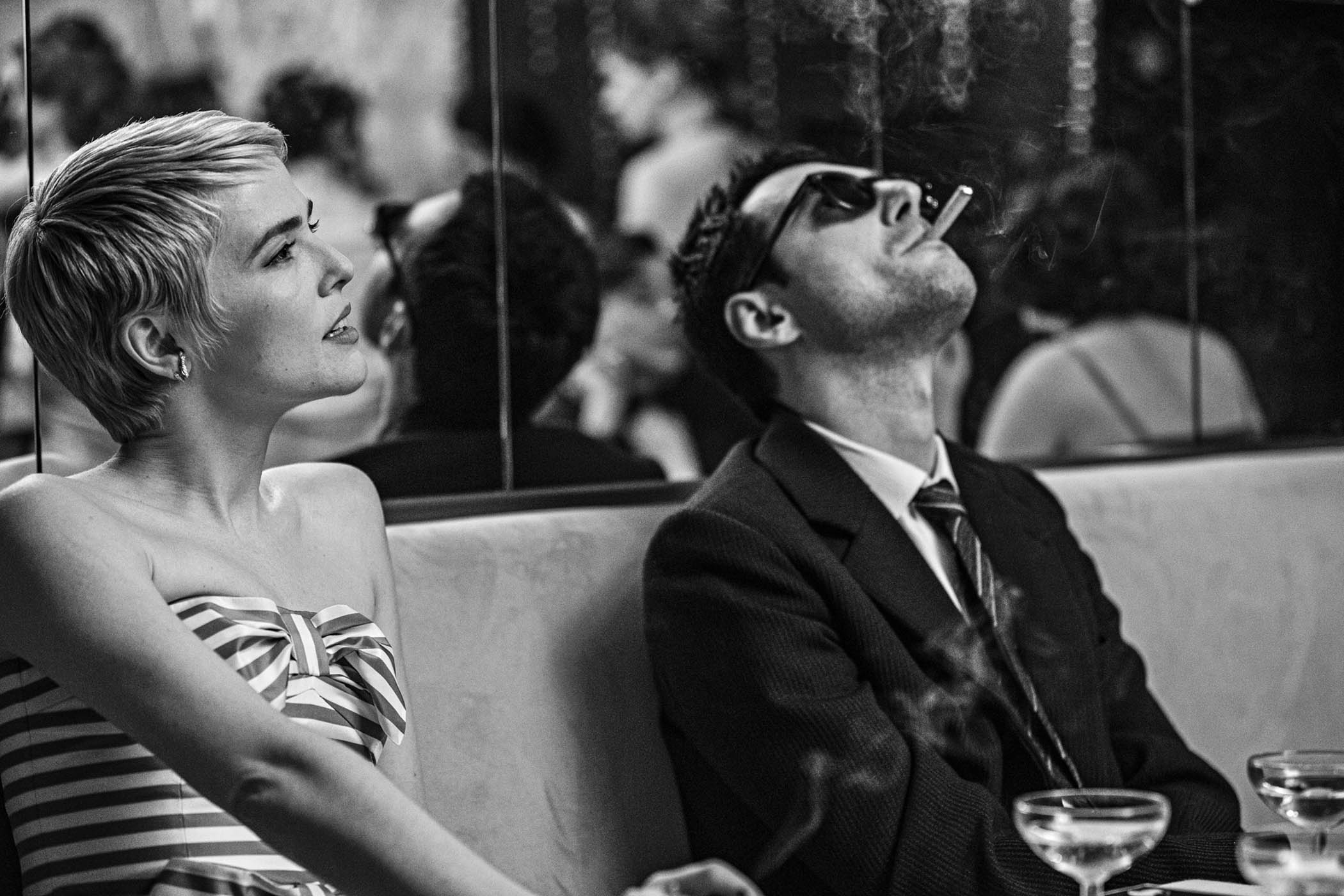
Newcomer Guillaume Marbeck is a dead ringer for the abrasively charming young Godard. Inscrutable behind his sunglasses, moodily shrouded in Gauloises smoke, he seems at times more affectation than man. A critic at the influential film magazine Cahiers du Cinéma, alongside the directors François Truffaut (Adrien Rouyard) and Claude Chabrol (Antoine Besson), among others, he is the last of his Cahiers contemporaries to make a film – a fact that clearly rankles him.
Armed with a seemingly inexhaustible supply of gnomic proclamations about cinema, he evidently believes he should be at the very crest of the New Wave, rather than surfing behind it. Even so, he’s not about to compromise his vision to get his foot on the ladder, to the mounting frustration – not to mention blood pressure – of his producer Georges de Beauregard (Bruno Dreyfürst).
Playing the gamine American actor Seberg, Zoey Deutch is close to perfect. The pixie cropped hair, her spoken French, with its prairie-flat midwestern vowels, her delicious repertoire of exasperated eye-rolls at Godard’s latest epigram: this is a terrific portrait of a woman increasingly sceptical of her director’s self-created mythology. And, more to the point, of his ability to direct.
Not without reason. Godard thinks continuity is for the weak, has no idea how his film will end and regularly packs up for the day after just a couple of hours of shooting. For Seberg, accustomed to working with controlling, autocratic tyrants such as Otto Preminger, Godard’s casual anarchy is both thrilling and alarming. In darker moments, she fears that Breathless will end her career.
Films about cinema are more likely to delve into the notorious failures – Tim Burton’s Ed Wood for example, or The Disaster Artist, about Tommy Wiseau’s notoriously terrible picture The Room – than the path to greatness. And while this movie’s audience will undoubtedly be well versed in the cinematic significance of Breathless, what strikes you watching Nouvelle Vague is how easily Godard’s picture could have turned out differently. What if just one of his gambles hadn’t paid off? He could have ended up with no film. Or worse still, a dull one.
Newsletters
Choose the newsletters you want to receive
View more
For information about how The Observer protects your data, read our Privacy Policy
Photograph by Jean-Louis Fernandez