
In their own way, Take That are as fascinating a British working-class success story as Oasis. That becomes evident as you watch the new three-part Netflix docuseries, Take That, about the northern boyband. It’s all here. The creation: the group – Gary Barlow, Robbie Williams, Mark Owen, Jason Orange and Howard Donald – were put together by manager Nigel Martin-Smith as a vehicle for singer-songwriter Barlow. The early scrabble for success: Barlow continuing his solo gigs at the local Royal British Legion, crooning The Phantom of the Opera, then gyrating his oiled, Lycra-clad body with Take That.
The glory: more than 45m records, sell-out arena tours and hits such as Back for Good and Pray (“We were all working-class lads given the golden ticket,” says Williams). The disasters: leaving the group in the mid-1990s, the hugely successful Williams trash-talked his erstwhile bandmates – particularly Barlow – with vicious glee. After Take That split in 1996, Barlow spent years in the pop wilderness, developing bulimia, piling on weight (“I killed the pop star”).
Then the triumphant comeback(s) as a four-piece, a five-piece (Williams rejoining for a bit) and the current three-piece (Orange retired in 2014). Well, you know the story. This is a problem for the series: anybody, myself included, with a soft spot for the greatest-ever UK boyband could recite the Take That narrative in their sleep.
And where the feck are they? The docuseries is made by David Soutar, who co-directed 2018’s hilarious Bros: After the Screaming Stops (considered the This Is Spinal Tap of pop documentaries). Here, however, it’s notable that Take That don’t appear as talking heads on screen. It’s wall-to-wall footage, spliced together with new audio interviews from Barlow, Donald and Owen, and with Williams and Orange heard in older clips.
Is this enough? With the heritage music industry in full swing, there’s been a plethora of 1990s/2000s documentaries, from band profiles (Take That: For the Record, Boyzone: No Matter What) to overviews (Boybands Forever). We’ve also seen the rise of the big, celebrity-documentary, PR-approved “confessionals” with personal flourishes, including Williams lounging in his undies for Robbie Williams (2023). He was also portrayed as a CGI monkey in the Hollywood biopic Better Man (2024).
By contrast, Take That feels like a cobbled-together home movie. It boasts rare early footage and it is unafraid to face boyband demons: egos (Barlow admits to feeling superior to the others, initially hogging the songwriting and royalties), mental health (after the split, Donald considered jumping into the Thames) and guilt (“I never ever considered that the most insecure and emotional person in the band was Robbie,” reflects Barlow).
There’s an element of rushed homework to the docuseries, but the footage-first approach whizzes along with none of the usual drag of watching celebrities navel-gazing on neutral hued sofas in flattering diffused lighting. If Take That has undermined the increasingly wearying “my big glossy doc” template, it’s done us all a favour.
Staying with Netflix, Shonda Rhimes’s Bridgerton, based on the Julia Quinn novels, returns for its fourth series with a four-episode drop (the rest are due later this month). The show is famed for modernising period drama; casting non-white actors, orchestrally reworking songs by Taylor Swift, Billie Eilish et al and serving up aristo smut (heavy breathing in stairwells, and the like).
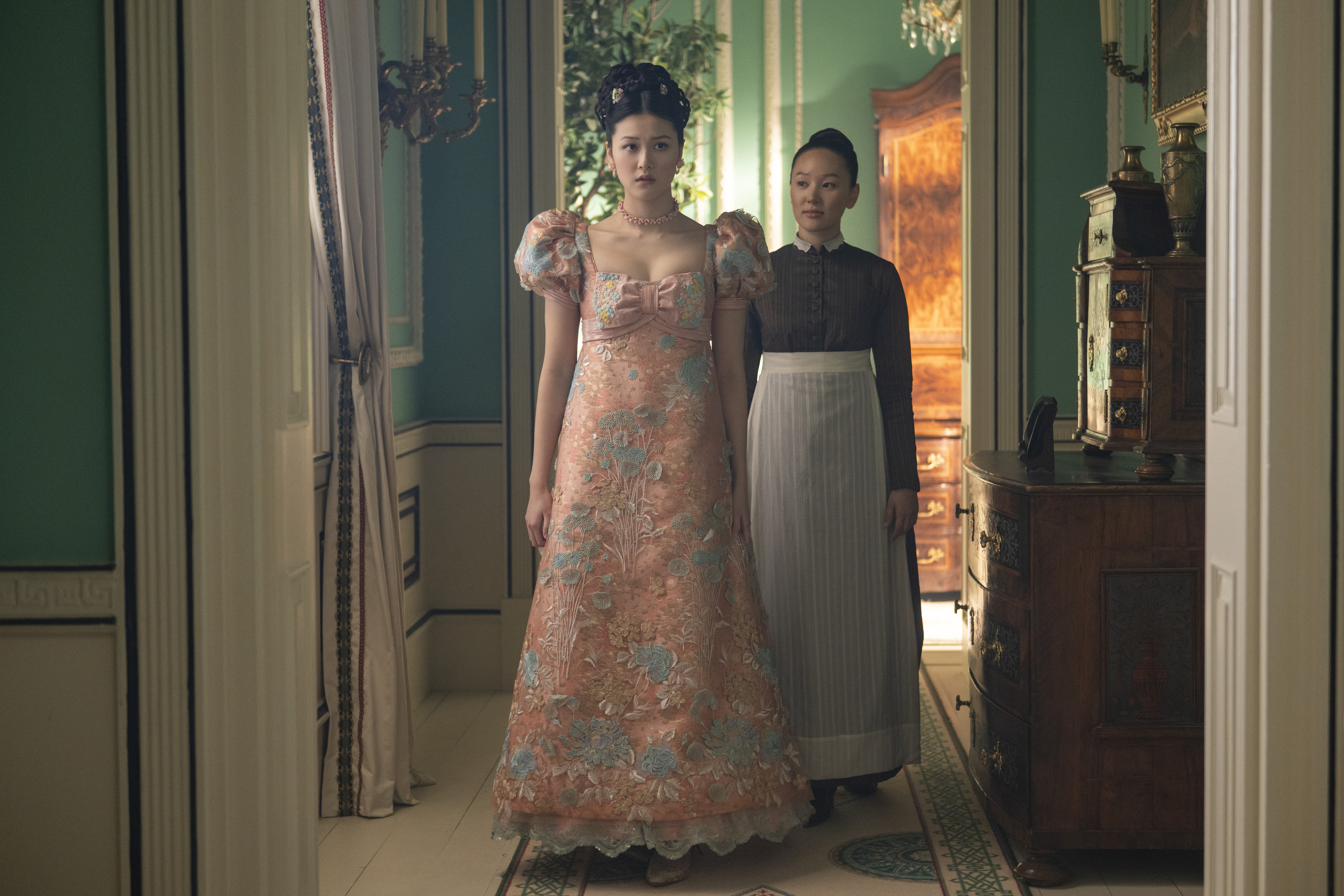
Isabella Wei and Yerin Ha in Bridgerton. Main image: Mark Owen in footage from the Take That docuseries
This series, there is the usual froth: balls, mansions, eligible gentlemen. Nicola Coughlan’s Penelope is now blissfully wed and delivering her Lady Whistledown gossip (narrated by Julie Andrews) directly to Queen Charlotte (Golda Rosheuvel).
The main plot revolves around bad boy Benedict Bridgerton (“the rake, the free spirit”, played by Luke Thompson), selecting a wife. At a masked ball, he falls for Sophie (Australian-Korean actor Yerin Ha), not realising she’s a maid. Has social realism improbably descended upon the show? (There’s also some Upstairs, Downstairs guff about a maid shortage). Maybe not, as Sophie has been forced to be a maid by a wicked stepmother with two daughters. Sophie has to leave the ball at midnight, and Benedict searches for her in the kingdom ... I mean, the ton … Are you getting the picture?
Newsletters
Choose the newsletters you want to receive
View more
For information about how The Observer protects your data, read our Privacy Policy
There are times when you feel you’re watching provincial panto, even if Thompson and Ha have great, spiky chemistry. Elsewhere, the show continues on its quest to unbutton the corsets of modern period drama. Widowed Lady Bridgerton (Ruth Gemmell) wishes to take a lover, while Francesca (Hannah Dodd) yearns to “achieve her pinnacle” with her husband John (Victor Alli). She seeks advice from Penelope, who’s still flushed from achieving her own pinnacle in a boisterous carriage scene. Bridgerton might have its flaws, but few could fault its dedication to the exploration of the Regency-era female orgasm.
At first, Claire Oakley’s Under Salt Marsh on Sky Atlantic, set in the fictional Welsh rural town of Morfa Halen, appears to be a standard-issue crime thriller. Jackie Ellis (Kelly Reilly) is a detective turned primary school teacher. She’s already navigating a complicated life – haunted by a missing young niece, embroiled in a love affair with a local man (Harry Lawtey from Industry) – when one of her pupils is found drowned in a drainage ditch. Rafe Spall plays Eric Bull, a detective sent to investigate (he has history with Ellis), while Jonathan Pryce shows up as a farm-owning patriarch. As other themes emerge (eco-crime, hidden sexuality) , a wild storm approaches, threatening the town.
Under Salt Marsh is elevated by a powerful cast, which also includes Mark Stanley, Naomi Yang and Kimberley Nixon, and gritty interactions. It’s also beautifully – cinematically – shot, capturing the drama, splendour and melancholy of the marshlands. Some moments – such as sequentially showing suspects looking, well, suspicious à la Nordic noir classic The Killing – feel a little dated, but this is shaping up to be a gripping study of small-town darkness.
Photographs by Netflix