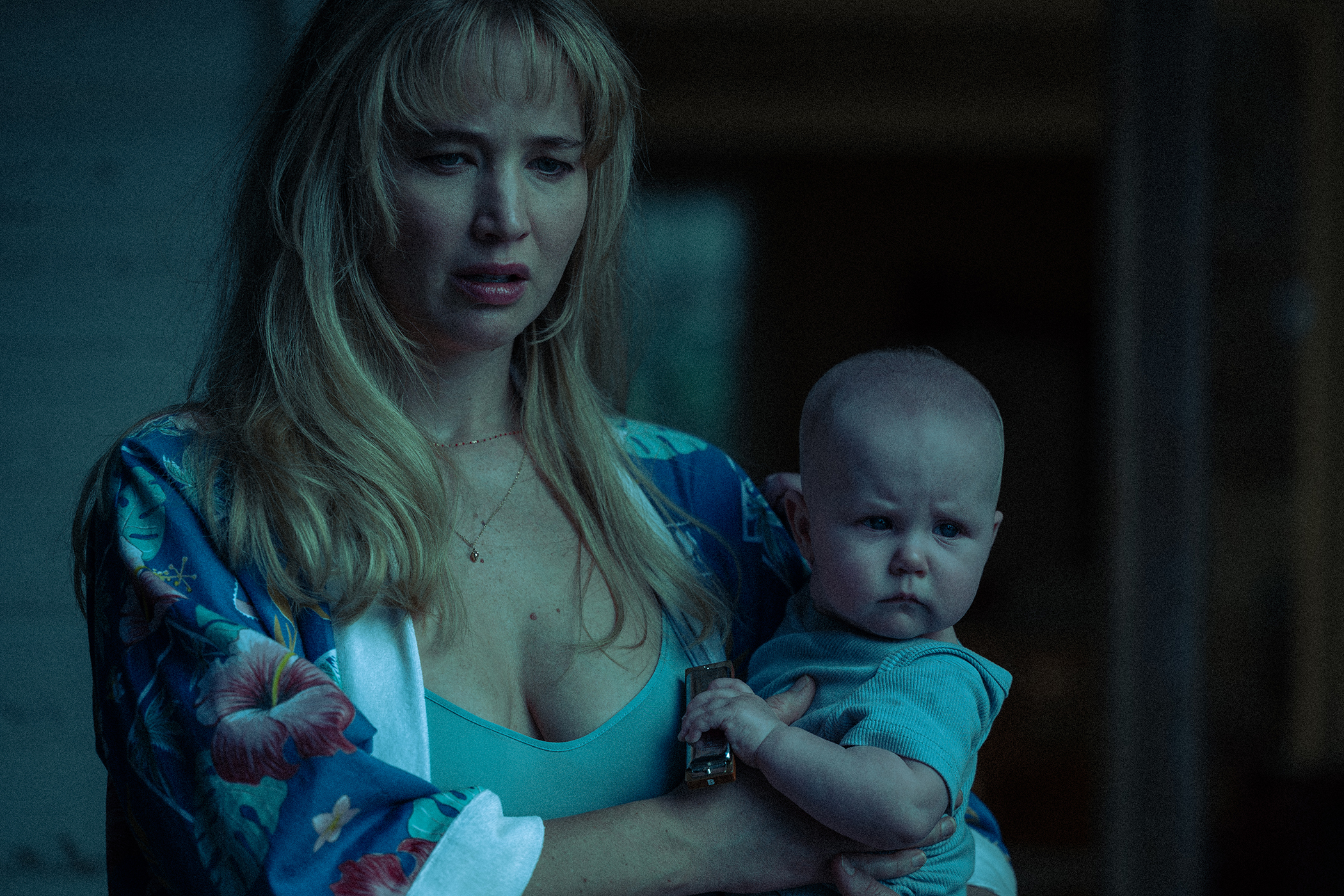

The trials of motherhood often go unrewarded – though not this awards season. In the runup to the Oscars, the bulk of the best actress awards have been shared between Jessie Buckley and Rose Byrne, both nominated for Oscars, for very different studies of maternal anguish in Hamnet and If I Had Legs I’d Kick You. Somewhat lost, however, has been onetime Oscar darling Jennifer Lawrence, despite her shattering, career-best performance as a mother in freefall in Lynne Ramsay’s typically uncompromising Die My Love. The film has just landed on Mubi.
Ramsay’s cinema never seeks a broad embrace, and Die My Love no exception. With no emotional uplift and only a slender, coal-black streak of alleviating humour, it’s a harrowing immersion into knocks of postpartum depression – a subject that cinema, like society at large, tends to avoid. It’s wrenching and exasperating to watch Lawrence’s Grace (right) steadily unravel in ways she can’t communicate to others, least of all her ineffectual, absent husband (Robert Pattinson).
Ramsay conveys her psychosis through the jagged, fractured rhythms of the storytelling and editing. A reliably vital, spiky performer, Lawrence can hold this careening character together through sheer force of personality – though, as often, the life drains quickly and alarmingly from her gaze.
In its feral emotional candour, Die My Love feels very much like the film that the terrifically titled but somewhat withholding Nightbitch aimed to be. Released in 2024, Marielle Heller’s adaptation of Rachel Yoder’s novel took a magical-realist approach in presenting postpartum depression as an out-of-body experience: Amy Adams’s overwhelmed stay-at-home mum becomes convinced that she’s transforming into a dog. It’s a conceptually clever collision of body horror tropes and real-world derangement, gutsily played by Adams, but finally veers into pat female-empowerment cliche.
Heller’s film wants for ambiguity, something that Maggie Gyllenhaal’s extraordinary The Lost Daughter has in spades. An intricate, time-hopping portrait of a mother choosing to live for herself at two different points in her life – her younger and older selves both brilliantly essayed by Buckley and Olivia Colman – it unsparingly examines maternal ambivalence.
Bess Wohl’s little-seen indie Baby Ruby, meanwhile, finds an all-out horror film premise in postpartum depression, as a lifestyle influencer and frazzled new mother (Noémie Merlant) feels her sense of reality slipping away to progressively jump-scary effect – while every fellow mum seems to her a Stepford wife-like antagonist. Such supernatural overtones, meanwhile, are placed in a different light in Elizabeth Sankey’s highly personal documentary, Witches, in which the filmmaker evaluates her personal experience of motherhood against longstanding cinematic tropes – pointedly asking why female psychosis is so often aligned on screen with portrayals of witchcraft
There’s softer empathy in A Mouthful of Air, director Amy Koppelman’s adaptation of her own novel, which follows a young New York mother in the wake of a suicide attempt – though Amanda Seyfried’s bone-weary performance avoids sentimentality. Finally, Jason Reitman’s underrated Tully, starring Charlize Theron, is a rare postpartum story directed by a man, though Diablo Cody’s script gives it conviction. It finds room for wry domestic comedy in the ordeal, and is frank but hopeful, pointing to a way out of the void.
Photograph by Kimberly French
Newsletters
Choose the newsletters you want to receive
View more
For information about how The Observer protects your data, read our Privacy Policy