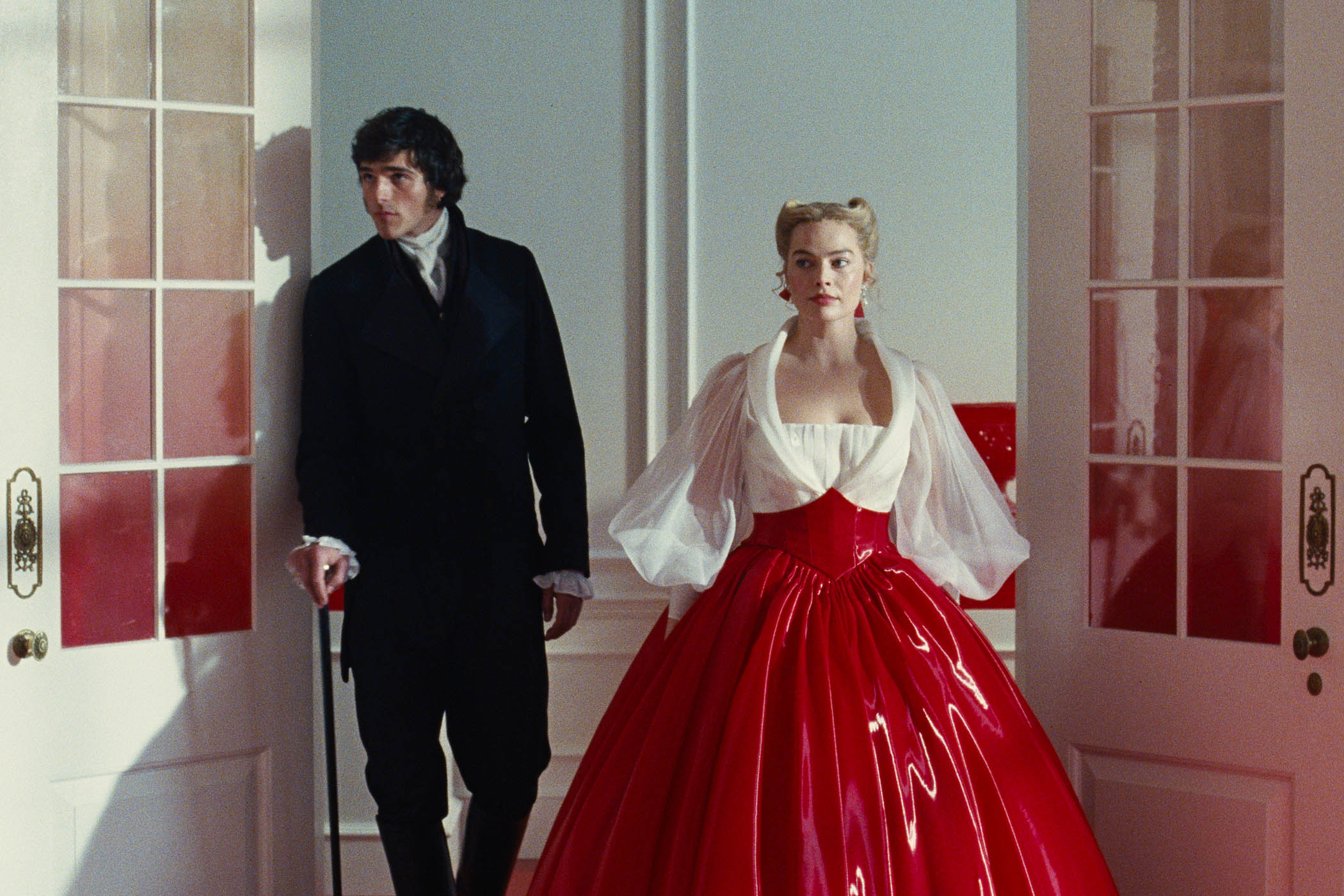

There’s not an inch of flesh in Emerald Fennell’s Wuthering Heights that isn’t flushed with arousal and glistening with a patina of trickling sweat. Not a bosom to be seen that isn’t straining to escape from the bondage of its corset. Not a shred of shirt fabric that isn’t rain-drenched and clinging to gym-chiselled musculature. To the surprise of precisely nobody, Fennell has had her wicked way with Emily Brontë’s cherished novel. This is less a respectful literary adaptation than a come-hither invitation to crawl down the cinema aisle on all fours and lick the screen. I enjoyed it immensely.
There has already been a great deal of umbrage surrounding this film, with purist Brontë-heads poring over teaser trailers for evidence of liberties taken with the source material. The casting alone generated outrage: Margot Robbie, 35, plays Cathy, who in the book is in her late teens; Jacob Elordi plays Heathcliff, a departure in age and race (the character’s ethnicity is ambiguous, but he is described as “dark-skinned” and widely thought to be Romany). And it’s fair to say that in this gaudy, trashy, provocative romp, the worst fears of the fidelity brigade are realised.
I could fill this review with a chiding list of the ways the film differs from the original text. But where’s the fun in that? Fennell offers an upfront caveat in the use of quotation marks around the title; this is her “Wuthering Heights”, not Brontë’s. And her vision for it is audacious and maximalist: think BDSM Bridgerton with a bodice-ripping Mills & Boon-meets-Yorgos Lanthimos aesthetic.
It shouldn’t really be such a big deal. If the recent Riz Ahmed-starring version of Hamlet can transpose Shakespeare’s tragedy to a moneyed Anglo-Indian community in modern London and Amy Heckerling’s Clueless can move Jane Austen’s Emma to a Beverly Hills high school, why shouldn’t Fennell set Wuthering Heights in what looks, at times, like a sparkly, high-camp Pierre et Gilles photo shoot?
One suspects, however, that some of the pre-release resistance to the picture is more about Fennell herself than it is about any perceived crimes against Emily. The director of 2020’s Promising Young Woman and the 2023 hit Saltburn can be something of a Marmite film-maker, but while I am no great fan of the latter, I have always felt uncomfortable about the ease with which criticism of her movies so frequently morphs into personal attacks, usually focused on her privileged upbringing.
Fennell makes films that provoke extreme reactions, and Wuthering Heights is no exception: loud, confrontational, it ramps up the sexual tension between the adult Cathy and Heathcliff to lens-melting intensity. Theirs is an obsessive connection that alternates between trysting and torture, while lady’s companion Nelly (Hong Chau) looks on in thin-lipped disapproval and Cathy’s cuckolded husband Edgar (Shazad Latif) buffoons around in the background, trying to quell his mounting suspicions.
Every item served on the dinner table is harnessed as overt erotic symbolism, even – alarmingly – an entire carp preserved in a block of aspic
Every item served on the dinner table is harnessed as overt erotic symbolism, even – alarmingly – an entire carp preserved in a block of aspic
The chemistry between Robbie and Elordi is super-charged, and sensuality seeps into every aspect of the film’s design: the salacious scarlet colour accents; the fleshy pink of Cathy’s boudoir; the fetish-adjacent costume design. Every item served on the dinner table is harnessed as overt erotic symbolism, even – alarmingly – an entire carp preserved in a block of aspic. It is outré, stylised and, with an anachronistic soundtrack by Charli XCX, thoroughly modern – in stark contrast to the earthy authenticity and inarticulate longing of Andrea Arnold’s 2011 film version of the book.
It’s not all about sex, power and tragedy. Fennell’s uninhibited adaptation loosens Brontë’s story and uncovers spikes of cruel humour. The main beneficiary of this is the character of Isabella (Alison Oliver): in the book, the insipid younger sister of Edgar; here, recast as Edgar’s innocent, unwittingly hilarious ward. Oliver’s well-honed comic timing is used effectively, bringing a levity that counters all the sweaty smouldering and lip-biting. In one of the bolder departures, Isabella is given a degree of agency in her dealings with Heathcliff. Rather than a hapless victim of his cruelty, she’s a willing participant in a sub-dom relationship. This is a canny if manipulative move by Fennell, rendering Heathcliff a more sympathetic and palatable character to modern viewers and less, well... cancellable.
Divested of glitter and sequins, of Cathy’s fabulous frocks and of the scorching stolen clinches, the film’s final act feels underpowered and the drama starts to drag. It is a shame, given how robustly red-blooded and raunchy this telling is at the beginning – an all-consuming passion that burns fast before it’s extinguished.
Photograph by Warner Bros
Newsletters
Choose the newsletters you want to receive
View more
For information about how The Observer protects your data, read our Privacy Policy