

Mawaan Rizwan is hungover, with good reason. We meet in a greasy spoon in south London the morning after his surreal, joyous comedy series Juice has been nominated for three Baftas, including Best Comedy Actor – an award he won in 2024 and for which his brother, Nabhaan, was nominated last year. We are here to discuss his upcoming Royal Shakespeare Company debut, starring alongside Mark Gatiss in a timely production of Bertolt Brecht’s vegetable-based fascism satire The Resistible Rise of Arturo Ui.
The combination of rehearsal-induced stress, harrowing global events and the previous night’s celebrations is making emotions run high. “I don’t know how you’re gonna type this up into an article,” he says, looking down at his fry-up. “This is just me crying into a fucking hash brown: ‘I met Mawaan in the café. He was wiping the tears off his omelette.’”
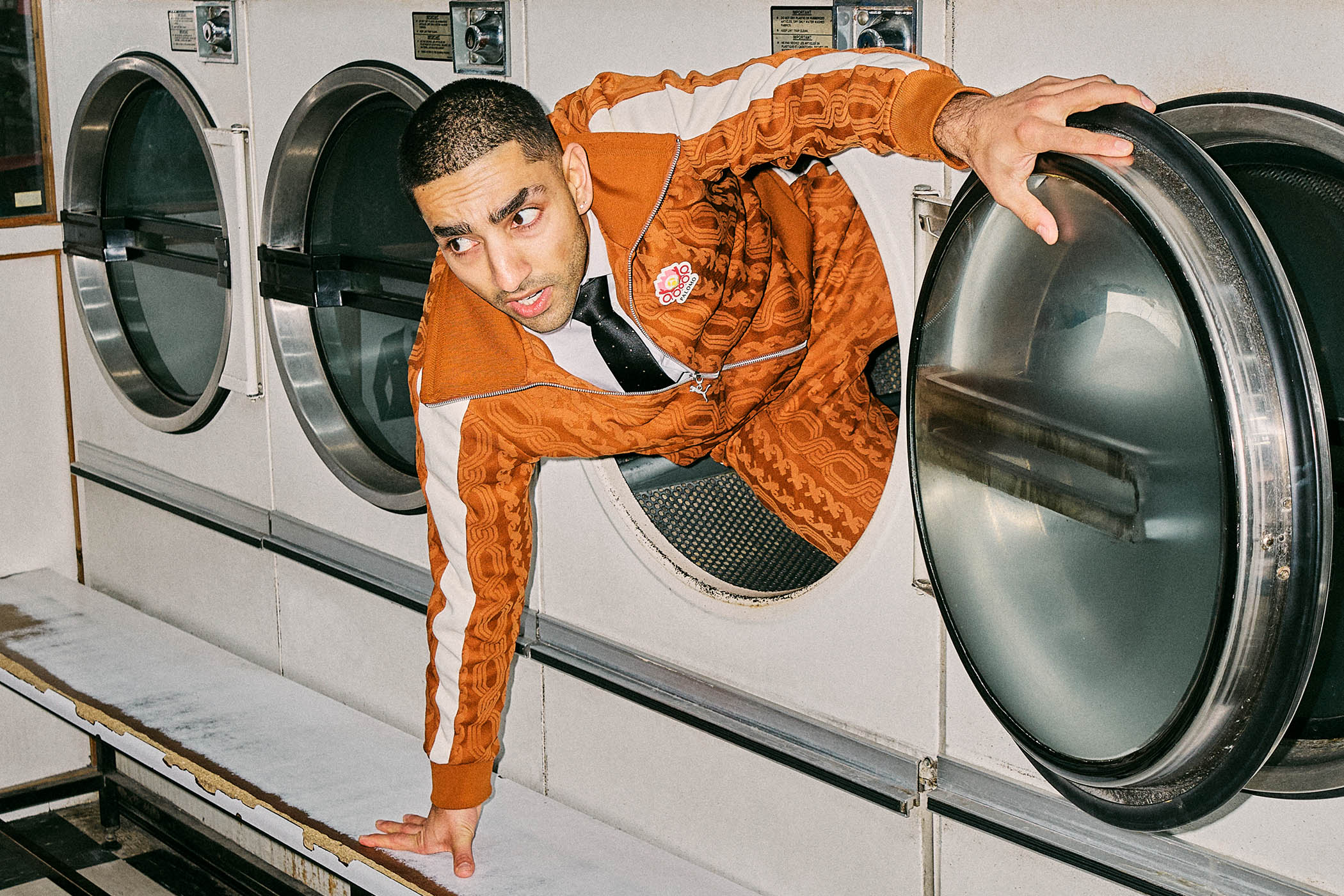
Rizwan has a magnetic, larger-than-life presence; in an intricately patterned orange tracksuit, he is both far too glamorous for the café and completely at home in it. The evolution of the 33-year-old’s comedy can be traced online, starting with the 2008 YouTube video Chips & Beans, an impossibly charming freestyle with Nabhaan.
Over the following videos, you can see Rizwan refine his craft, channelling his early potential and megawatt charisma into evermore sophisticated sketches and songs, such as the infernally catchy Are You Checking Me Out Or Are You Just a Racist?
Born in Lahore, Pakistan, and brought up in a “chaotic, crazy environment” in Ilford, east London, Rizwan didn’t have industry contacts or financial security to fall back on, so he was powered by unwavering self-belief. “I had a really healthy dose of delusion,” he says. The year he was meant to start university, fees tripled to £9,000; having seen beloved family friends struggle with debt, he decided against it. He trained at the prestigious clown school École Philippe Gaulier, near Paris (“a very serious qualification that I take very seriously”), presented the BBC Three documentary How Gay Is Pakistan? and later got a writing job on the Netflix comedy Sex Education.
The experience gave him the confidence to turn his 2018 one-man Edinburgh show, Juice, into an affecting, wildly original BBC series. “The genesis of the idea was: how do I make a panic attack funny and visually interesting?” he says.
Using puppetry and an elaborate custom-built set, the show is an expressionistic portrayal of the central character’s mental health, tackling issues such as colonialism, family trauma and homophobia while maintaining an exceptional gag rate throughout. The second and probably final series aired last autumn to critical acclaim. A memorable appearance on Taskmaster followed, an impromptu dance with Kylie, and a panel show appearance in which he gave Jimmy Carr the finger while showing off his manicure (“probably one of the most fulfilling moments in my career. Stick it to the man – with press-ons”).
In an industry populated by trust-fund kids and nepo babies, Rizwan’s rise to fame is a prime example of what talent and dedication can accomplish. Yet he is keenly aware that opportunities available to him have since been decimated by cuts, making the arts increasingly inaccessible to young people from working-class backgrounds. Art, he says, should not be seen as a luxury. “People think, Oh, it’s just fictional characters. No – it’s survival.”
He points to his experiences growing up, when his mum was working three jobs and running a community centre where she put on plays and taught English to hundreds of immigrants.
“My parents were under a lot of strain and stress,” he recalls. “Immigration takes its toll – it’s not easy. It was really sad seeing your mum trying to make things work and keep her kids safe. But she was only human and she would break sometimes.” When he was eight, his family was threatened with deportation. Watching other families go through the same thing, he says, his gaze darkening, is “heartbreaking. I’m seeing whole communities with so much to offer being dehumanised. If I was growing up now, if my family were in that situation, we would have no hope.”
His YouTube videos were a way of escaping these worries but also of exploring them in a safe space. Donning a silly wig and turning on a camera gave his family permission to talk about things that were otherwise unsaid. “I came out to my mum on camera, by accident. We were doing a rap challenge, and she said something that pissed me off, and I was like, ‘Well, what if one of your children was gay?’”
Rizwan’s family is at the heart of his work: his mum was in his early videos as well as in Juice, which also features Nabhaan as his brother. Nabhaan, who has starred in films such as 1917 and In Camera and the TV shows Kaos and Film Club, has been a sounding board for Mawaan, and vice versa (though he is still furious that his younger brother is one inch taller than him – “That’s the universe saying, ‘Fuck you, Mawaan’”).
It’s fascinating how much more dangerous a clown can be than a straight-laced person who follows the rules
It’s fascinating how much more dangerous a clown can be than a straight-laced person who follows the rules
Under the bright colours and musical sequences, there has always been a serious political undercurrent to Rizwan’s work. In person, he is genial company, though he is sometimes frustrated by the public perception of him as a constantly upbeat, happy-go-lucky figure. “Some days I just want to be a cunt,” he says. “But when I’m on, I’m great – bants oozing out of me left right and centre.”
As world events have got darker, so has Rizwan’s work, culminating in his upcoming performance in Arturo Ui as Giri, an art-collecting, hat-stealing thug based on Hermann Göring. The absurd elements of the play (which depicts the rise of a Hitler-like figure against the backdrop of a cauliflower racket) combined with the obvious contemporary parallels make it a perfect fit for his talents. “It’s fascinating how much more dangerous a clown can be than a straight-laced person who follows the rules,” he says, slowly picking at the food on his plate.
Uploading bedroom raps to his YouTube channel all those years ago, little did Rizwan know that it would lead to performing with the RSC at Stratford-upon-Avon, where he will be living in a “cute little cottage” Helen Mirren once stayed in. “I feel really creatively fulfilled,” he says. “Theatre is hardcore – I can feel my edges growing.” Rather than cultivating a lucrative but restrictive TV persona, he is enjoying performing as other characters. “If you have your shtick, you do it on every panel show and you’re that guy: the wacky one, the surreal one. But it’s not your whole self.”
“I keep telling my agent, I just want to wear a cape,” he says, growing animated. “I’ve always wanted to be limitless in the characters I play – I want to play wizards and astronauts. I want to do it all.”
The Resistible Rise of Arturo Ui is at the Swan Theatre, Stratford-upon-Avon, from 11 April to 30 May (rsc.org.uk)
Newsletters
Choose the newsletters you want to receive
View more
For information about how The Observer protects your data, read our Privacy Policy