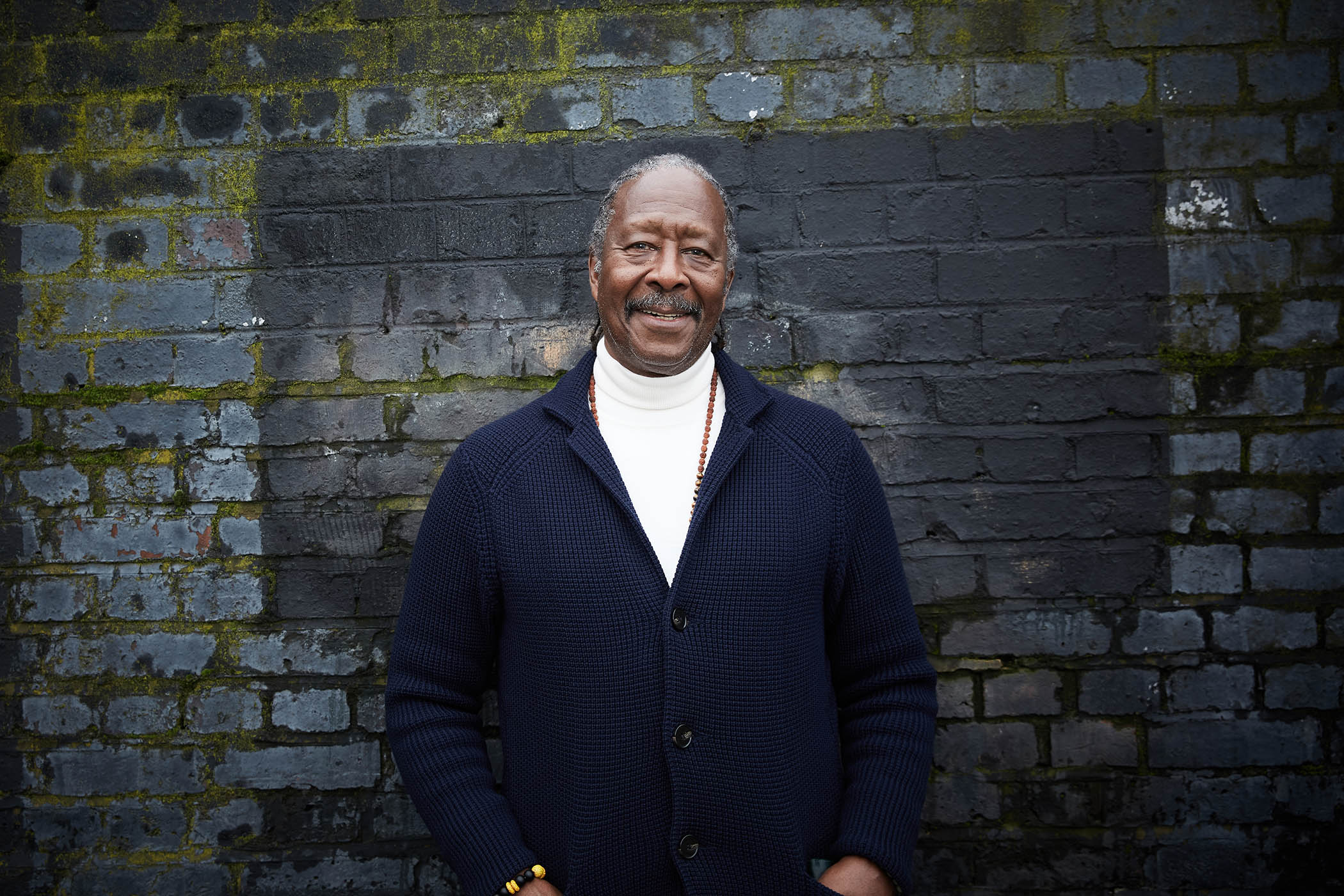
Clarke Peters was born in 1952 and raised in Englewood, New Jersey. He moved to Paris in 1971 and arrived in London two years later, changing his name from Peter Clarke to avoid confusion with other actors of that name. Across a prolific career he has starred in West End musicals and plays; appeared in films such as Notting Hill and Da 5 Bloods; and staged his own musical, Five Guys Named Moe. From 2002 to 2008 Peters played detective Lester Freamon in the revered HBO series The Wire. Now he’s back as a hippyish septuagenarian in Netflix’s The Boroughs, about a New Mexico retirement community beset by monsters.
What drew you to The Boroughs?
The two writers [Jeffrey Addiss and Will Matthews]. At first I was given a brief outline and I said: “At this age, I do not want to be chasing monsters till I’m 80 years old.” And then I started reading the script, and met the cast, and I thought, I’m really glad they talked me into it. I don’t think I’ve seen anything like it with this type of scenario, where the seniors of a community decide to fight the monsters. It’s normally a children’s adventure.
But here, all the main characters are retirees. Did you find that refreshing?
I certainly did. We are all septuagenarians and higher. When you’re with people of your own age, in these upper regions, you’re more patient and you find more ways to explore your character. When you’re with younger people, it’s more, “Let’s get it done, get it out there!”
Do you think opportunities for older actors are improving?
I certainly hope so. The seniors in the world have a lot to offer. It’s not about instant gratification as much as depth of information. Certain communities just want things to be now, immediate. And that’s not good for our health, spiritually, physically or mentally.
After a season of The Boroughs, does the idea of a retirement community seem more or less appealing to you?
[Laughs] When I retire, I’m going to be by myself in nature. If anybody wants to come with me, that’s fine. But as far as going into a community with all those people, hell no. I think I’ll give that one a miss.
Am I right in saying you were in school with John Travolta?
He was the year behind me, and we only really hung out when ice skating on a local pond. His mother was a director, and the first performance I ever gave was in a production of My Fair Lady directed by her. That made me think, OK, let’s do more of this.
And then you went to Paris, where you lived in Jean-Luc Godard’s apartment and met James Baldwin.
Meeting Baldwin was just wonderful. When I met him first in Paris, it was just, “How you doing, Clarke?” “How you doing, Jimmy?” There was no conversation. Then he came to London, when we were doing [Baldwin’s play] The Amen Corner, and he stayed with me for a month and that’s when I really got to know the man. We will miss that kind of intellect. [When he was talking] he would start a sentence at seven in the evening and finish it at nine. Somewhere around seven-thirty, eight, you’re completely lost. About quarter to nine, you are beginning to understand what’s going on, and by nine o’clock the denouement comes and the scales fall from your eyes. He was magnificent, man. Just magnificent.
Many people came to know you from The Wire. Did you have any idea it would have such an impact?
No, not at all. In fact, I didn’t really see the whole thing until 2012. I’ve always said it wasn’t just about Baltimore, it was about the whole western world. I had friends in Europe who had seen it and said, “This is just like Lisbon”, “It’s just like Paris.” And that made me think that, yeah, they really hit on something there.
I see you’ve just reunited with your old Wire co-star Dominic West to make a documentary about Kyrgyzstan. What was that like?
Brilliant. Dominic called me going, “Hello old bean, how about riding horses across the steppes of Central Asia?” “Yeah, OK, Dominic, you’re just winding me up.” And the next thing I know, we’re out and we’re doing it.
Why on horseback?
When we were shooting The Wire, Dominic and I befriended a horseman just outside Baltimore who had six or seven stallions, and he lived near a reservoir with 800 miles of tracks that we could ride around. So it wasn’t a surprise that Dominic should call and say: “Let’s go on this adventure.” It was basically to follow parts of the Silk Road and get a history on that, but it was harrowing in some places.
How so?
We were 3,000 metres up and the altitude affected me much more than it did Dominic. And there were sheer drops and the path felt like gravel. So it wasn’t an easy ride, but it was a great ride. Next, I want us to do it in Africa.
What’s your dream role as an actor?
I’m too old now, but I always wanted to be in at least one RSC production. And then somebody said: “They’re never gonna let you do that, Clarke, you’re too old, you don’t speak the language, you don’t have the education.” It’s a credit I would love to have had, but it’s not going to happen any time before I check out.
You did get to do Othello [with West at the Sheffield Crucible in 2011] and King Lear [in New York in 2014 and again at the Almeida in 2024].
Yeah, but it would have been nice to be part of that company. I mean, I was part of the National Theatre within two years of hitting the stage, so I know it hasn’t anything to do with being capable; I think it has more to do with culture.
How do you feel about ageing?
I’m re-evaluating a couple of things. I was offered some nice theatre work and I turned it down because I figured, eight shows a week, I know I can’t do that. The mind is there, the heart and spirit are there; but the body – it does what bodies do.
The Boroughs is streaming on Netflix from 21 May
Photograph by Ed Miles /The Times via News Licensing