

You will know the fashion designer Luella Bartley’s work, even if you do not know you know it. To quote the speech in The Devil Wears Prada: “You’re wearing a sweater that was selected for you by the people in this room.” You inhabit a world whose visual parameters she helped to create, at her label, Luella, at Marc Jacobs and elsewhere. Bartley was part of a golden generation that gathered at Central Saint Martins College of Art and Design in the early 1990s and later embodied Cool Britannia – which was, as media inventions tend to be, half mythical and half real.
Bartley has been, in her own words, “very lucky and very unlucky”. Five years ago her 18-year-old son, Kip, died of leukaemia, and she threw off fashion for a different art form, which seems like either a repudiation of everything she made before or an attempt to understand it better, from its beginnings. I’m not sure, because Bartley emits ambivalence about almost everything: about her body, about clothing, about this interview. Perhaps that is why she is such an influential designer – because femininity is ambivalence. But she, one of the most influential designers of her time, has chosen to draw a world without clothes.
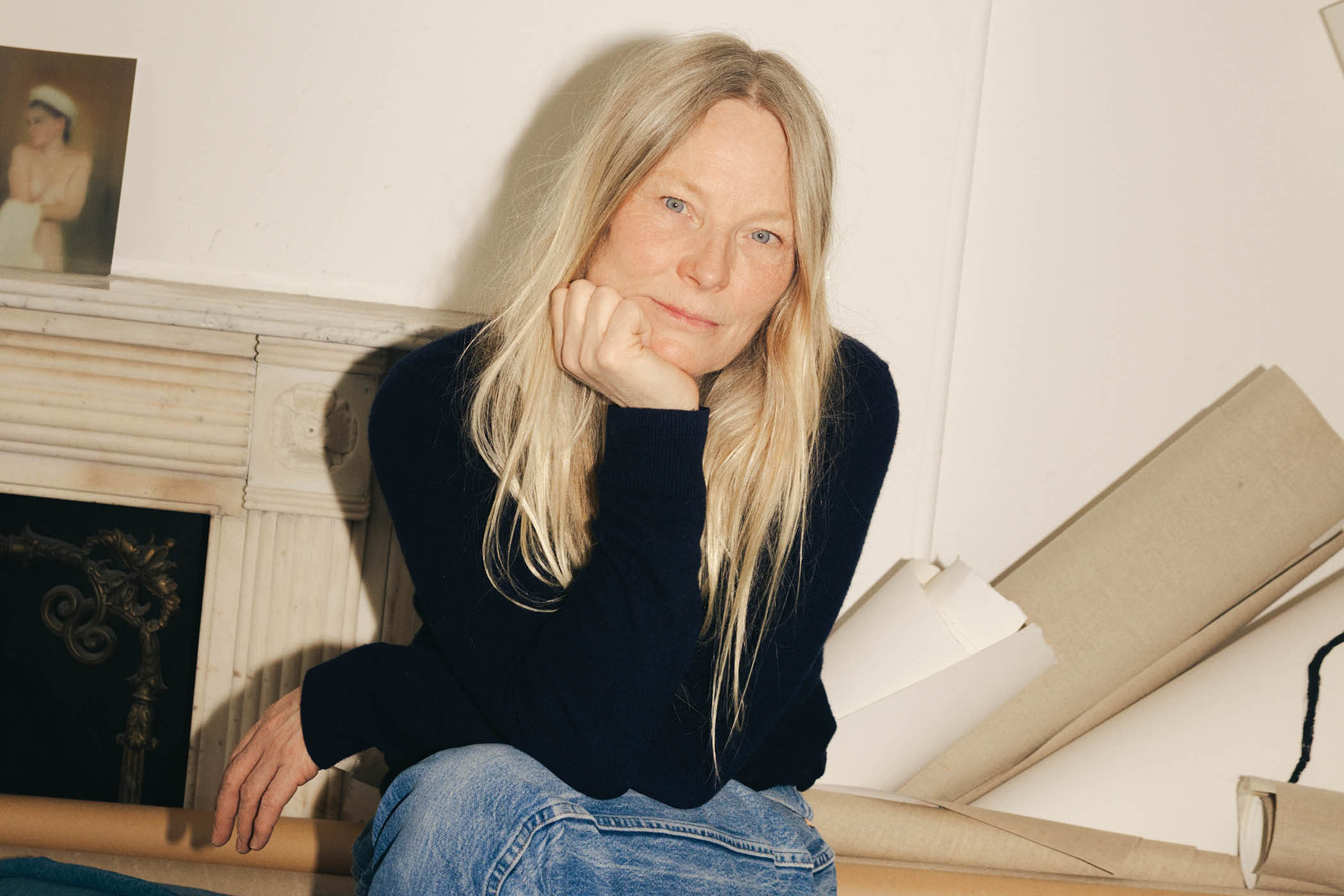
We meet at her tall Georgian house in London, which is clean and stripped back to almost nothing. Bartley is slender and blonde, reserved and friendly. Dressed in a navy wool jumper and Cambridge-blue jeans, she looks like an affluent 52-year-old woman. This invokes the first lie of fashion: that the people who make it dress like Cruella de Vil (those are the clients). Bartley can walk undetected through the world.
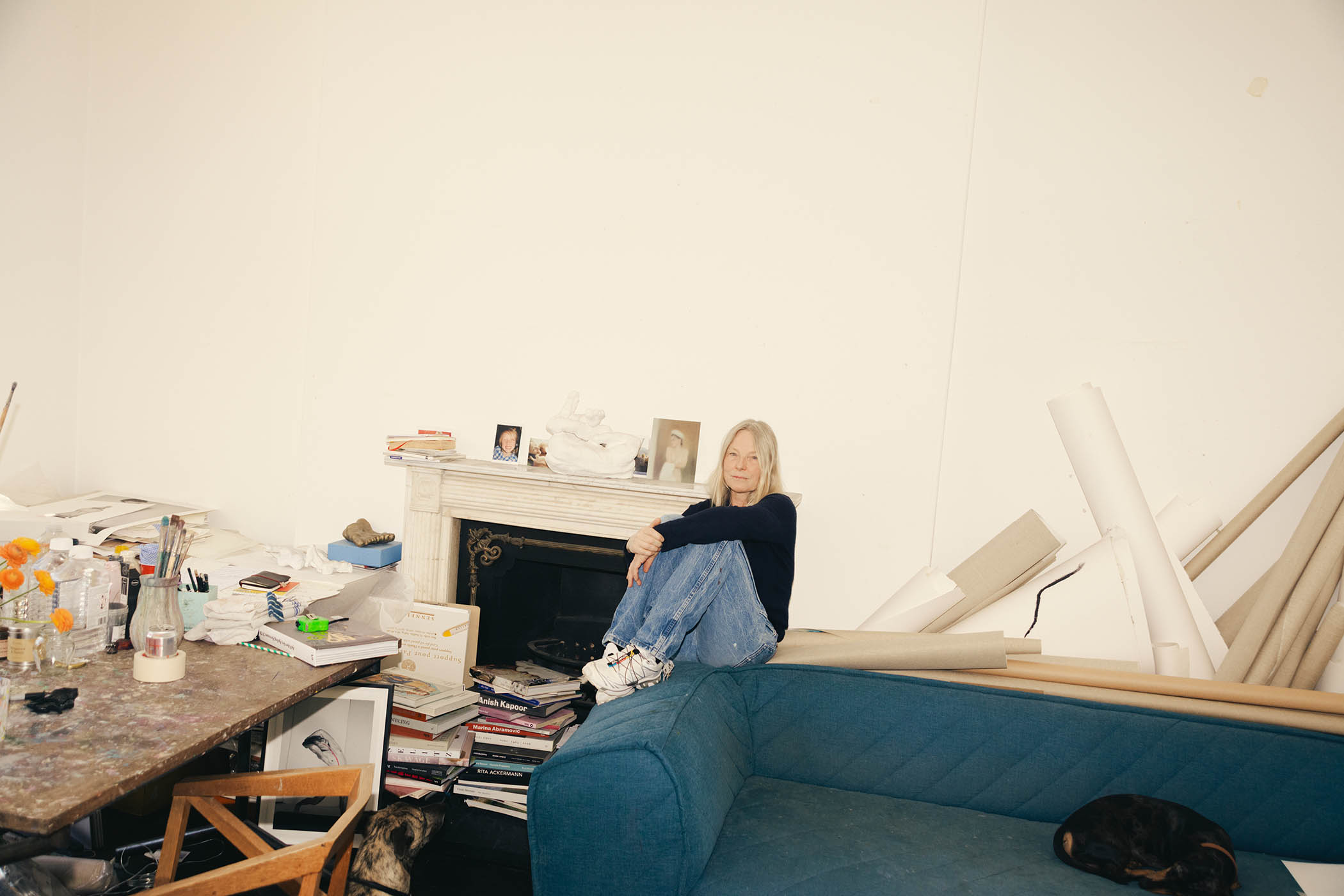
Intimate spaces: Luella turned the kids’ playroom into a studio when her son Kip was ill, so they could make art together
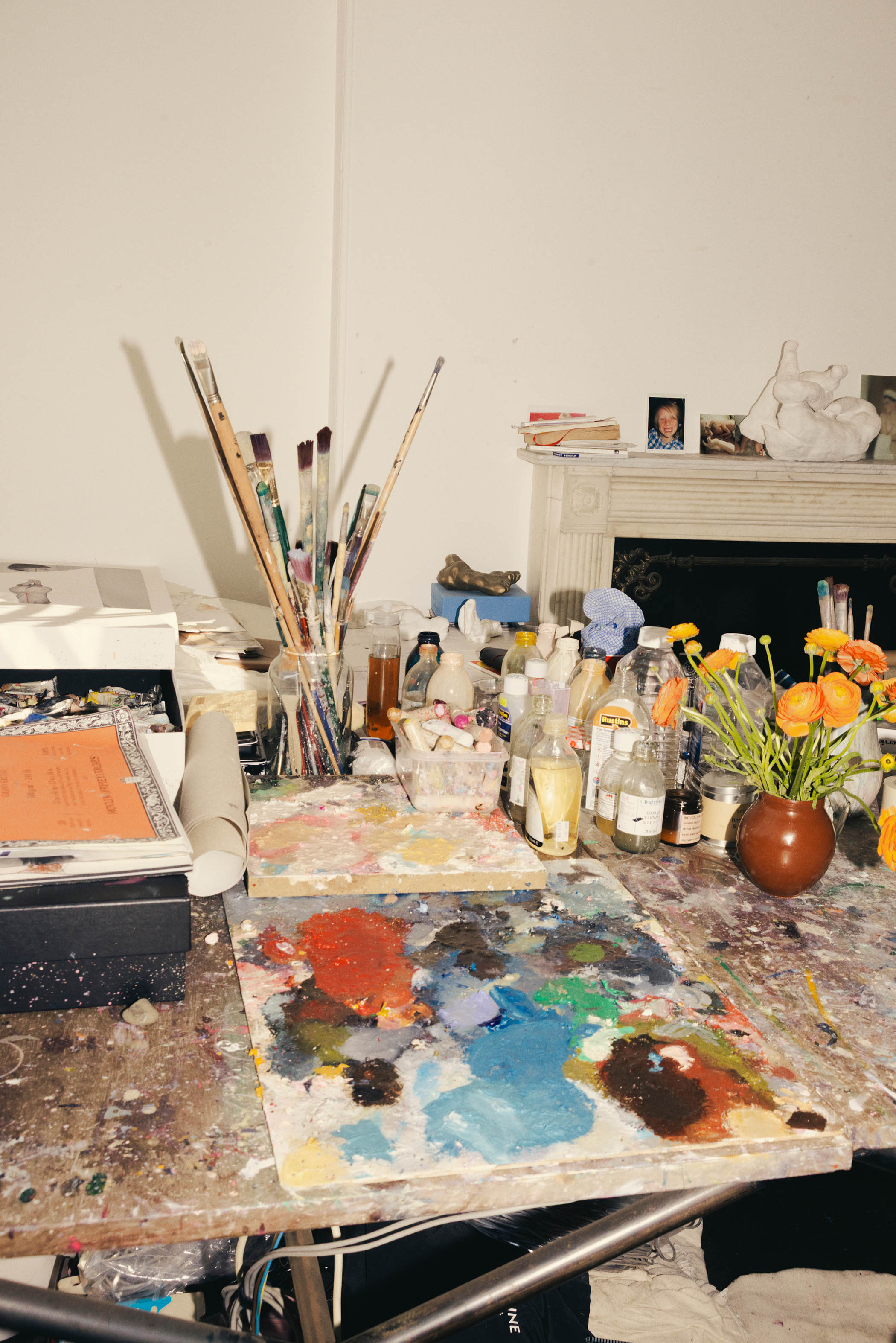
We sit in a room on the first floor. It used to be the children’s playroom, but when Kip was ill she turned it into a studio, and together they made art. He doodled faces; she made clay sculptures. On the floor are piles of books about Maggi Hambling and Lee Miller, Lucian Freud and Nan Goldin. On the walls are printouts of oil and ink works, many from her new show, Dressing for Pleasure. There is her son Ned, 18, with grey eyes and wild hair, a female friend in a suit, a man in a blue tie. It’s the comic Eric Morecambe. “I just love his stance,” she says. Bartley’s voice is changeable: loud to soft, London to Warwickshire.
She grew up in Stratford-upon-Avon, the only child of a single mother who loved to draw. Her father “was around, but not a lot”, and her mother could be “distant. She read all the time and I think that was her escape.” There was a duality to her childhood, “a crazy, bohemian quality”. Laughter coexisted with struggle: her mother did not have enough money. “Life was tough,” she says, but “tough and fun”. Bartley grew up surrounded by feminist literature and financial insecurity. Femininity and fear: a fine hinterland for a woman who shows others the possibilities of their self-expression. The Women’s Room by Marilyn French is still her favourite book: “She drowned in words that could not teach her how to swim.”
Bartley had “a drive just to leave Stratford-upon-Avon”, and Central Saint Martins, on Charing Cross Road, was a kind of Oz: the school of Alexander McQueen and Stella McCartney. Young Bartley was “naive and only just 18, very shy and quite intimidated by a lot of things, quite embarrassed by myself”. Then, she did not really know herself at all. “And still” – she looks faintly amazed – “I managed to somehow get myself to London and walk into that bloody college on the first day, terrified.”
If Stratford was “a conservative middle-England town”, within weeks of arriving at Saint Martins, it was “Old Compton Street, going to Comptons and drinking and going to [the nightclub] Heaven. The whole world just opened up.”
Nineties London is remembered as an Elysium – a mythologised Bartley is part of the history of fashion – but to her, who lived it, it felt accidental. “I didn’t really have a plan,” she says. “I think I always felt like I was slightly lacking.” Saint Martins “was incredibly out there and creative, and the more ridiculous things you did, the more praise you would get. And I wasn’t really that person. I was still that little girl from Stratford-upon-Avon trying to find out who I was.” It is a pattern for her, she says. “I’ve always gone with what appears in front of me at the time.”
She left without graduating for a work placement at the Evening Standard to become a fashion writer, which was “very chaotic and not like a real job”. She wrote about getting her belly button pierced and describes a photo casebook feature she invented, a sort of fashion version of Dear Deidre, the Sun’s agony column. “I got away with it,” she says, and she was head-hunted by Vogue, “which I always find so weird,” because what she was doing was “fairly juvenile: satirical at its best, puerile at its worst”. She struggled at Vogue. “It was a little too one-track for me.” She did “a high-street bit and the young bit”. In fact, she “traded off being young for quite a long time”.
Bartley lived at the crossroads of music and fashion. She shared a flat, in Maddox Street, Soho, with the stylist Katie Grand, who later married Steve Mackey of Pulp, and another with Justine Frischmann of Elastica, in Kensington Park Road. When I ask about a party at Maddox Street with a bath full of champagne, she corrects me. “I think maybe we had a party and we didn’t have a fridge. So we put – as many, many young people do – cold water and ice and you put alcohol in the bath. Not a bath of champagne: it was more practical.” She remembers “rails of clothes, mainly Katie’s. We were young.” They hung out at the Bricklayer’s Arms in Shoreditch.
Newsletters
Choose the newsletters you want to receive
View more
For information about how The Observer protects your data, read our Privacy Policy
She calls it “falling through the chaos of those 10 years. But I think we had fun. I haven’t sorted out those memories properly yet. We got into scrapes. We went to lots of parties. Was that youth or was that trauma? I don’t really know. I felt like we were quite a close-knit family of misfits.”
If Bartley doesn’t resent the myth-making, she does reject it: you cannot find yourself within myth. She doesn’t think the way she felt was different from anyone else’s 20s, when “you cannot begin to understand what you know. I know so much now. I’ve been through so much.”
‘I did so many interviews at one point, and it was always about the 90s, the parties, the cool girl, and I’ve kind of outlived that’
‘I did so many interviews at one point, and it was always about the 90s, the parties, the cool girl, and I’ve kind of outlived that’
Later she says, “I did so many interviews at one point, and it was always about that: the 90s, the parties, the cool girl, and I’ve kind of outlived that.” Of her self-image she says: “Some days I feel really good. Other days I still get that kind of… the shame of a woman. It doesn’t completely go away, but I definitely feel different than I did when I was in my 20s. I don’t really remember our generation enjoying our youth.” I wonder if she is amazed by how innocent she was then.
At 25, Bartley left Vogue and founded Luella. By 2008, she had been named Designer of the Year. “I always designed around narrative,” she says, “and it was always about a character – English girls.” Her first real collection was called Daddy, I Want a Pony. (It was followed by Daddy, Who Were the Clash?) She admits a “tiny” element of unconscious autobiography – “or maybe what I wanted to be?” When I ask why she is addressing a father, she says, “I’m aware of all that. It wasn’t conscious, it wasn’t intentional, it was funny.” People thought Luella was, “slightly punky, slightly girly. But there was always some kind of subversive stuff in there. The subcultural history of fashion is just so potent. I’ve always been so fascinated by it – and class.” British fashion, she says, “is very on its head. It’s very contrary.” I am no fashion writer, but to me Luella’s woman – she cannot be a girl any more – has freedom. She is playful, idiosyncratic and multiple.
Guido, Bartley’s dachshund, walks up with a stone in his mouth, drops it and whines. “He wants you to throw it for him,” she says, and gathers him in her arms. She had three children in five years with the photographer David Sims and moved to Cornwall to raise them. (She and Sims are now separated). Bartley’s CV indicates she does trust in her luck. After Luella folded in 2009, an early victim of the financial crash, she wrote Luella’s Guide to English Style and looked after her children. To be a mother “you need to be a strong force, you need to be there for them”, she says. “You want to be as solid a person as you can.”
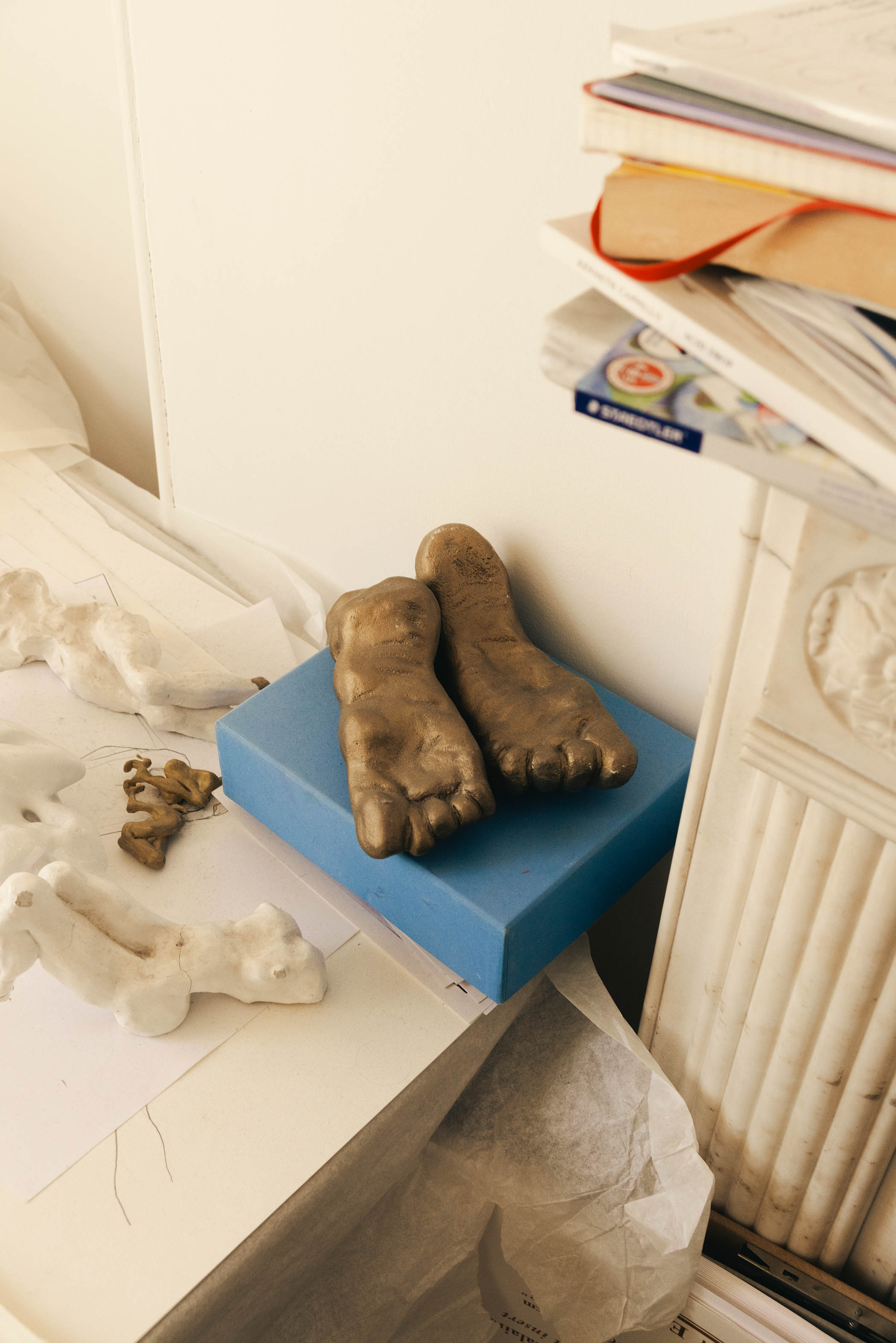
Finding form: examples of Bartley’s sculptures in her home studio
It was when the family returned to London, around 2012, that anguish arrived. Kip died, and Bartley became an artist. “Sometimes I go through periods when I can talk about it, and at the moment I can’t,” she says. “It’s so hard. It’s nearly five years, and I miss him, and I don’t want to talk about the experience or the illness, and Kip wouldn’t want me to do that either.”
The art is her speech, and her speechlessness. “Obviously, when I started painting, it was the healing process,” she says. “I’d stepped out of fashion to look after my son. And I’ve always drawn. When my son became ill, he was 16, and he couldn’t really be in school, so we just sort of drew together. He was” – she sounds emphatic – “an amazing draughtsman. I wasn’t working, so it was something to keep me busy and my mind off the horror of our situation.”
After Kip died, she kept drawing and painting. An artist friend saw a picture and asked her to put it in her show. “I was like, ‘No, no, no, no. It’s not for that.’” But she relented. I look at that early work online: tiny, agonised sculptures in bright white, as if colour is an impossibility. And transgression. Body parts. Things.
Not long after that show she met Esther Bunting, a life model, and began drawing her, and the drawings became her first show, Intimate Spaces. “She’s quite an interesting person,” Bartley says. “She is sort of the very opposite of how I was feeling, or who I kind of still am.” Now we’re speaking through the metaphor of art, she is more relaxed. “I can feel very anxious, embarrassed. I have all these negative emotions around my body, and she was the opposite. She’s so free. When you look at a female form like that, and you see the strength, and you see the vulnerability, it feels very grounded and very real.” It was “the antithesis of what fashion is. The first show was a kind of rejection. I didn’t want to talk about fashion. There were no clothes. It was just about raw experience. It was about being yourself”
They are not self-portraits, then, but fantasy portraits: of the person Bartley wished she was then, knowing what she knew. The woman in Intimate Spaces is in pain. She is contorted. But she is also solid and strong. Fashion could not help Bartley: it was too speculative, too transient, too joyful. How can you dress a person who is annihilated?
“Art is quite incredible,” Bartley says. “You can do something and not know why you’re doing it and then you can finish it. And it’s like, it’s talking to you, telling you exactly what you were dealing with at the time. Why are you incessantly painting naked women? What’s going on?” When she looks at the work now, she sees it was “very much stripping everything back, going to something very simple, quite painful, raw. And” – she is very quiet now – “it was helpful to me.” She adds: “I’d just been blown to pieces. It’s not my journey. It’s his journey. But I had a journey within that. I think I was blown to pieces, and I was trying to reconstruct something about myself. Because I could never be the same person again, you know? And it’s very hard to talk about.”
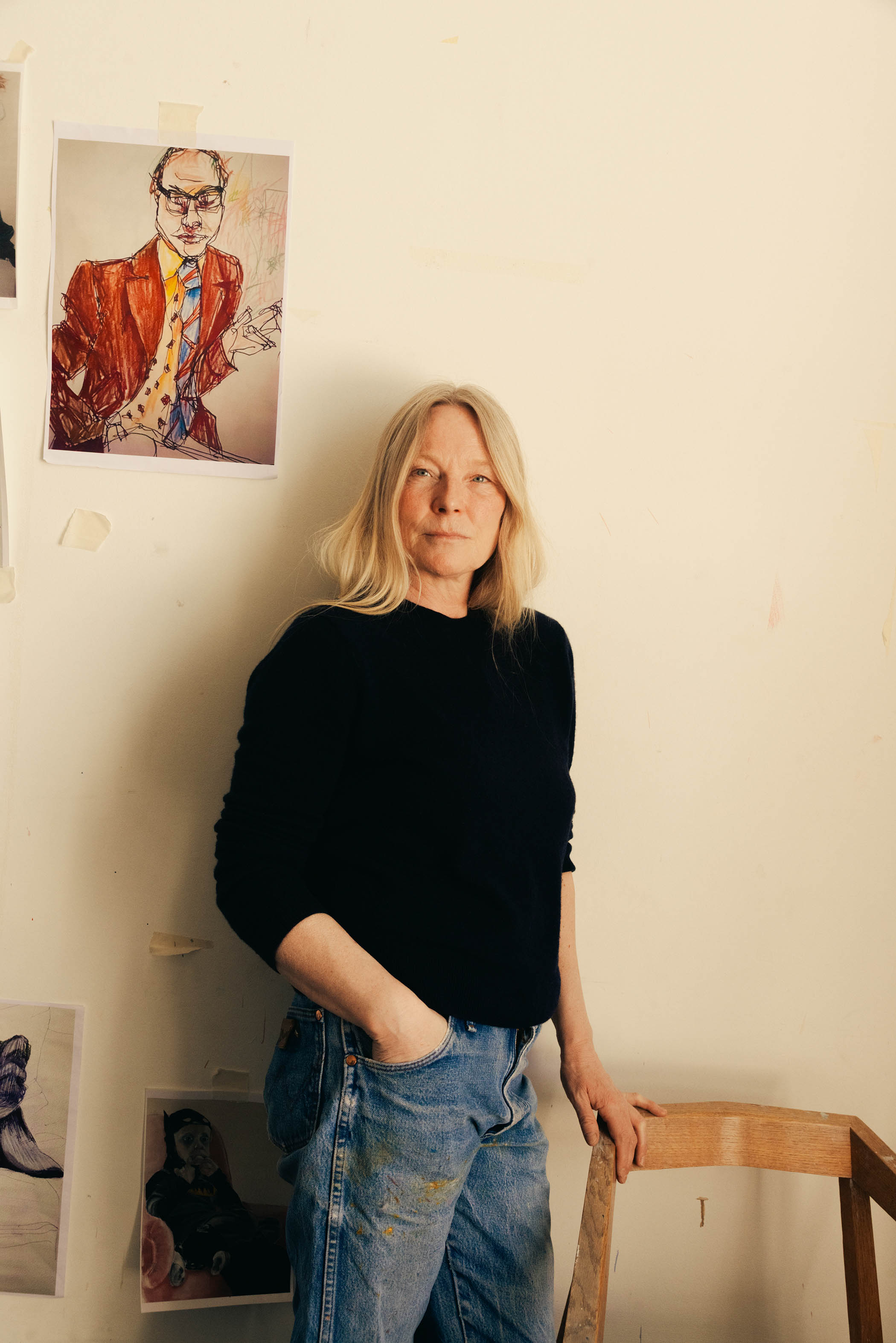
Personal style: Luella Bartley with a print of one of her pieces, Red Suit and Cigarette
When Bartley was younger – the mythical party girl – she was, she says, “so angst-ridden, but I was also so carefree. I just didn’t think on that level. I’m not sure you do. I suffered quite a lot of trauma in my childhood, but then kind of blasted through my 20s.” Now, with painting, “You get to slow down, and you get to think about life and think about what you’re doing here, and all those questions that I really didn’t think about for a long time, I think probably because of childhood trauma. Many things that I don’t want to talk about. Maybe this generation is different, but I didn’t want to face any of those things.”
Slowly, the paintings dressed themselves, but not formally. Bartley’s second show, Passenger, was oil-and-pencil drawings of dancers in their rehearsal clothes: “sweaty T-shirts and tracksuits and socks”. She drew “their blood and sweat and stamina and strength”. For the dancers, she says, “what was going on inside was a clash with how you presented outside. Your feelings are one thing, and what you’re portraying to the world is something else. We’re so fucked up inside, and it will come across as completely normal. And I was dealing with a lot of that at the time.”
Today, Bartley’s people are formally dressed. There is: Pencil Skirt and Sheer Tights; Brown Slippers and Yellow Socks; Grey Suit and Heels. There is her son Ned, “so good and so sweet that I just wanted to paint him”, wide-eyed in Socks and looking down in Green Plastic Trousers. There is her daughter, in Stevie on the Phone, in pink-and-green striped trousers. There is a little drawing of Kip as a tiny Batman, low on the wall, but it isn’t in the show: “I really want to paint Kip, but I haven’t yet,” she says. “I don’t feel good enough yet.”
‘I probably get more excited than most people about a red sock with a tweed suit. I see the meaning in that. I can see the story behind it’
‘I probably get more excited than most people about a red sock with a tweed suit. I see the meaning in that. I can see the story behind it’
The new paintings are about “seeing how bodies acted inside the clothes: the way people sit, the way people interact with their clothes, and what their clothes say about them.” But it’s not fashion. “Some of the clothing does look like a fashion thing, but it’s not. I didn’t want these clothes to be about fashion. I wanted them to be about people.”
I see a growing joy – or at least presence – in this art, and Bartley allows herself that. “I probably get more excited than most people about a red sock with a tweed suit,” she says, and for the first time I hear the designer in her: the woman who speaks a different language that is nonetheless universal to us all. “I see the meaning in that. I see the story behind it.”
“I haven’t done a lot for a long time,” she says. “I’ve spent many years reflective and in grief and very quiet and quite isolated. And the painting has been very good for that, because it meant I can do something without having to engage in a big way with the world”. I sit at home with the dog, I say. “That’s exactly what I do now,” she says. “And I’m very happy for it.”