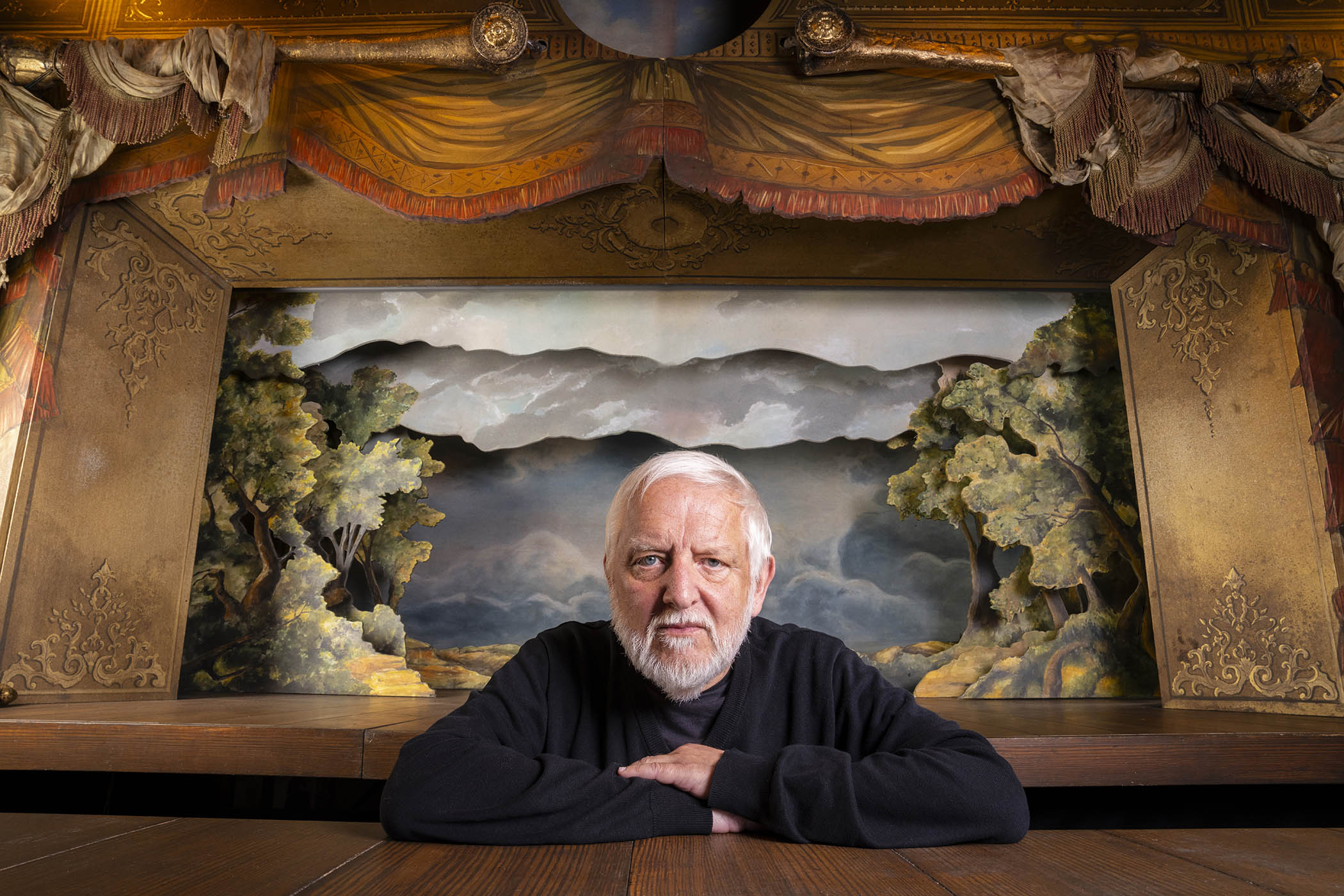

Photograph by Antonio Olmos for The Observer
The job title “actor” is often confused in the public imagination with “celebrity”. It’s an understandable misapprehension when even respected actors trade on their fame. But if the overwhelming mass of the profession is dedicated solely to the craft of acting, then no one better exemplifies this silent majority than Simon Russell Beale.
He is that rare thing: a highly successful actor who is not famous. That’s not to say that he has been neglected or overlooked. His performances in plays from Lehman Brothers to Uncle Vanya are the stuff of legend. The winner of two Baftas, a Tony, and three Oliviers, he has been called the greatest stage actor of his generation.
Yet in person he is far from an imposing theatrical presence. He speaks so quietly in our interview that it’s sometimes hard to hear what he is saying. When we’re introduced at a rehearsal room on Holloway Road in London, he apologises about something I don’t pick up at first.
He’s trying to tell me that this is the first day he’s had a bad response to chemotherapy. Towards the end of last year, he was diagnosed with colon cancer. I’d been warned by the PR that he doesn’t want to be asked about his condition.
As it turns out, I don’t need to bring it up. Despite the nausea, he looks fit – something he’s heard a lot and puts down to the weight loss caused by the cancer and treatment. In any case, Russell Beale, 65, is back at work, rehearsing Venus and Adonis, Shakespeare’s narrative poem, in a revival of former RSC artistic director Greg Doran’s celebrated 2004 puppet production at the Other Place in Stratford-upon-Avon.
The original, which Russell Beale saw, was narrated by Michael Pennington, who had died a few days before we meet. Like Russell Beale, Pennington had performed many of the great stage roles to critical acclaim but was a connoisseur’s actor who never gained much recognition in the wider world. There was a time, I say, back in the days of the theatrical knights – Olivier, Ralph Richardson and John Gielgud – when the renowned stage actors were household names, staples of TV talk shows such as Parkinson.
“That has changed,” says Russell Beale. “But I think acting has changed. Screen acting has unquestionably influenced what we do to try to convince the audience we’re being truthful.”
Russell Beale is now the narrator in Venus and Adonis, a role that demands an hour’s continuous speaking. Will he find that tiring?
“I think so, yes,” he says. “But I don’t have to move. I said to Greg that it’s perfect timing because if something goes wrong, I’m not going to let a load of people down.”
Newsletters
Choose the newsletters you want to receive
View more
For information about how The Observer protects your data, read our Privacy Policy
A reworking of one of Ovid’s Metamorphoses tales, Venus and Adonis is the story of the goddess of love’s unrequited passion for a handsome young man. In today’s understanding of the rules of seduction, Venus might be classified a stalker. “I think the unrequitedness is not the unrequitedness that we feel,” Russell Beale says. “I presume most people who have love refused them look to themselves to see what’s wrong. Venus can’t do that because, by definition, there isn’t anything wrong with her.”
It’s a characteristically astute reading from the Cambridge graduate with a first in English literature who once described acting as “three-dimensional literary criticism”. He has always approached a text, he says, in the same way “as if I were writing an essay on it”.
In his memoir A Piece of Work, he writes about studying classic texts to find the key to a character, the buried piece of information that will unlock their motivations. Sometimes, he says, that secret hasn’t quite revealed itself and he has not inhabited the character in the way he’d like to.
“I wasn’t happy with Edgar in Lear, which I did years ago. I knew it wasn’t what I wanted to do. But there are moments where you say: I have no idea what to do and I’ll just have to present it as best I can.”
It’s a remarkable admission because Russell Beale never looks anything less than convincing. I first noticed him not on stage but in the 1997 TV adaptation of Anthony Powell’s series A Dance to the Music of Time. The 12 volumes were compressed, absurdly, into just four parts, but Russell Beale was a revelation as the unstoppable mediocrity Kenneth Widmerpool.
Having dropped out of Titus because of this fucking cancer, I thought it would be funny if the next thing was so unlike it
Having dropped out of Titus because of this fucking cancer, I thought it would be funny if the next thing was so unlike it
You felt for the other actors, who had to try to capture Powell’s languidly comic tone while working in the shadow of Russell Beale’s transfixing performance. He’s worked on and off in TV since, most recently in House of the Dragon, the Game of Thrones spin-off.
But TV, like film – where he’s also worked consistently since his 1992 debut in Sally Potter’s Orlando – is not where he feels most at home. He says he still feels like an outsider when he turns up on a film set: “I’m certainly aware that they [the screen actors] know what they’re doing.”
Anyone who saw his terrifyingly creepy portrayal of Soviet secret police chief Lavrentiy Beria in Armando Iannucci’s The Death of Stalin will be aware that Russell Beale knows what he is doing too. To deliver such genuine menace in the midst of what is ostensibly a comedy is, I think, one of the most impressive acting achievements in recent cinema.
He side-steps the plaudit, praising Iannucci’s willingness to allow completely different styles – his own immersive analysis and much looser comic approaches – to coexist.
“I’m not great at improvisation,” he says. “We were doing a cabinet scene on one of the hottest days of the year, and it was half-improvised. Sorry, I just can’t improvise the 1953 famine in Ukraine. I just don’t know enough. I’m sitting there thinking, it’s a politburo meeting so presumably they must have talked about corn supplies. But of course you watch the great improvisers and they don’t do that at all; they improvise the fact that it’s hot or they need a coffee.”
He’s not a fan of watching his own performances back, but he loves observing other actors. He speaks with awe of watching Mark Rylance give a speech in the film they made together, The Outfit. And he likes to appropriate things from performances he admires. He tells me about once watching Alex Jennings play a fop at the National: there was a little tic he introduced that Russell Beale illustrates by asking me what I had for breakfast. Halfway through my sentence he repeats the word “muesli” in a sincere but utterly vacuous manner that is inexplicably funny.
“He did that with every sentence and you knew he hadn’t heard a thing. So he was acting social concern and interest but he’d absorbed absolutely nothing. I said, Alex, one day I’m going to nick that.”
When he’s not acting or watching others do so, Russell Beale lives alone in Marlborough, Wiltshire, not far from the home of his father, who died in April aged 92. Peter Beale was a military medic, at one time the surgeon-general of the armed forces.
The family lived a peripatetic life. Russell Beale was born in Malaysia, the eldest of six children – his sister Lucy died when he was 11 and she was four. By then, Russell Beale was a boarder, first at St Paul’s Cathedral School, where he was a chorister, and then at Clifton College in Bristol.
He says his father wrote him two letters, one after his performance in King Lear at school and another when he finished his degree. They meant a lot to him. “They were about achievement. Well done. But Mum was the one who wrote every week.”
His mother, Julia, also a doctor, died of pancreatic cancer in 2000, while Russell Beale was playing Hamlet. She was, he says, “incredibly nurturing” and, despite often living far apart from his family, his was “a wonderful childhood”.
He says he’s a “political nerd” who follows the comings and goings of Westminster with rapt attention. On the day we meet, Wes Streeting has announced his resignation from the government, leaving Keir Starmer irrevocably damaged. Shakespeare’s plays are chock-full of flawed leaders brought down or betrayed by their one-time supporters: Julius Caesar, Lear, Othello, Richard II. Which character, I ask, does Starmer most remind him of?
He bursts out laughing. “I’m not going to answer that. That would be the headline.”
He instead recalls rushing back home after a rehearsal to hear Geoffrey Howe give the famous resignation speech that triggered Margaret Thatcher’s downfall. “Absolutely thrilling. Years later I heard somebody who worked at the House of Lords say that you could hear people running [he mimics the sound of footsteps with his hands] from the Commons to the Lords to say that she’s gone. I’m slightly ashamed to say I’m much more interested in that sort of stuff than the actual policies.”
Dramatic research, I say. “Yes, those footsteps,” he whispers. “I used that later. I think it was Richard III.”
His next role will be a long way from naked villainy. He’ll be playing Liberace in the premiere of Martin Sherman’s play I’ll Be Seeing You at the Pitlochry Festival Theatre in Scotland, directed by Alan Cumming. “Having dropped out of Titus Andronicus because of this fucking cancer, I thought it would be funny if the next thing was so unlike Titus Andronicus.”
He spends most of the remaining minutes of our interview talking in the camp manner of Liberace. Will Cumming, I ask, ever be called upon to tell him to tone it down?
“I shouldn’t think so,” he says in high Liberace style.
Liberace was perhaps the most flamboyantly closeted gay performer of modern times, going so far as to sue the Daily Mirror in 1959 for suggesting he was homosexual – a crime in those days.
Russell Beale’s sexuality has never been an issue, ever since his schoolmates at Clifton accepted that he was gay without any fuss. He says he doesn’t know what he’s going to do with Liberace, but I imagine he’ll uncover some hidden feature that will turn a self-created caricature into a complex human being. It’s the quality that makes his performances unforgettable, even if some of the public might struggle to remember his name.