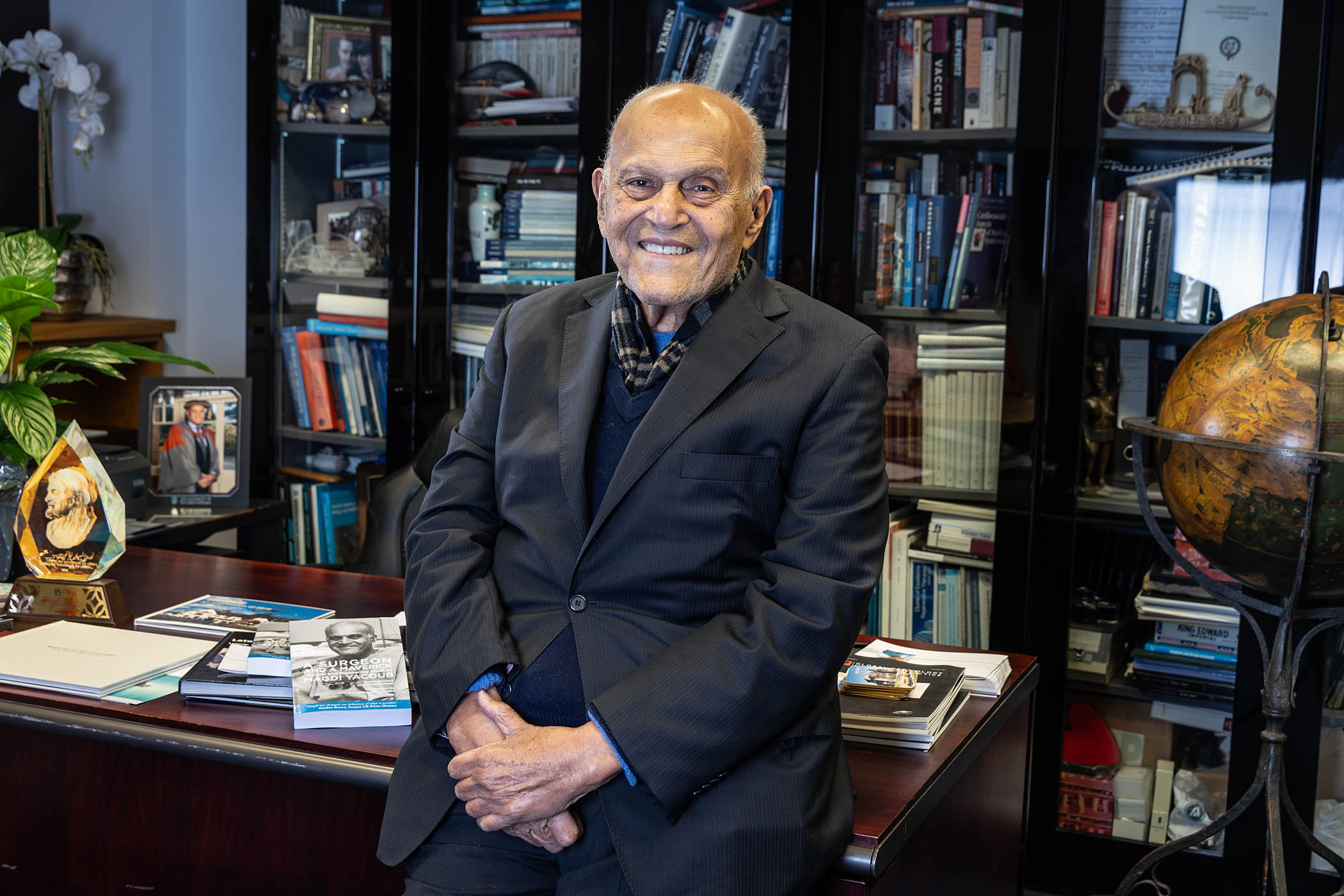
Prof Sir Magdi Habib Yacoub, 90, is a retired professor of cardiothoracic surgery who established the heart transplantation centre at Harefield hospital. He performed the first combined heart and lung transplant in the UK, and set up the Chain of Hope charity, which helps to provide life-saving heart operations for children around the world. From a Coptic Christian family, he was born in Egypt in 1935 but moved to the UK in 1961. He is the subject of the biography A Surgeon and a Maverick by Simon Pearson and Fiona Gorman, which is out now.
The book is filled with remarkable stories but the detail I found most surprising is that you’re squeamish around blood. Can that be true of a celebrated heart surgeon?
That’s absolutely true. The first time I assisted in an operation, I fainted. And whenever I see blood in the street, for example, or somebody hitting somebody, I become faint. The reason why I do not faint when I am operating and cutting the skin and seeing blood is because I feel that I am in charge and that I can control the bleeding. So the concept that I am not in control and somebody is being injured makes me sick and I feel that I could fall to the ground.
As a pioneer of new procedures, you’ve had to deal with periods of high mortality rates and public criticism. Did you ever feel deterred?
If a patient has no other way of surviving except a new operation, then I try to devise such an operation. People say, “You’re experimenting on some patients.” Not really; I was acting on his or her behalf. With heart transplantation, people said that patients wouldn’t last more than a year, and therefore it was unethical. But heart transplant patients have gone on to live up to 36 more years. So I was pleased that this happened but obviously there were anxious times.
In the book we see you working 18-hour days and flying around Europe to remove a heart, then immediately flying back to the UK to transplant it into a patient. Did that work and responsibility ever take a toll on your own health?
At the time I would call on every bit of reserve of my body – adrenaline, endorphins, whatever – to keep me going but afterwards I’d be completely exhausted and fall into a deep sleep. In those days we used to recover very quickly. I also used to swim a lot and do a lot of exercise. The body has remarkable reserves. I know for sure that hard work does not kill you, but stress does. I try to avoid stress.
Harefield hospital, on the outskirts of London, was called a ‘village hospital’. How was it able to surpass the great teaching hospitals in heart surgery?
It’s such a special place. It helped people during the first world war. It helped people with tuberculosis, and then Sir Thomas Holmes Sellors did some of the pioneering operations on the heart. My job was to carry on this tradition, and the staff were completely dedicated to the speciality. Everyone from the cleaners and porters was focused on helping the patients. So I was fortunate to work in such an environment, rather than in huge hospital, which is more rigid in its ways.
You treated famous patients including Eric Morecambe, but you became friendly with one in particular, Omar Sharif. What was the bond?
Newsletters
Choose the newsletters you want to receive
View more
For information about how The Observer protects your data, read our Privacy Policy
Well, we both came from Egypt, but I also identified with Omar in a big way. I got to know him so well, and he had an incredible sense of humour. He used to help a lot with Chain of Hope, my charity. He would often recount how he came to me saying that he had severe chest pains. I looked at his angiograms and said: “Have you had lunch?” He said “No” and I said: “We can do the operation tonight.” He said: “Oh my God, what are you talking about?” After the operation he moaned out loud a lot and a nurse said: “Are you in pain, Mr Sharif?” He said no. So she asked him why he was moaning. “In Egypt,” he explained, “when you have an operation, you are told to keep saying ‘Aagh.’”
You also became friends with Princess Diana. What was the connection there?
She cared about people. She asked me once which child patient was suffering most. I mentioned a 14-year-old girl from Ireland who’d lost her kidney and was on dialysis three days a week. Princess Diana would visit at night and sit with the girl. When I did my night rounds, I would hear them both giggling, while she painted the girl’s toenails. She really cared about people.
You’ve always been a strong supporter of the NHS, but it’s going through a very difficult time at the moment, under a lot of criticism and pressure. What do you think should be done?
I’m totally committed to the NHS because I practised in other countries, including the US, and I am totally convinced that it is the best system. Why? Because it maintains the sacred relationship between the patient and doctor. Obviously there are problems, and issues with funding, but it remains the best system in the world. Ask a British person if they want to have the very best treatment for themselves and their family, they will say yes. And then you ask them if they want to have the same for their neighbour, it’s still yes. That’s an admirable attitude because it’s not present in every country.
How do you think you would have been as a heart surgery patient?
That’s difficult to answer, because I haven’t been a heart surgery patient, but I have been a patient when I fractured my pelvis trying to escape from cameras at Rome airport about two years ago, and I think I was a good patient. I tried to comply and do everything they wanted me to do, and I wasn’t saying “Aagh” all the time, like Omar [Sharif] did.
You’ve lived in the UK now for 64 years, you’re a British citizen, and you’ve contributed enormously to this country. Do you think of yourself as British, or do you still feel essentially Egyptian at heart?
I feel British-Egyptian or Egyptian-British, but I’ve lived longer in this country, so I have great loyalty to this country. But I like to think of myself as a citizen of the world. I really think equity in healthcare delivery is vital because we are all the same. So I am a British, Egyptian citizen of the world, if you can combine all that together.
What part has music played in your life and work?
It plays a major role. I listened to it when operating, particularly Johann Sebastian Bach, so measured and perfect and calming. Also Mozart, his piano concertos, for example. Music is a great healer, and without it, life would be almost intolerable.