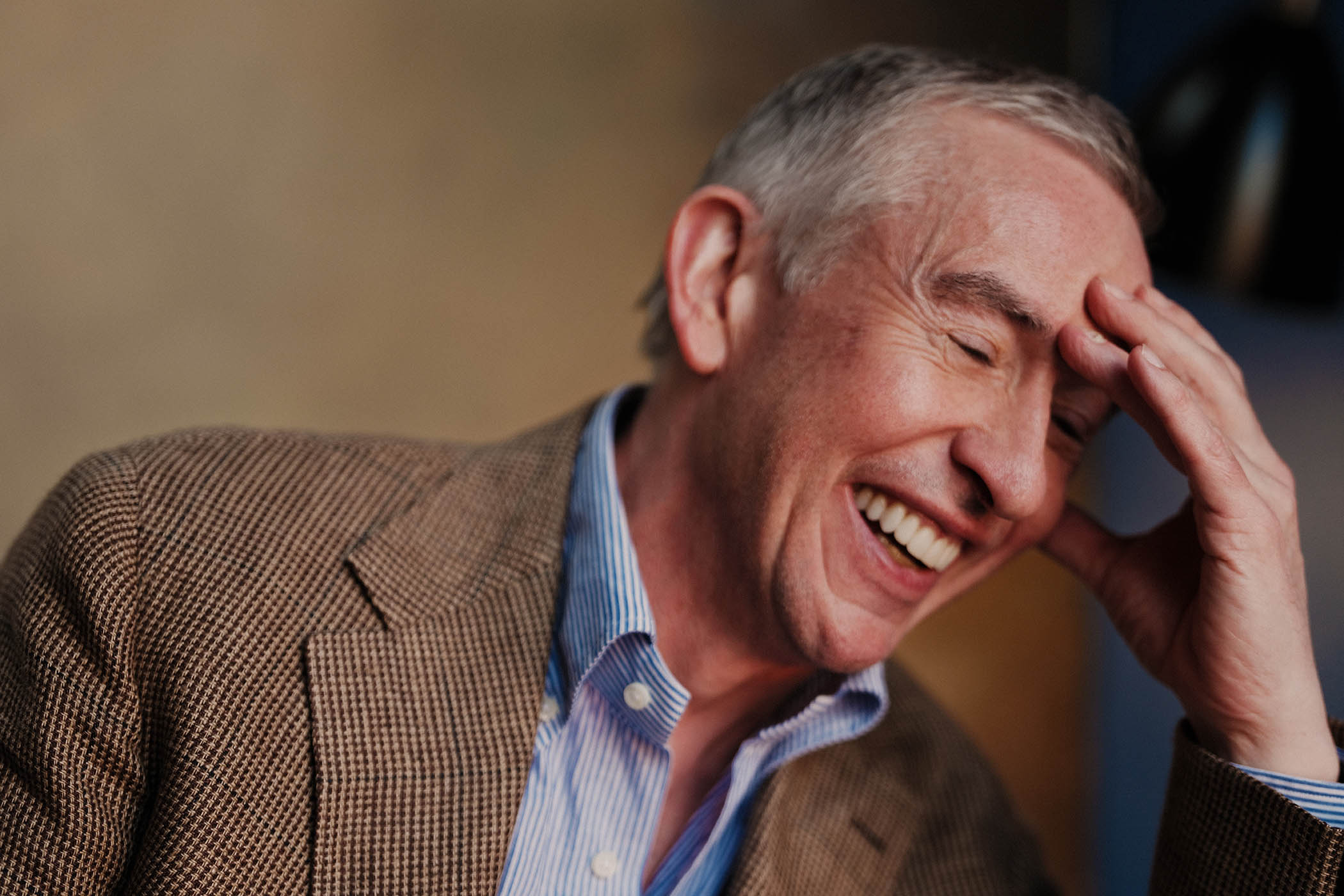

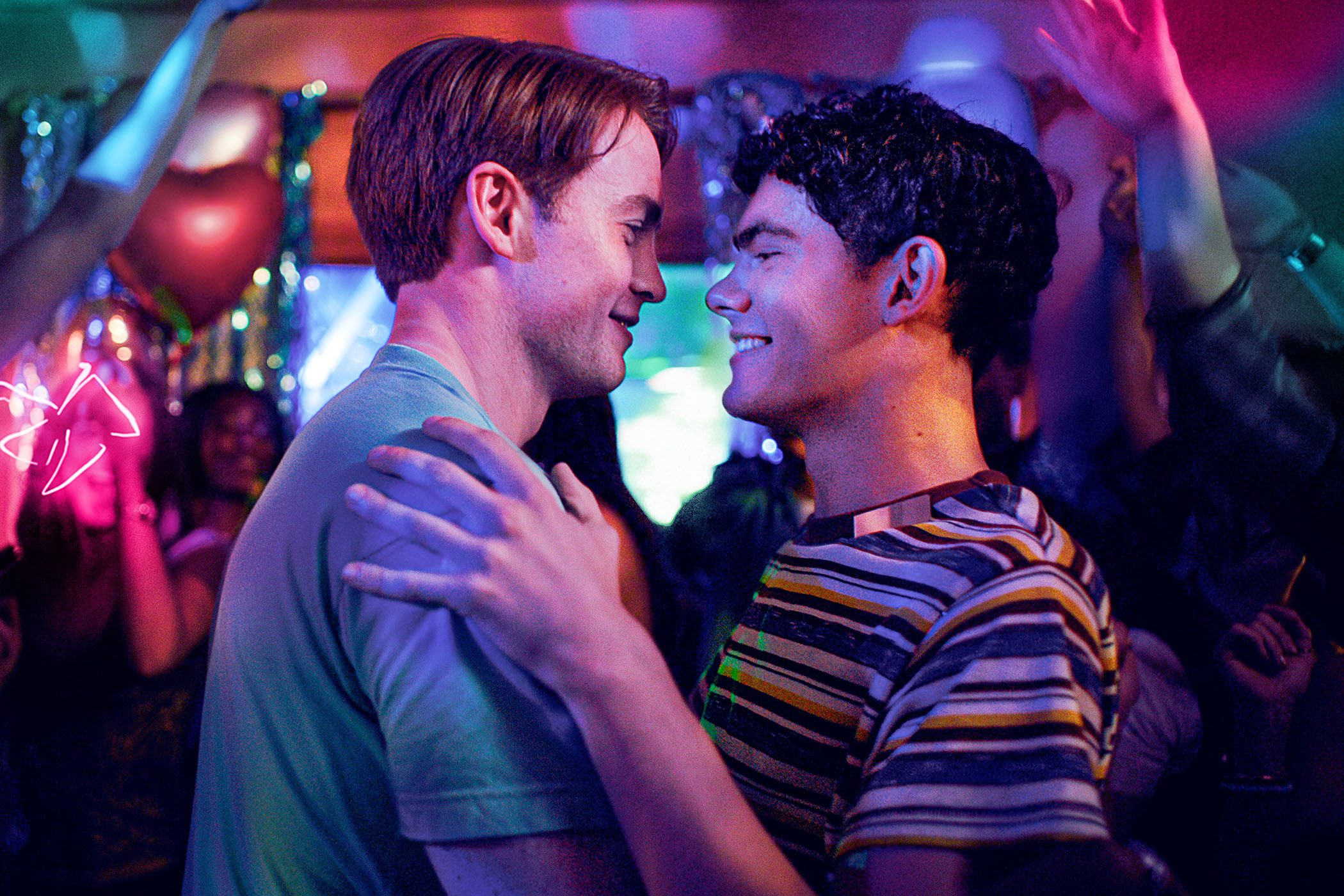

The actor and comedian Steve Coogan was born in Middleton, Lancashire, in 1965 and got his break as a voice actor on Spitting Image. He’s best known for his comic creation Alan Partridge, who first appeared on Radio 4’s On the Hour in 1991 and has since featured in books, podcasts, a film and numerous TV series, most recently How Are You? It’s Alan (Partridge). Outside comedy, Coogan has starred in 24 Hour Party People, Philomena and the 2023 BBC series The Reckoning, in which he played Jimmy Savile. His latest film, Saipan, focuses on tensions between the Republic of Ireland football manager Mick McCarthy (Coogan) and captain Roy Keane (Éanna Hardwicke) in the leadup to the 2002 World Cup.
Saipan took me back to when the spat between Mick McCarthy and Roy Keane dominated Irish headlines. What drew you to the role of Mick?
I’m not a huge football person, to be honest. I’ve got four brothers and they all play five-a-side once a week, and they’ve all got knee problems, and I don’t. I was interested in it more as a member of the [Irish] diaspora. I thought, I understand that schizophrenic idea of identity, of feeling that you live in the middle of the Irish Sea. My parents came from Ireland. I spent all my summers there. So I felt like I knew a little bit about that.
There’s a scene where Roy quite viciously questions Mick’s Irishness [although an Irish citizen, he was born and raised in Yorkshire]. Did that strike a nerve?
Yeah, it did. I’ve got my Irish passport and I brandish it in certain places as a badge of honour, but that is a double-edged sword. When I first read the script, I felt it was a bit too hard on Mick, and I lobbied for that to be softened a bit, because I felt like I wanted to be an advocate for him, and let Éanna be an advocate for Roy.
Did you talk to Mick?
Yes. He wasn’t that forthcoming but he was very friendly. He said something like, “I only hope it’s not one-sided.” And I don’t think it is.
What for you is the nub of Mick and Roy’s disagreement?
I think the heart of it is the line where Roy says about the Irish [that] everyone likes them but they’re not one of the grownups at the party; they’re a bit of light relief. So the Roy side of things is like, the Irish should be playing to win and to take themselves seriously as a nation and a culture, and damn the PR. He’s in it for the fight, and that is compelling. But the Mick side of things is that, ultimately, we’re not going to win, and therefore make this experience fulfilling in and of itself. I really can see both points of view.
You had a bit of Roy Keane in you earlier in your career.
Yeah, I understand that anger. And I don’t mind if some people think I’m a cunt, as long as it’s a manageable amount [laughs]. I don’t mind having a fight. I probably gravitate towards it. Weirdly, my mother, who’s Irish and Catholic, always liked Roy Keane, even when he was in trouble for some of the horrible things he did; she wouldn’t hear a bad word said against him. And I think it was because she sensed a sort of authenticity. He wasn’t a slimeball; he wasn’t turning on the charm to be something he wasn’t. There was something elemental about that.
Are you gravitating more towards Mick as you get older – mellower, less confrontational?
Yeah, I think so… I did sometimes like to pick fights and get angry about stuff, but when you get older, you realise that kindness – even in the face of discord – is really important. You realise you can’t change the world, but you can have a material effect on your immediate environment, and you can be useful rather than just say stuff.
Newsletters
Choose the newsletters you want to receive
View more
For information about how The Observer protects your data, read our Privacy Policy
You’ve played a few real-life people over the years, some nicer than others.
11 or 12.
You’ve been keeping count?
I sat down and worked it out the other day because I thought, I’ve played quite a few real people.
Why is that? Is it because you have a talent for impersonation?
That certainly helps. I do have a good ear, and I find it quite easy to adopt physical and verbal mannerisms. I have a sort of outside-in approach: method acting tells you that you have to start on the inside, but in actual fact you can, without knowing someone, learn to walk like them and talk like them, and you start to get a feeling what it is to be like them. It’s counterintuitive.
Which of those real-life people got under your skin the most?
Jimmy Savile got under my skin. That might sound a bit incriminating, but it did affect me. At first, I was quite blasé about it. And then, after having done it for a couple of months, I started to feel a bit depressed in a way that shocked me, because of the relentlessness of it. I started to feel physically sick.
Is doing Alan Partridge a respite from these more serious, difficult roles?
Definitely, yes. That really is like a warm bath, even though he says some things that are terrible. But he’s not nasty or twisted. He’s what Alexander Pope said about a little knowledge being a dangerous thing: drink deeply or not at all. And Alan, I think, is the living embodiment of “a little knowledge”.
Do you think Alan would be a Reform voter? Would he fall for Nigel Farage?
No, I don’t think he would. Early in his career, he might have done, but I think he’s worse than that in a way. What I mean is that he likes to think he’s the voice of moderation, and he’d probably like Starmer, and he’d like David Cameron, Tony Blair, all these people. Basically, he would fully support the neoliberal consensus. And I lay the rise of Reform squarely at the feet of the neoliberal consensus, of which Alan Partridge is a representative. They are the ones who got us in this fucking mess, because had there been any attempt to change the conditions and lives of people who are the victims of our post-industrial landscape, rather than saying, “Nothing we can do about it,” things would have been different. Now those people have gone: “Well, the status quo hasn’t done anything for us in the last 40 years, we will vote for anyone. We will vote for a clown, as long as what he says is different from what we’ve been told.” And yes, the message is simplistic. But as we know from Weimar Germany, simplistic messages are quite contagious. But, no, Alan Partridge would wag his finger at Reform, not realising that he is part of what was responsible for it.
Where are you finding your political home at the moment?
I’m not really engaged in national politics. I am engaged in local politics, with the idea that you can’t change the world, but you can affect your local area by trying to encourage politics in a different way. I’m a big fan of the cooperative model. When people feel engaged and empowered, they do more. It’s not really left-right, it’s sort of bottom-up. Andy Burnham is a big advocate of this. He had an epiphany when he went into local politics because, unlike at cabinet level, he could actually have an idea and action it within a manageable amount of time.
You’ve just been filming a fifth season of The Trip. What should we expect?
Oh yeah, I did The Trip to the Northern Lights with Rob [Brydon]. We did Norway, Sweden. We dressed up as Vikings. Rob and I were both approaching 60 at the time. Well, he was 60 and I wasn’t – just yet. And he had a big party with celebrities, whereas I climbed Kilimanjaro. And I think that sort of sums it up. So it’s the same old thing: I play pretentious sanctimony, which is half true, and he plays people-pleasing Rob, which is half true.
What’s the best thing you’ve eaten on all these different jaunts?
Well, it’s very hard to remember because it isn’t really about the food. I get just as much pleasure from a fried egg sandwich. In fact, I love rhubarb, and I had this triple rhubarb dessert in the Lake District, at a place called Hipping Hall, which I think is now shut. It was 15 years ago and I’ve never forgotten that dessert. But when you have Michelin-star food all day, every day, it does make you crave really simple food.
On Louis Theroux’s podcast a few months ago, you said that comedy is a mixture of music and maths. What did you mean?
That you learn formulae [in comedy] but you can’t just rely on them; you have to go off-piste. The funniest things are the things where it’s still mysterious. You’re not quite sure why it’s funny, but you know that it is, and that is always a delight. When I write with the Gibbons brothers [Neil and Rob] on Partridge, we have some things that we know intuitively are going to work. Sometimes you’re almost talking in algebraic terms: it’s x plus y. But then you’ll trip over something that is really funny, that doesn’t obey any rules at all, and it does something in your brain. You’ll be laughing and not knowing quite why. And even now, at my age, having done it so long, those are still delicious moments, because you know other people are going to be laughing too.
Saipan is released on 23 January
Photograph by Phil Sharp