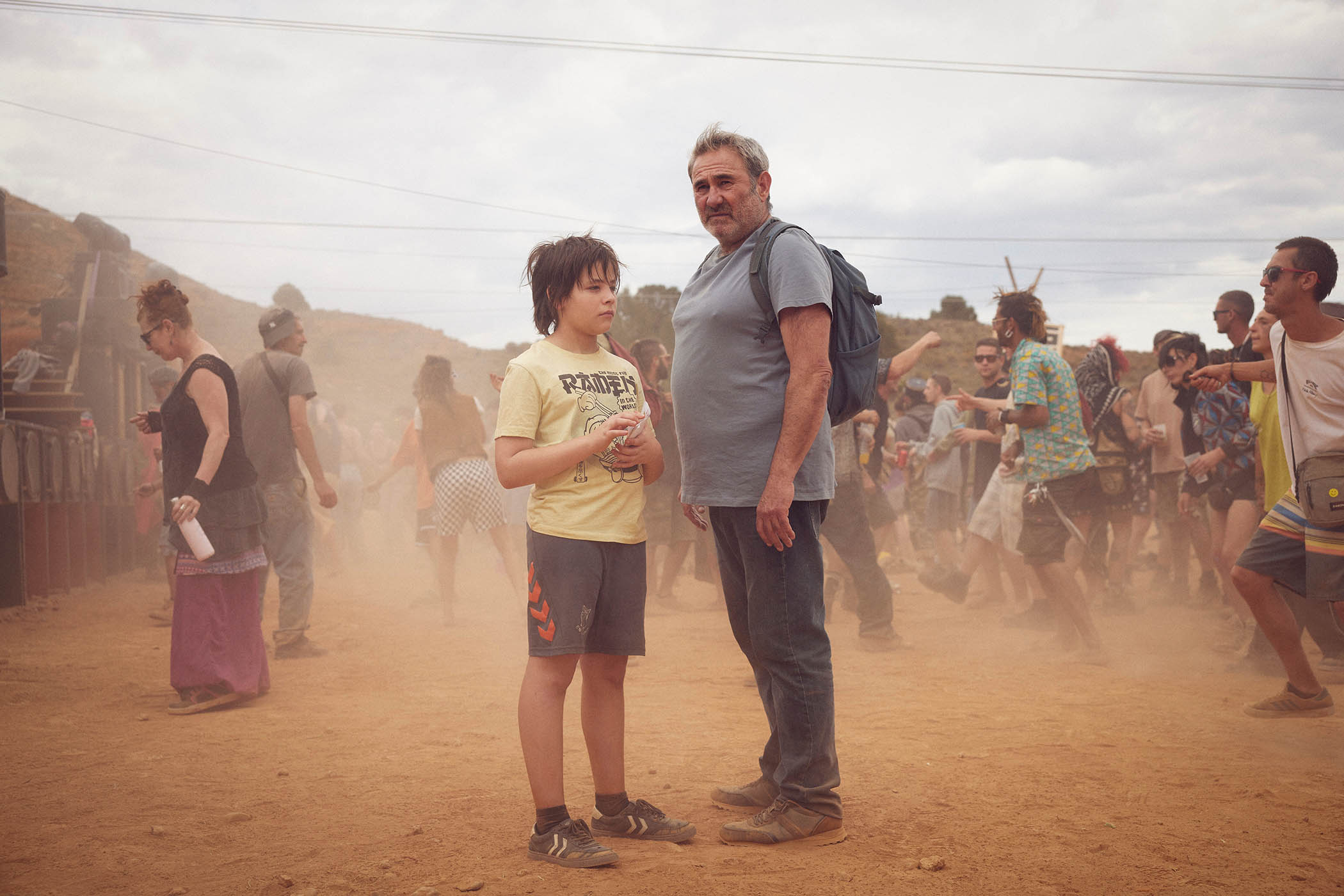



Óliver Laxe’s desert rave odyssey Sirāt is unlike any other film you might have experienced. It begins with an extended sequence of exultant revellers worshipping at a wall of speakers, in a pulsing, primal shrine to trance techno, before taking us on a journey to the edge of the abyss. There is a visceral, gut-punch of a story swerve with an impact that few movies could even hope to achieve. Combining deep spirituality with nihilistic abandon, this is a picture designed to be felt more than understood. Sirāt is a trip: cinema as a mind-expanding substance.
Describing the plot feels almost reductive. That initial party, held somewhere in Morocco, stretches over bleary days and endless nights. The camera weaves through bodies that lurch and stomp in time with the driving rhythms – these are bodies that wear the cost of living outside society in missing limbs, tribal tattoos and sun-damaged skin. Amid the throng, we glimpse a middle-aged man and his young son, distributing flyers to the ravers.
He is Luis (Sergi López); together with his youngest child, Esteban (Bruno Núñez Arjona), he is searching for his missing daughter. He has been informed that she might be at this party, but nobody recognises her from her picture. Still, there’s always another party, and the next one is deep in the desert country near the border with Mauritania. It’s a hostile land at the best of times, with unmade roads and rough tracks that snake around the sides of precipitous mountain slopes. But a state of emergency has been declared, with the outbreak of what one character describes as “World War Three”.
The camera weaves through bodies that lurch and stomp with the driving rhythms
The camera weaves through bodies that lurch and stomp with the driving rhythms
A military intervention halts the rave. Soldiers with guns and scared faces attempt to marshal the partygoers on to vehicles. But these are people who don’t do what they are told. A splinter group of vans and buses accelerates into the mountains on a dirt track. Not knowing what else to do, Luis follows them. A de facto family of ravers, all played by magnetic non-professionals, agree to let Luis and his son accompany them to the next party. They caution, however, that the trip will not be easy. This turns out to be something of an understatement.
The journey, rather than the destination, is the heart of the film – one that is as much spiritual as it is physical. The film’s title is taken from the Islamic concept of a bridge that links hell and heaven, “as thin as a strand of hair and as sharp as a sword”. The division between those realms is thoroughly blurred during this gruelling trek across the vast, purgatorial nothingness of the desert.
This is a piece of extraordinarily visceral film-making by Laxe. The visionary cinematographer Mauro Herce (Laxe’s collaborator on his two previous films, Fire Will Come and Mimosas) sculpts with light and colour. The choking ochres and rust-red hues catch in your throat and eyes like grit; the aftermath of a sandstorm softens the harsh light of the sun and gives the picture a heady, dreamlike wooziness. And then there’s the use of music and sound (the film is Oscar-nominated for the latter, as well as for best international picture). The score, by the French DJ and composer Kangding Ray, begins as deep, crunchy analogue techno that you feel deep in your chest cavity. But as the film progresses, the tone shifts and the characters become unmoored in an existential hinterland: Laxe has described it as “dematerialisation”. The music frays and degrades into sonic textures rather than recognisable rhythms. It’s a soundscape that matches the disquieting landscape.
This is such a distinctive and unusual film that it is hard to draw parallels with other works. But there are several American productions from the 1970s with which it shares a spiritual and aesthetic kinship: William Friedkin’s nightmarish road trip Sorcerer; Michelangelo Antonioni’s Zabriskie Point, Monte Hellman’s Two-Lane Blacktop and, perhaps above all, Dennis Hopper’s Easy Rider, with its unfeigned countercultural spirit.
There is always a challenge in making a cinematic depiction of an alternative lifestyle feel authentic – the very fact of bringing a film crew into a closed milieu changes it. But Laxe is part of the rave scene and knows this world intimately. His dispatches from the party at the end of the world are bracingly truthful.
Photograph by AP
Newsletters
Choose the newsletters you want to receive
View more
For information about how The Observer protects your data, read our Privacy Policy