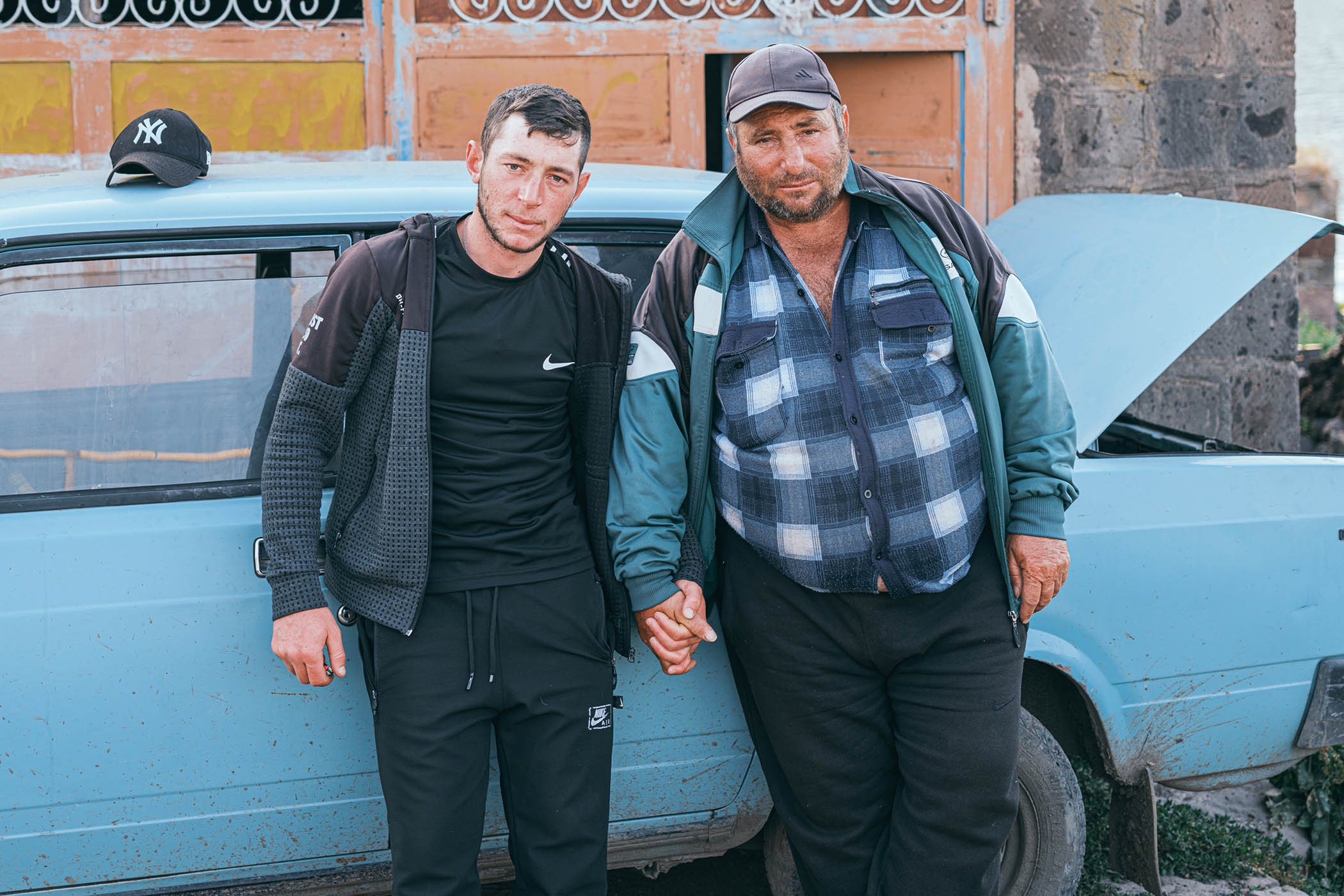

Five years ago, the Bulgarian documentary photographer Valery Poshtarov was walking his two sons to school when a friend of the family approached from the opposite direction. Poshtarov’s sons were eight and 10 years old, and he was holding both of their hands, an act that was familiar and comfortable for him, but which surprised his friend, whose own child was a similar age. Poshtarov was briefly struck. “At that moment I realised our situation wouldn’t last forever,” he told me recently. Eventually his sons would let go.
Poshtarov considered what he might do to “maintain closeness” and “ensure this would continue to feel normal in the future” – a kind of sad-dad quest common to many fathers of his generation. Then he thought of his own father – when was the last time they held hands? – and about his grandfather, who was 95. In time, he convinced the two older men to stand for a portrait.
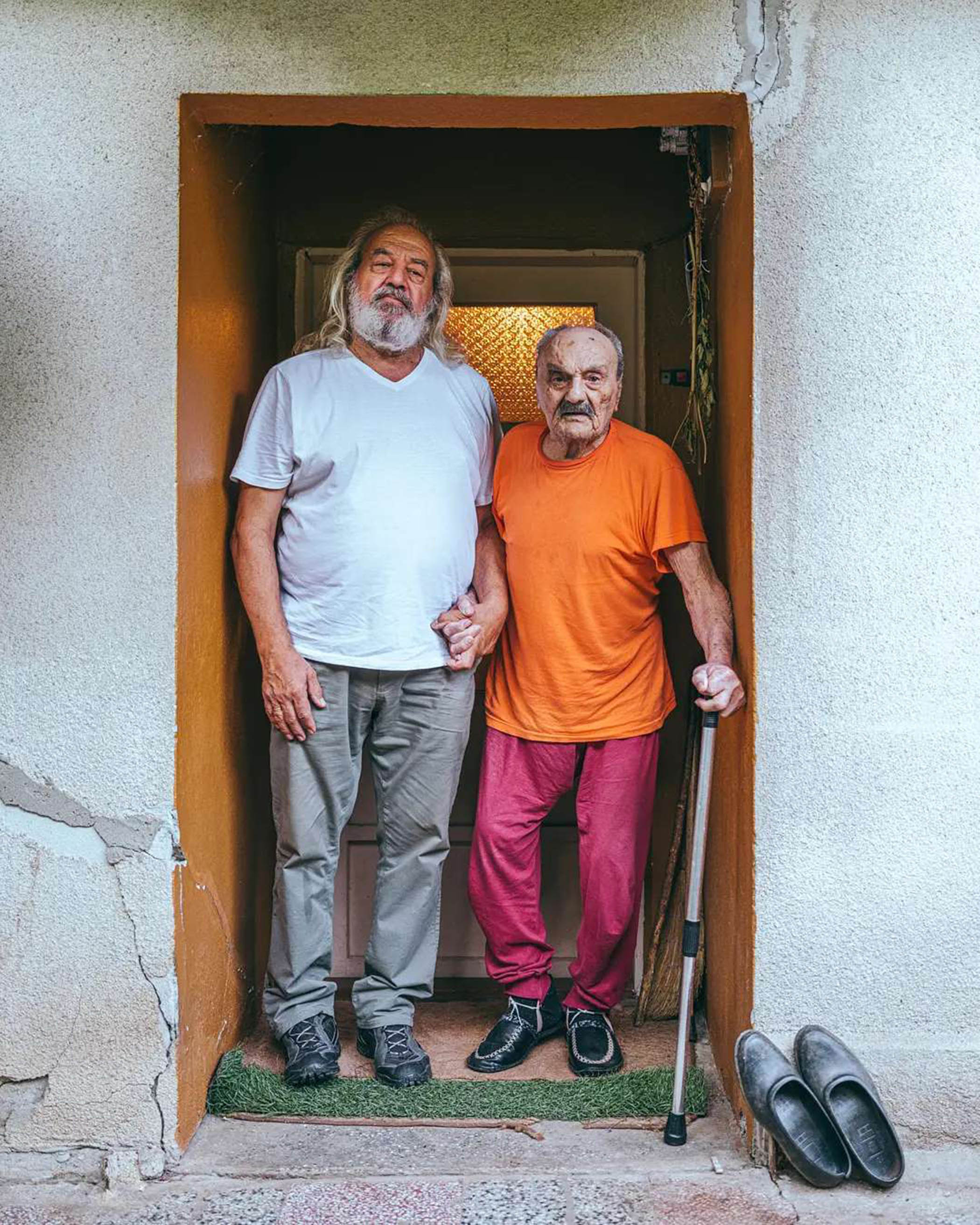
Poshtarov’s father and grandfather in Dobrich, Bulgaria, 2021. Above: Poka, Georgia, 2023
“The hand-holding was interesting,” the photographer told me. His grandfather’s health had been in decline, and his father had begun caring for him. While taking their picture, Poshtarov imagined he might capture a “reversal of roles” – son as parent, parent as son. And yet the portrait shows “two men of equal strength and respect.”
Poshtarov began travelling across Europe, looking for other fathers and sons to photograph. He would land in France or Greece or Italy, show examples of his work to strangers, and ask if they would take part. Sometimes the men he spoke to did not immediately realise that the hand-holding was a prerequisite of participation, and in the end they declined the invitation. “I don’t really try to convince them,” he said. “I leave them space to decide if it’s OK to take part.” But plenty have said yes, which is when something like magic happens. A significant number of the men Poshtarov has photographed haven’t held hands for decades, and their moments of first contact are often curious and complicated. (“I normally don’t take a picture of that reaction,” he told me. “I give them time.”) Some of the men have never held hands. “I’ve had instances when the father was completely absent” from their son’s childhood, he told me, and “this image, and the process that led to it, becomes a part of their reconciliation.”
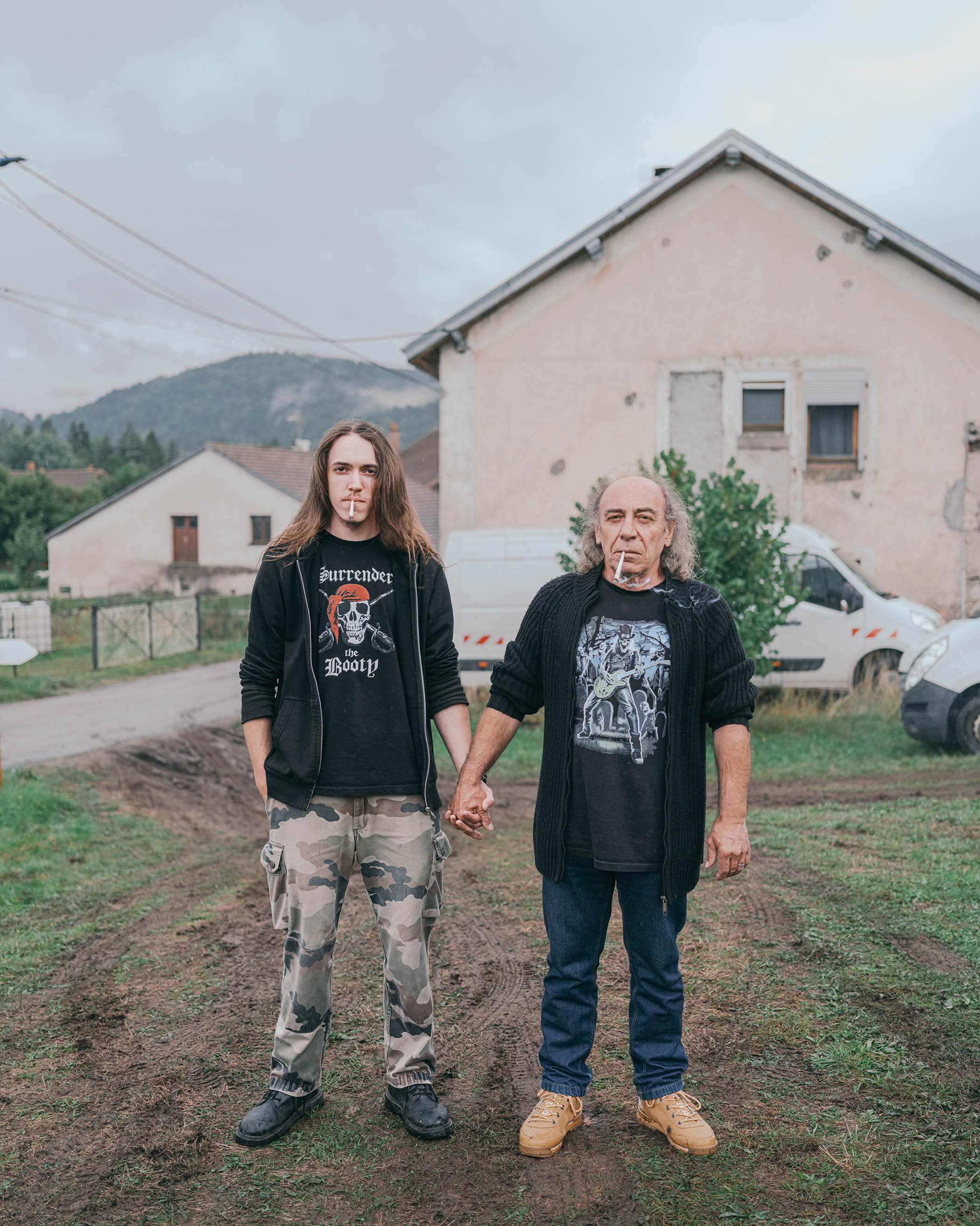
Ferdrupt, France, 2025
When you look closely at these photographs, what do you see? All of these compelling men in different locations, staring directly at Poshtarov’s lens, quietly laying bare their relationships. Is that love in their embrace, or tension? Is that a smile or a snarl? Is it remorse or bitterness or familiarity? Do each of these men want to be holding hold hands, or did one party somehow coerce the other? Poshtarov has come to realise that the strength of his photographs lies in the power they have to reflect how viewers feel about their own relationships. People see these pictures and want to embrace their own fathers, to tell them they love them, tell them they’re sorry. They want to say “thank you” or “come back” or “goodbye” or “now I understand.”
During our conversation, Poshtarov spoke of the courage required to take part in his project – the decision to publicly hold hands with another man, even if it is a direct relation, weighs heavy with cultural prejudice. “It’s different from country to country, because of the different taboos and stereotypes,” he said. In some countries men feel free to hold hands. In others they do not.
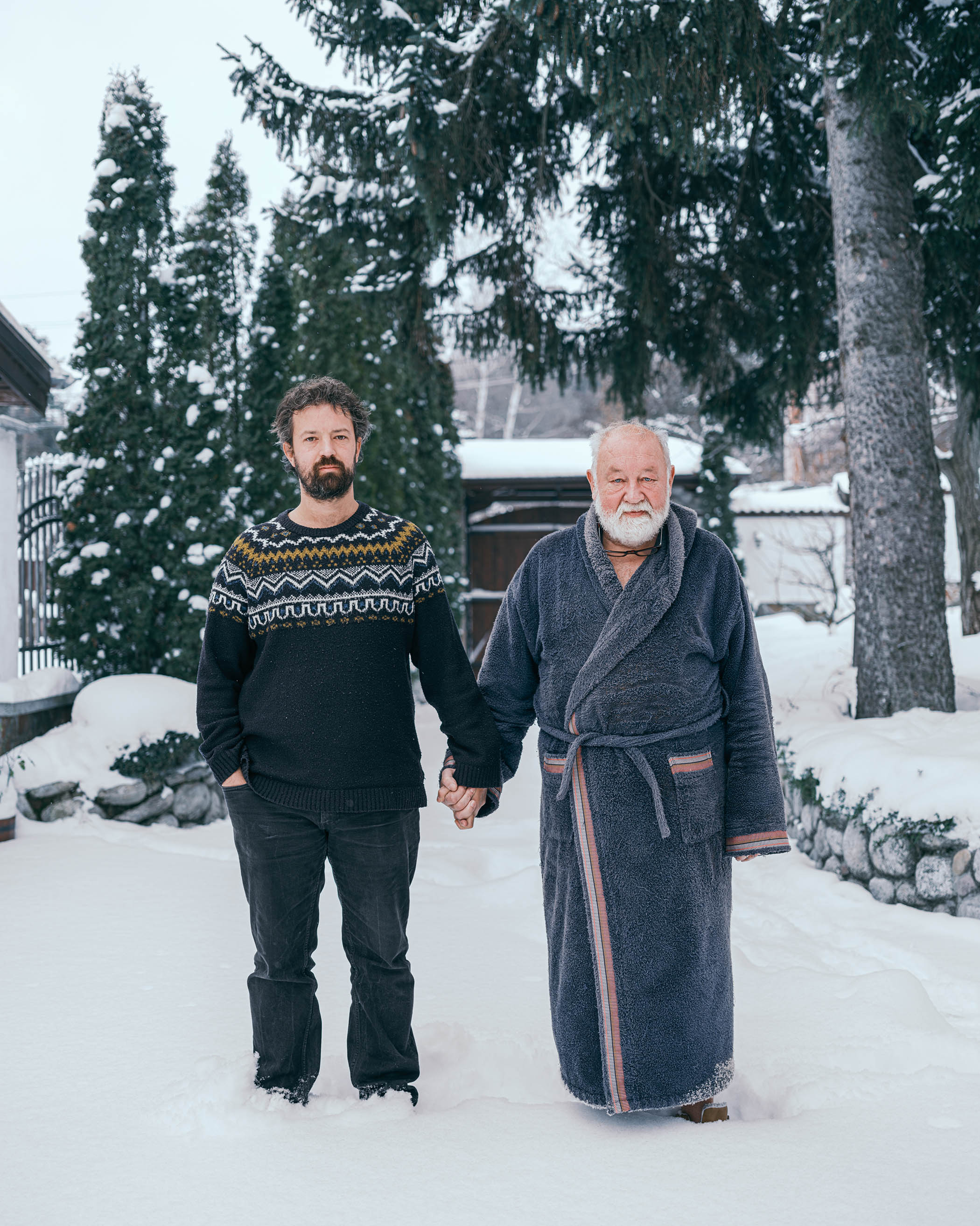
Bistritsa, Bulgaria, 2023
When I first came across Poshtarov’s photos, last year, I immediately thought of my son, who was then eight, and my father, who died when I was 20. Though I tried very hard, I couldn’t remember the last time I held my father’s hand. And though we must have done – he was a tactile man, if not always present – to my knowledge no proof exists.
This makes me sad, obviously, though to be honest I don’t understand why. I loved him deeply. He was not always a good man. I know that he loved me, too. It was a complicated relationship that ended prematurely.
What would a memory of our holding hands change?
And then I think of my son. I absolutely remember the last time we held hands, because it was last night, while he was telling me of trouble at school. His is a hand I always crave, and yet, now he is nine, it is a hand he is less willing to offer. No longer do our hands meet automatically when we are walking home at the end of the day, or along our small high street to find snacks, or while weaving through crowds. I am already mourning the loss of this specific kind of touch, and as a result I miss him now even though he is still very much here.
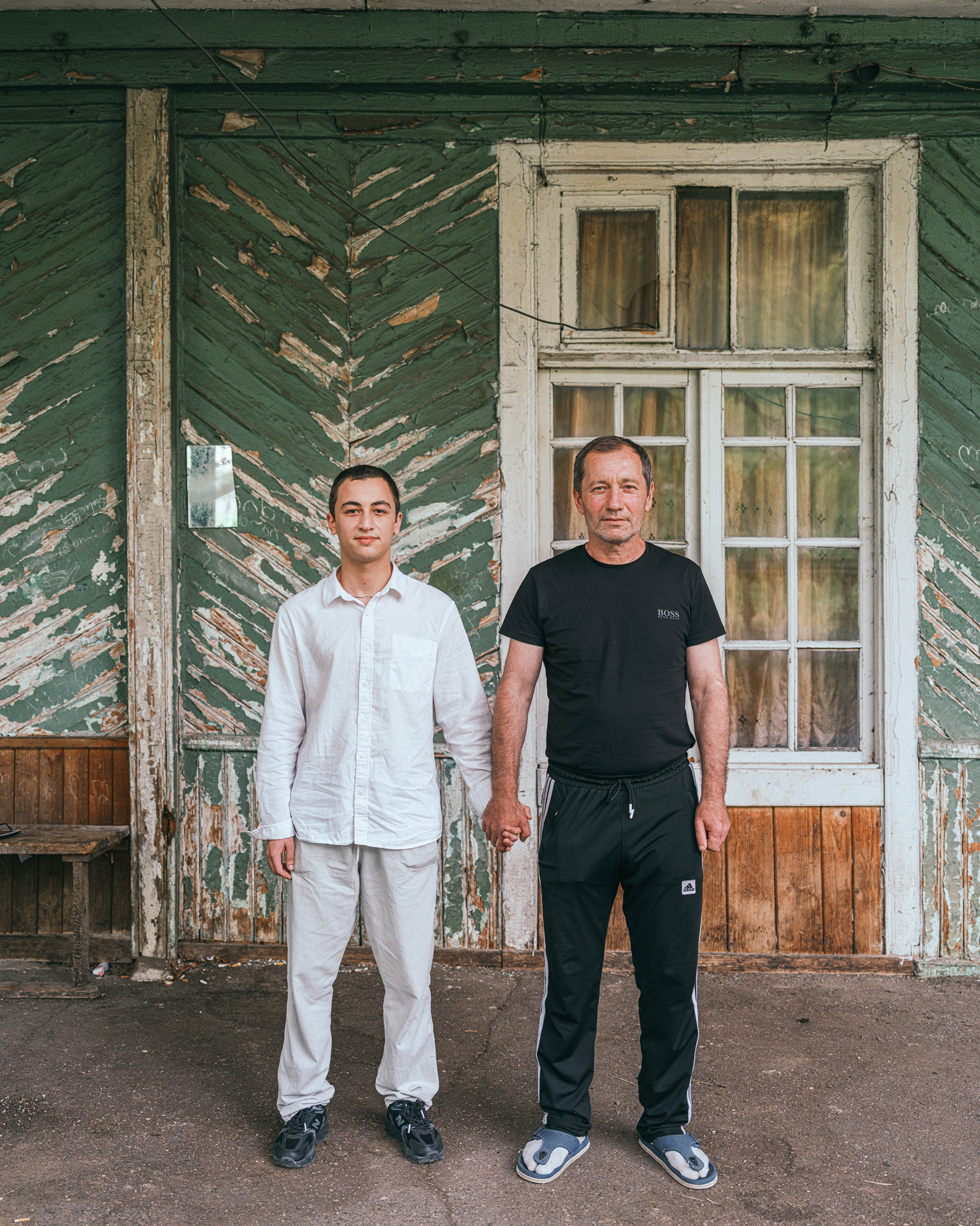
Akhaldaba, Georgia, 2023
My wife jokes, not incorrectly, that I am a sad sap, and that I must let go. (She is always right.) I will when the time comes, of course. All of us know that the horrible crux of parenting is the requirement to develop your sweet-terrible dependents so that one day they may comfortably leave. This is easy for my wife to say – cultural preconceptions will not prevent her from holding our son’s hand when he is fully grown. What about poor me? A slightly older colleague told me recently that he often sees his wife holding hands with their adult son. In public. But he can’t remember the last time he did so.
This is not untypical. The other day, I asked several male friends to recall the moment they last held their father’s hand, and the answers were mixed.
“Powerful question,” one said. His answer was, “Last year.”
Another said he recently helped his father across a stream, but that the action was more pragmatic than emotional. (To help someone you love is something more than pragmatism, I would argue, but no, this was business.)
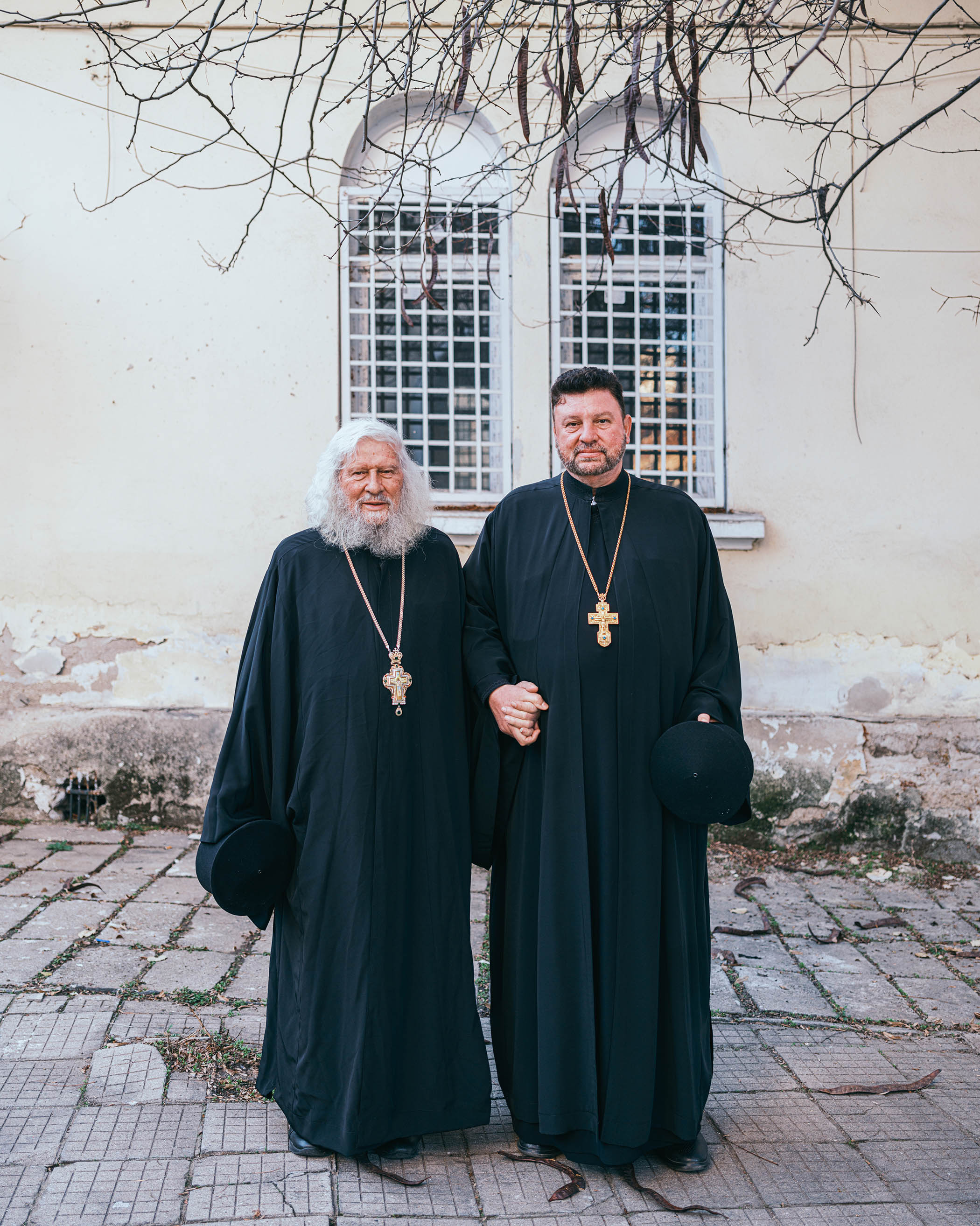
Plovdiv, Bulgaria, 2022
An old friend of mine said he couldn’t remember the last time, and seemed mostly nonplussed by the thought. “A long time ago,” he supposed, and then, “I must have done when I was a kid?”
Other responses were more heartfelt, particularly from those whose fathers are no longer present. In a series of messages, a friend wrote:
“It was in the hospice.”
“And we had an afternoon just me and him.”
“We watched Grand Designs.”
“And I held his hand.”
These photographs prompt all of these feelings to swell into difficult questions: do I miss my father? What was our relationship like, really? Will my son and I follow suit? The guiding thrust of Poshtarov’s project is the very simple idea that boys become men, and that so many boys become versions of their fathers, often physically, sometimes emotionally, and every now and then vocationally. Several of Poshtarov’s images show sons who have followed their fathers into specific professions: the priesthood, the railways, the agriculture industry. (My father, a doctor, very much wanted me to join him within the NHS, but when I spent a week shadowing him at the hospital and discovered he performed colonoscopies, I chose a different path.)
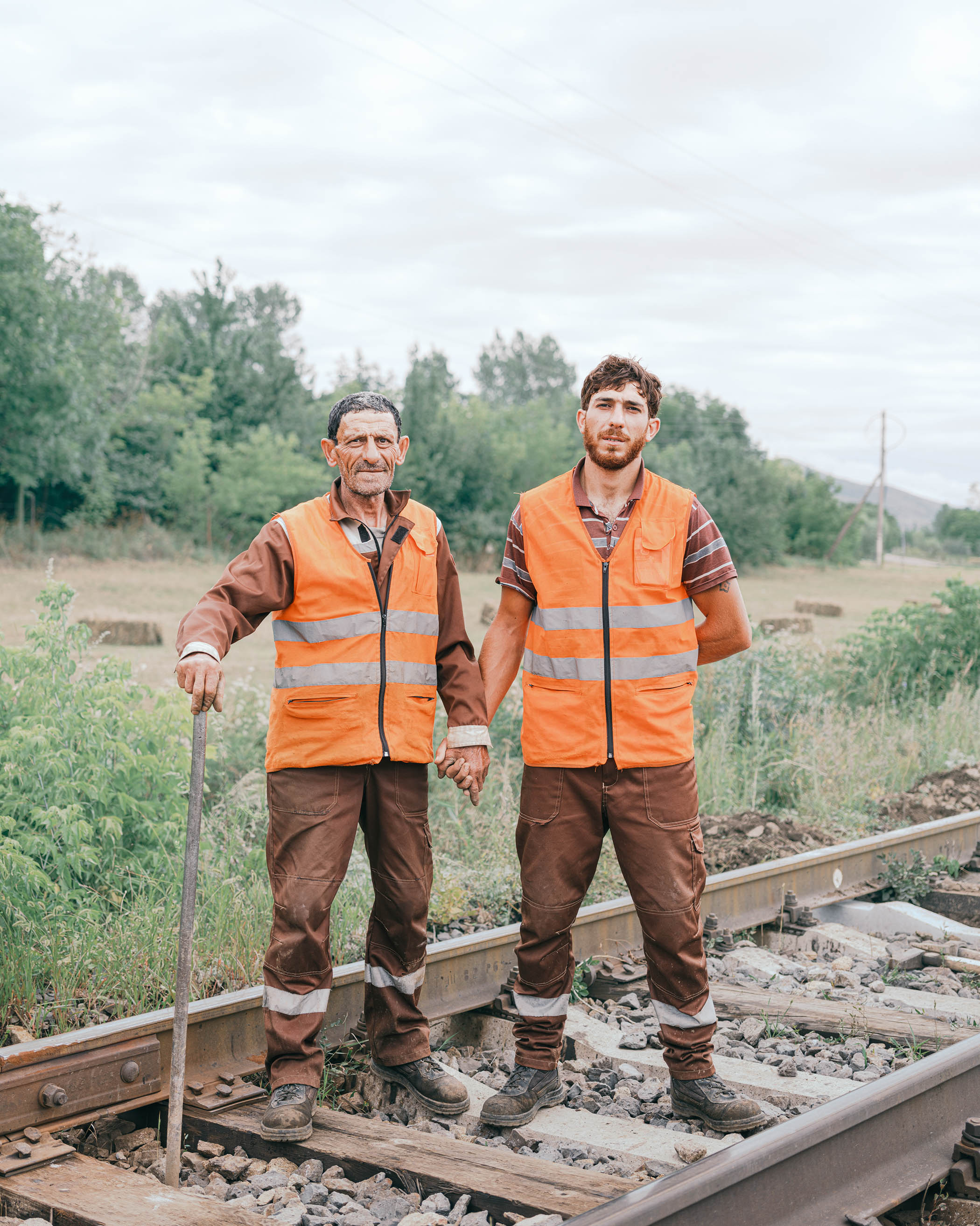
Lusaghbyur, Armenia, 2023
The photographs are all examples of male inheritance – what is given by one generation of men to the next. In his pictures you learn that some men are tactile because their fathers were, and some men are tactile because their fathers weren’t. Either way, behaviour is passed down and learnt.
Poshtarov is less keen to mine the personal situations of the men he photographs, and instead likes to focus on “how we inherit the values of our ancestors” and, more broadly, “how differences between generations shape the world in which we live”. Still, he is making big points about masculinity. Who is a more important role model in a boy’s life than his father? As the manosphere continues to expand, who better to guide them safely away? The men in these photos have all become themselves thanks to forces applied to them, and the suggestion is there is no greater force on a son than his father.
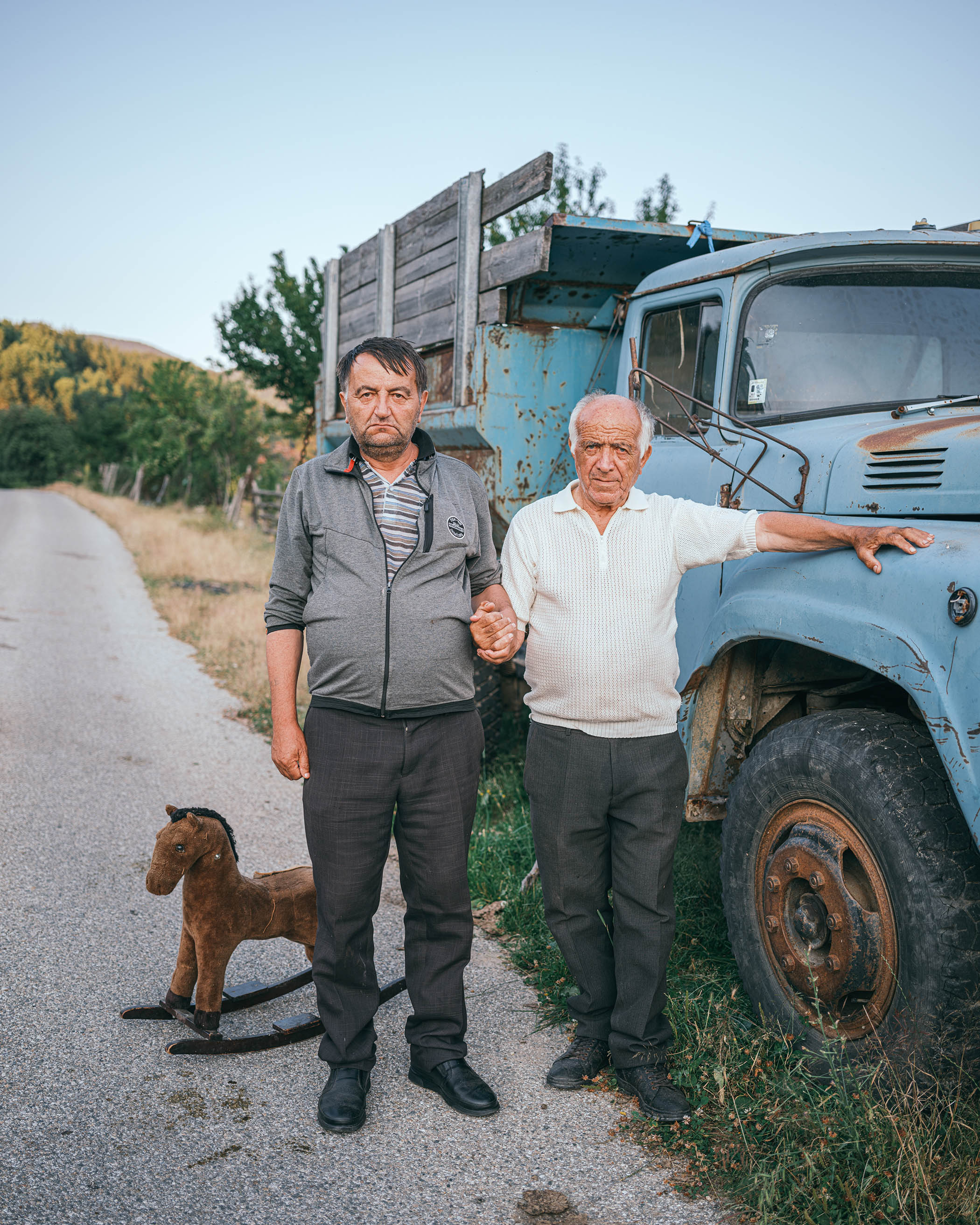
Petvar, Bulgaria, 2022
The photographer was in Malta recently, taking new portraits for this project. He was away from home for two weeks. When he got back he sought his eldest son, who is now 15. “When I came home from Malta I took a power nap with my son and he held my hand,” Poshtarov told me. “I had missed him.”
Newsletters
Choose the newsletters you want to receive
View more
For information about how The Observer protects your data, read our Privacy Policy