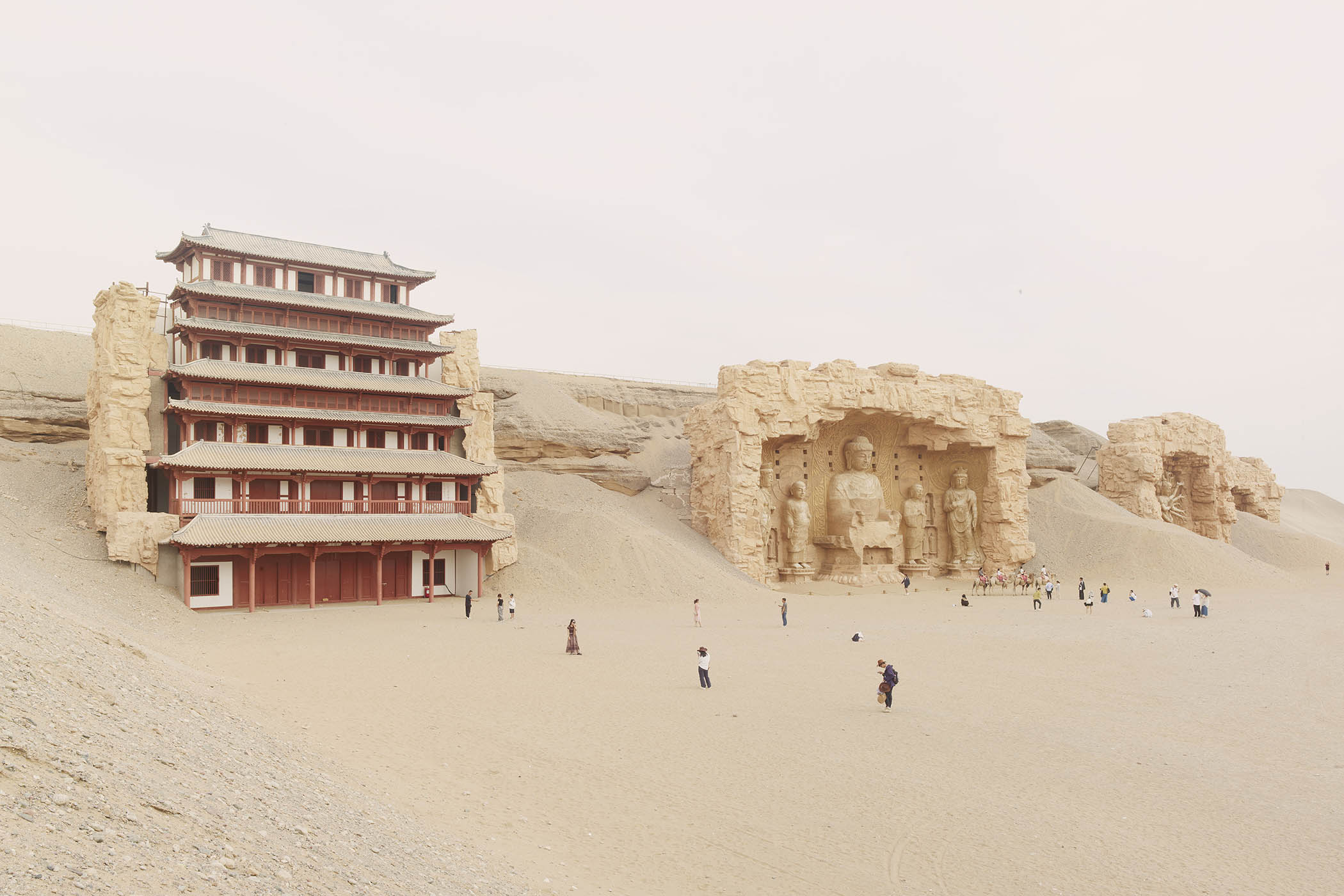

Encountered individually, these majestic structures rising out of the Gobi desert in northern China might inspire a sense of wonder and awed curiosity. How many centuries ago were they constructed, and by whom? Did they lie buried beneath the shifting sands for generations before being rediscovered by some intrepid latter-day archaeologist?
Seeing them all lined up like this, however, you begin to have second thoughts. They are in fact replicas of famous Buddhist sites housed within a 1980s film complex, first used for the 1988 Chinese-Japanese co-production Dun-Huang, aka The Silk Road. “It had been abandoned,” says Sichuan-born photographer Zhang Kechun, who came upon the site at the start of a two-week journey across the Gobi desert last summer. “But with the rise of social media it was rediscovered and gradually became a popular tourist destination.”
The Silk Road Heritage City, as it’s now known, sits about 12 miles outside the genuinely ancient city of Dunhuang, one of the earliest trading posts on the Silk Road as well as an important site for Buddhism – the Mogao Caves, a system of almost 500 art-filled temples carved into cliffs, are just down the road. But many present-day visitors choose to see these replicas instead, along with lifesize copies of other ancient Silk Road attractions, including Greek and Egyptian temples.
Kechun’s series, The Yellow Desert, which resulted from his trip and is now showing at Huxley-Parlour gallery in London, captures the often surreal ways in which ancient and modern worlds rub up against each other in this part of China. Some of the photographs look like tableaux from 1,000 years ago, aided by the fact that a number of Kechun’s fellow visitors to the heritage city “wore ancient costumes and rode horses and camels under the giant sculptures – it felt like travelling back to the ancient Silk Road”. His colour palette, inspired by the “warm yellow tone” of old Chinese landscape paintings faded by time, adds to the impression. Then you look closer and see the tourists with the tote bags and selfie sticks, and all illusions of antiquity fall away.
Zhang Kechun: The Yellow Desert is at Huxley-Parlour gallery at 45 Maddox Street, London, W1S 2PE, until 28 February
Newsletters
Choose the newsletters you want to receive
View more
For information about how The Observer protects your data, read our Privacy Policy