Extraordinary how much a play – or my opinion of it – can change in the course of an evening. I have never read a first-rate book that has a null first page (even Ulysses starts invitingly), yet a show can begin with a bang and then slowly dwindle. Or it may stealthily turn from the lumbering to the extraordinary. Such is the case with Bengal Tiger at the Baghdad Zoo.
Rajiv Joseph’s Iraq war drama, which arrives in the UK 14 years after it was staged on Broadway, begins with jerky overemphasis but, over two and a half hours of slow-burning imagination, it gathers momentum. It ends in revelation. Joseph specialises in reimagining historical events and examining their aftermath.
Next summer, Archduke, his play about the assassination of Franz Ferdinand, will open at the Royal Court. Eight years ago at the Bush, his Guards at the Raj declared that killing people does not erase the ideas that drove them on.
Bengal Tiger, prompted by real events at the Baghdad zoo during the invasion, has a similar thread pulsing through its action. It is a play full of ghosts (literally – or as literal as ghosts can be) of the tortured and murdered, of the guilty who can’t be at rest. It is a mistake to think “that when things die, they go away”. The consequences of the 2003 war are enduring.
Joseph’s intent is evident from the deliberate opening moments. Here is an evocation of the moral jumble, the physical and mental devastation wreaked – on all sides – by war and invasion; a sense of the utter mangling of normal life, the surfacing of scepticism, anarchic violence. Circling the action, seeming to be in charge of its meaning, is a tiger. Who talks. And is dead.
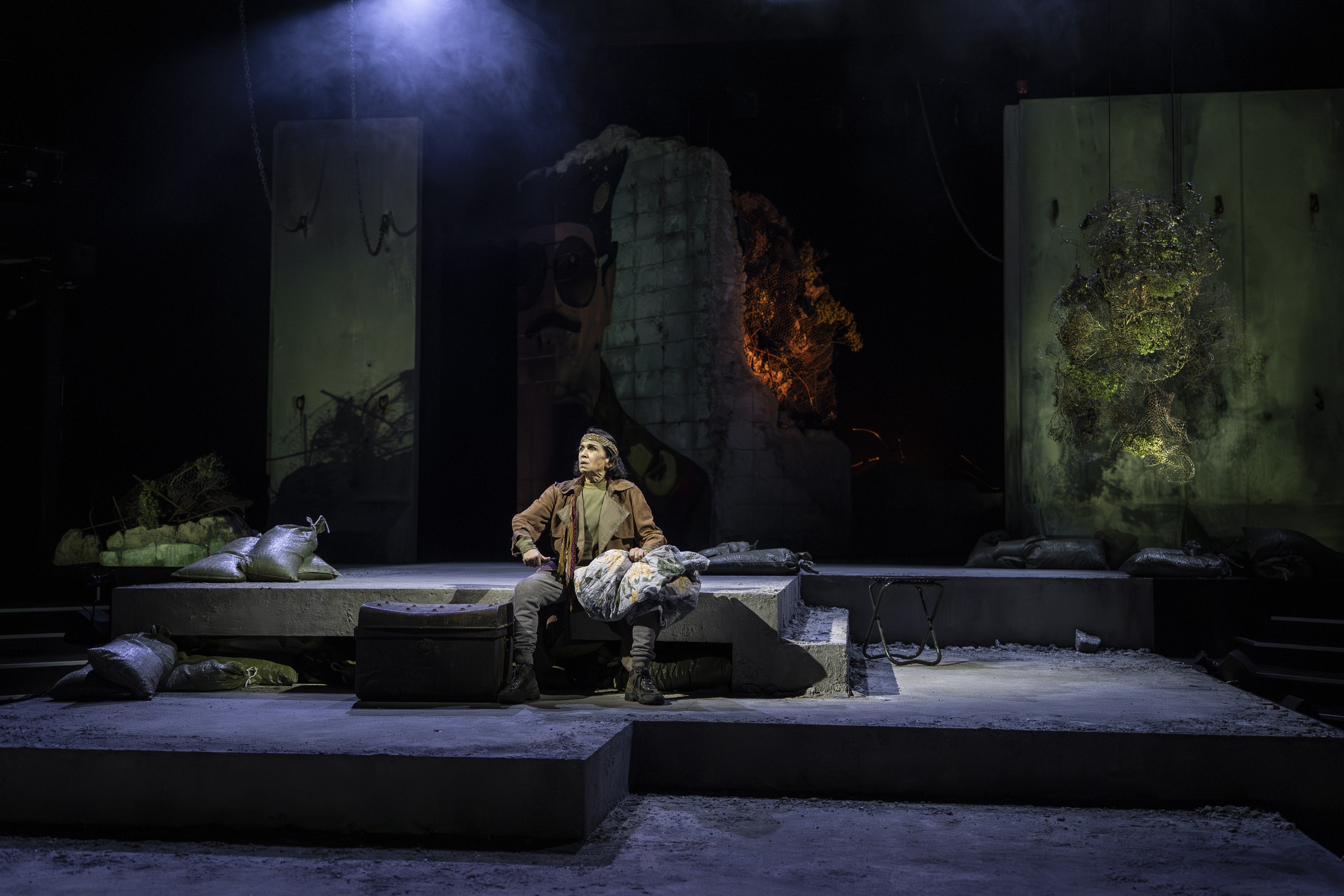
Kathryn Hunter is a feral centre: sourly meditative, casually predatory, who has no time for her former zoo neighbours
Kathryn Hunter is a feral centre: sourly meditative, casually predatory, who has no time for her former zoo neighbours
The combination of bewildered American soldiers and the savvy, cynical tiger makes for awkward transitions, and sluggish movement, with confusion, strenuous humour, archness. Yet from the beginning, the stage smoulders with the possibility of something larger developing. As it does. Rajha Shakiry’s design, aided by Jackie Shemesh’s lighting, is superb: it confirms her gift, apparent in her transporting design for The Father and the Assassin three years ago at the National, for creating a large landscape in a small space, for conjuring resonance.
Everything here is recognisable but strange, suggestive rather than explicit: crumbling masonry, an enormous mural of Saddam Hussein, rising smoke from unseen depths. Later, a huge stars and stripes is slapped across one side of the stage, and the memories of a garden of topiary animals – an alternative Eden – are floated. At the desolate end of the evening, a woman stands in black robes and sings. She is a leper; everyone around her is dead. These are scenes that might dismantle a mind.
The action is bloody: one conversation with a severed head (dangled in a plastic bag), one onstage, gut-wrenching suicide, and the act that explains the tiger’s death: the beast was shot after detaching the hand of one of the marines. Shot, as the tiger sees it, for being a tiger: eating people “wasn’t cruel. It was lunch.” Meanwhile, the marines (strongly played by Patrick Gibson and Arinzé Kene) are stunned, joshing, angry as they gloat over a golden toilet seat looted from the palace belonging to Saddam’s sons. Ammar Haj Ahmad, contained and persuasive, is their nuanced, but not saintly counterpart: once a gardener to the deposed leader’s family, now a translator, spinning painfully between two languages.
This is not the first time Omar Elerian has directed a play in which a sense of absurdity is incarnated in the animal of its title. Last year, he convincingly staged Rhinoceros, Ionesco’s attack on unthinking conformism: he cast a watermelon as a cat.
Here he has the great benefit of Kathryn Hunter, who in David Threlfall’s temporary absence due to illness, has stepped in as the tiger: it is hard to imagine Robin Williams, who played the role on Broadway, pulling it off with more sardonic insouciance. In tawny and russet coat and trousers (no stripes), Hunter doesn’t growl, paw or jungle slink, though she does play guitar.
Newsletters
Choose the newsletters you want to receive
View more
For information about how The Observer protects your data, read our Privacy Policy
She is a feral centre: sourly meditative, casually predatory, who has no time for her former neighbours in the zoo – a suicidal polar bear and those stupid lions who escaped and got killed. She declares herself – nothing lowly about this creature – trapped in an existential quandary: “a dead cat consigned to this burning city doesn’t seem just”. Hallucination begins to look like realism.
Bengal Tiger at the Baghdad Zoo is at Young Vic, London, until 31 January