
The mixed aroma of microwaved suppers and hairspray wafts backstage. Dozens of wigs, some clotted with what looks like blood, are being carefully combed and placed on stands. On stage, the cast are beginning a warm-up, while in the office of the stage manager Vicki Mackenzie, a small puppet cow lies face down and forlorn on a sofa.
It’s Milky White, inanimate star of the Bridge Theatre’s Into the Woods. “Only at the moment, she’s looking a bit Milky Grey,” says Mackenzie. “She needs a good steam clean.”
The need for a cow – not to mention multiple birds, a wolf, a witch, a beanstalk and a giant – are just some of the challenges facing anyone staging Stephen Sondheim and James Lapine’s 1987 musical. The fact that this production, directed by Jordan Fein and designed by Tom Scutt, has been nominated for 11 Olivier awards – including best director and best musical revival – shows just how comprehensively they have been overcome.
That’s perhaps because this production springs from a strong combination of passion and pragmatism. Fein has been obsessed with Into The Woods since he was 11 and playing the original cast VHS on repeat. “In some ways it is the reason I am sitting here,” he says, in his quietly inflected American accent. “It was huge for me. I felt seen by it. It was a form of theatre and musical theatre I had never witnessed.”
When Nicholas Hytner, artistic director of the Bridge in London, rang and asked if Fein would consider mounting the show, he didn’t hesitate. “I could do it for you right now,” he told him. But then Fein sat down and worked out how. “I essentially mapped out the entire show before we started rehearsal,” he says. “Which I have never done before. It’s a 15-page document – and of course things changed. But I had to create the logic, to give the cast an architecture to hang their hats on.”
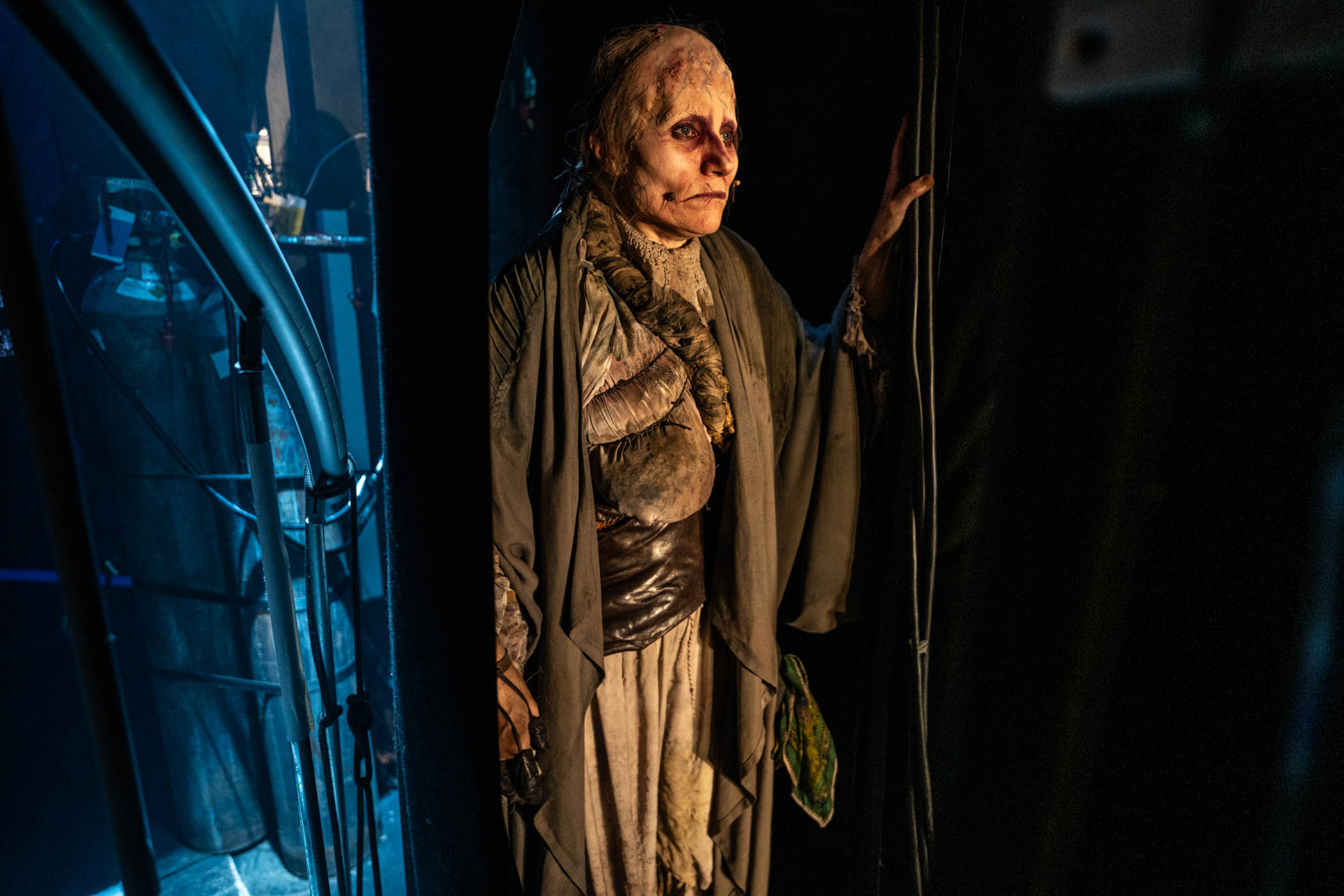
Kate Fleetwood offstage as the Witch
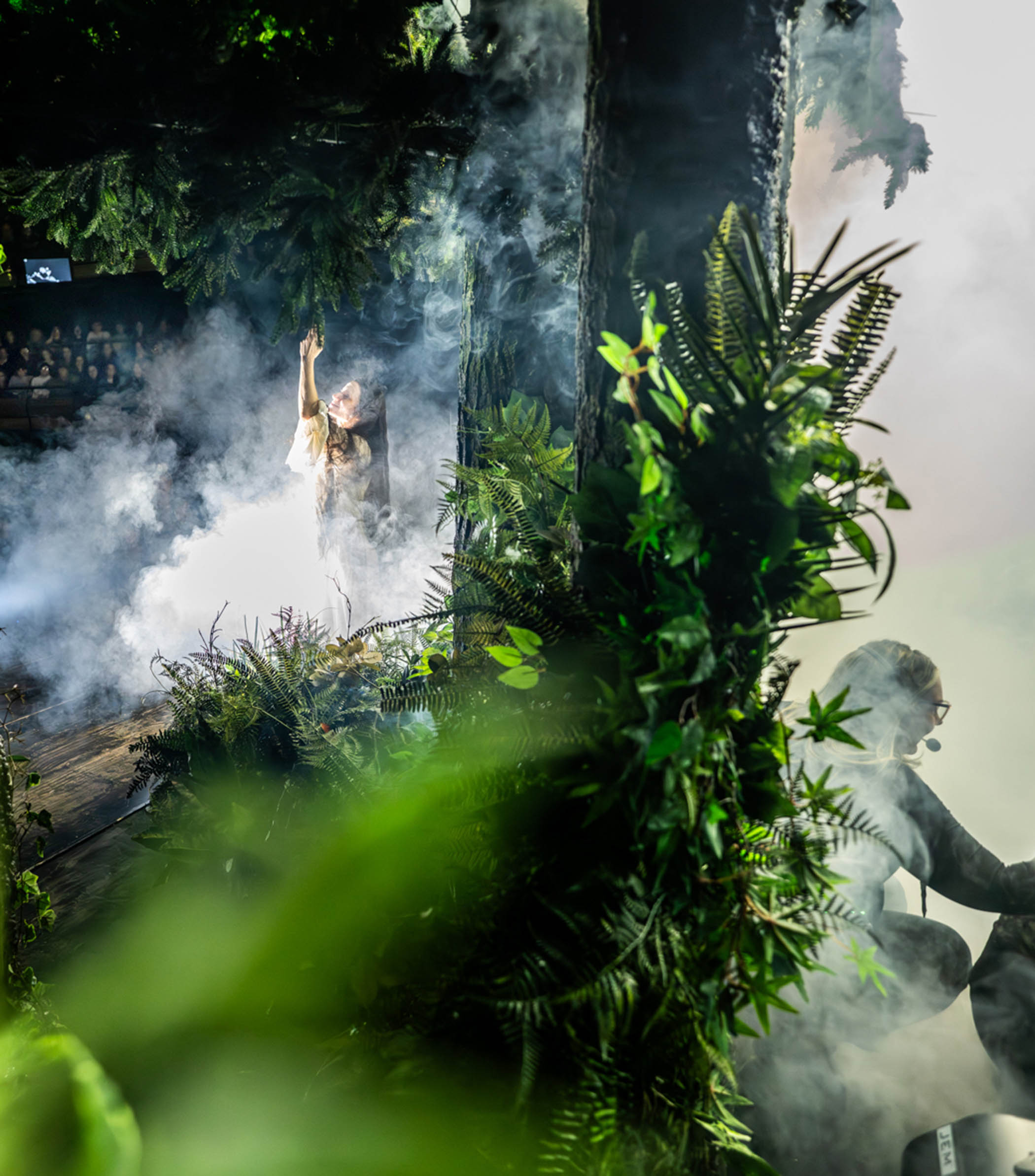
The woodland filled with ‘mystical light and shade’
Sondheim and Lapine created a show that is essentially their retelling of multiple fairytales – Little Red Riding Hood, Cinderella, Jack and the Beanstalk and Rapunzel – each with its own ferocious twist. Along with these familiar characters, they add a Baker and his wife, desperate for a child, and the Witch who lives next door and is searching for lost youth and beauty. The happy ever afters of the first act become something entirely different in the second as the characters’ woodland journeys alter them and the world around them.
“It’s just huge,” says Fein. “The music is so challenging, and every page has a new thing to negotiate, whether it’s toes being cut off or a witch’s transformation. Within three pages, you can have 10 entrances and exits. And the tone is hard to get right. It moves from farce to moments that feel like Ibsen, to moments that feel like Chekhov.”
By his side as he put the production together was Scutt, who has provided both set and costumes, and is Olivier nominated for both. The two worked together on the hugely successful version of The Fiddler on the Roof at Regent’s Park Open Air theatre – the first time they had been a professional double act, though they have been an offstage couple for 10 years.
Scutt, renowned for his radical reimagination of Cabaret set inside the Kit Kat Club, was meticulous in his preparation for Into the Woods. “It’s a curious big spell of a piece,” he says. “Sometimes when something is as big and daunting as this, the best place to start is with some incredibly hard, dry data dos and don’ts. It’s like carving a sculpture, carving in the detail by removing possibilities.”
The trees are made from metal and fibreglass, with extravagant foliage. To create the patterns of the bark, Richard Nutbourne went out into real woods to cast moulds
The trees are made from metal and fibreglass, with extravagant foliage. To create the patterns of the bark, Richard Nutbourne went out into real woods to cast moulds
The pair knew quickly that the reveal of the woods would be a big moment. “There is a challenge in the amount of movement in the forest in Act One,” Scutt says. “There are so many set pieces – it’s like all the pantos I have ever designed in one show – and it was a real case of keeping our powder dry and returning a bit of musicality to the design so that it has an ebb and flow and is dynamic. We’ve taken 15 minutes off the running time by having a set in the first act that doesn’t move.”
Newsletters
Choose the newsletters you want to receive
View more
For information about how The Observer protects your data, read our Privacy Policy
They quickly assembled collaborators – many of whom they’ve worked with before – who could realise a vision of the woods that is unveiled after 15 minutes: lush and verdant, with light glinting through the trees – a forest of the imagination. In act two, this mystical space becomes a wasteland.
It was partly up to the lighting designer Aideen Malone (who is also nominated for an Olivier alongside the video designer Roland Horvath and sound designer Adam Fisher) to bring the trees to life. “It was no small feat,” she says with a smile. “When I go for a dog walk in the woods, I can no longer see woodland in the same way. I’ve never worked on a project that was so organic and so reliant on the build and on lighting to make it work. Tom was afraid there wouldn’t be enough foliage; I was afraid there would be too much.”
Her backlighting creates great shafts of light that pierce the space, and deep shadows and smoke that surround the characters. But even with those transforming effects, the level of detail is astonishing. The trees are made from metal and fibreglass, with extravagant foliage attached. To create the patterns of the bark, Richard Nutbourne, of Scenic Studio, went out into real woods to cast moulds. The care seeps down to every level. Grandmother’s house, where Red and her grandmother are eaten by the wolf before emerging dripping with stage gore, has a Neighbourhood Watch sticker on the outside, fairytale ornaments in each window and a broken CCTV camera on the porch.
Nowhere is the attention more precise than in the puppets designed by Cheryl “Chuck” Brown and Max Humphries, with Scutt. Humphries has known Scutt since their training at the Royal Welsh College of Music and Drama, where Brown also studied. They’ve been making puppets together for 20 years as Unit 9, and this is their second Into the Woods (the first was at the Châtelet in Paris in 2014) so they are well aware of the pitfalls.
They know, for example, that there are websites devoted to “Low-Budget Milky Whites” and “Cursed Milky Whites” – studies of the cows that have failed. When Scutt came up with the idea of making the character a much-loved toy, manipulated by Jo Foster who plays Jack (Olivier nominated for best actor in a supporting role in a musical), they used all their ingenuity to make sure the concept was a success.
Brown found an old teddy bear plush fabric to cover the structure, and then applied every stain by hand. “We also ran it through the rock polisher,” she says. “And added some teabags.” The problem, explains Humphries, was “to make it look completely worn and falling apart but actually have it handcrafted and strong enough to last the entire tour.”
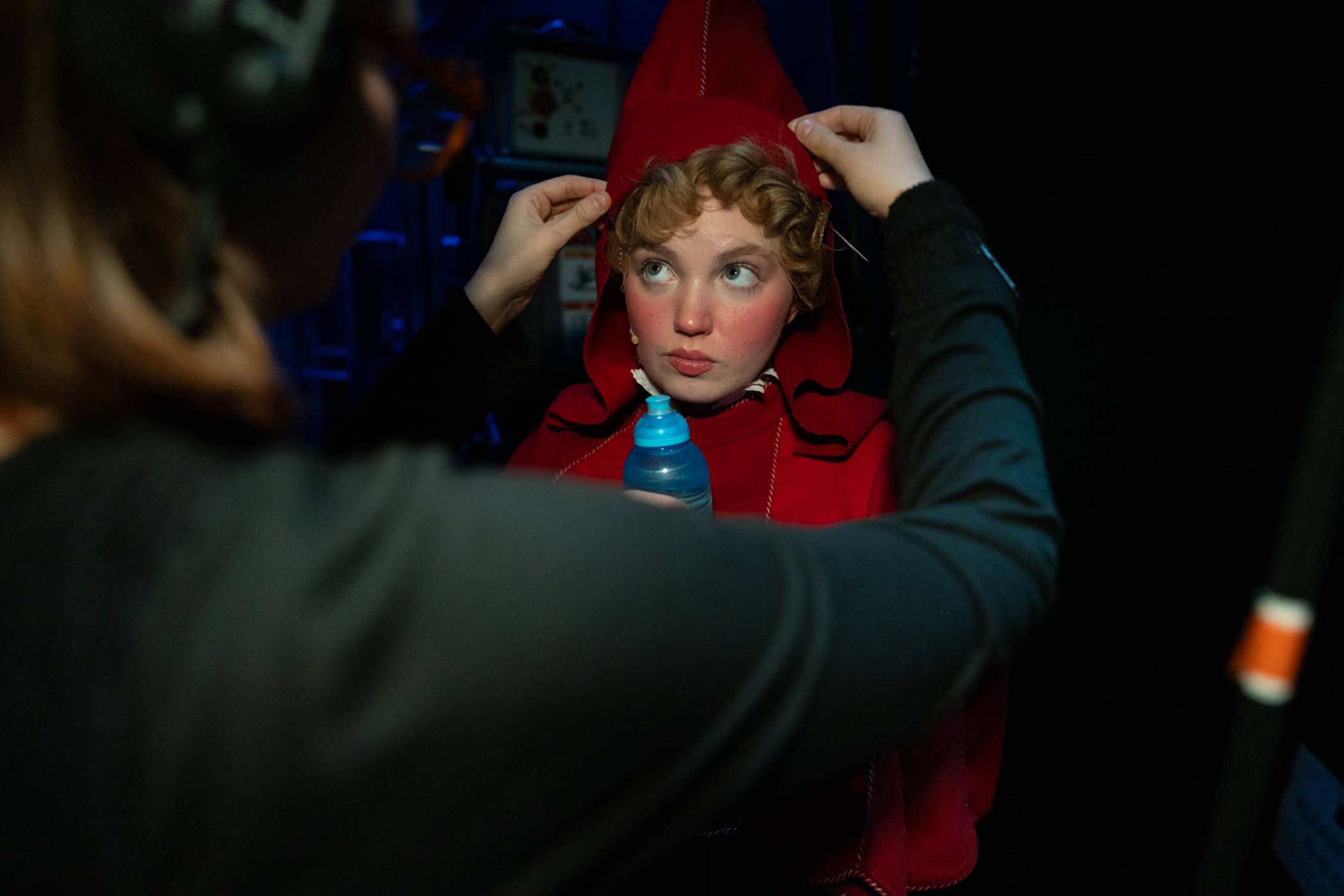
‘The care seeps down to every level’: Gracie McGonigal, playing Little Red Ridinghood, gets ready backstage
His responsibility is mainly the mechanics, which came into play when crafting the birds who talk to Cinderella and which were built with reprogrammed mechanisms from a twitching cat toy. The robin that sits on Cinderella’s hand was one of the smallest puppets they have ever made, with fine wheels built into its body so the act of stroking it makes the head turn and tail flutter. Brown delicately painted its felt wings. “That’s not going to be visible to anyone in the audience, but it is going to be visible to Cinderella when she picks it up,” says Humphries. “It builds a richness into the world that makes the character or the prop more believable.”
From the start Scutt wanted his designs to be clear so that the audience understands what is going on. “It sounds strange to say this, but I almost don’t mind what it ends up looking like. I am more interested in making sure that the ideas are connected across the whole project.”
His costumes are textured and unusually real; the Baker and his wife get grubbier and tattier during their three nights in the woods. “It’s easy to produce a fairytale image that doesn’t have root in the person. We need to show that degradation and that journey so you connect and emphasise with the characters and what they are going through. Our intention was to hand over to the company all these little signposts that gave them something to root the characters in.”
Reality is the key to Fein’s production, reflected in performances that have earned five Olivier nominations and in the motivation for a team of creatives that fills pages of the programme. When the movement director Jenny Ogilvie was working with Kate Fleetwood’s Witch, she took her cue from designs that make her bald and covered in droopy pouches, with a twisted corset that affects her physicality. When she is transformed into a beauty, the movement expands too.
“The key to it was working with sudden changes,” she says. “We looked at references like John Lydon in the Sex Pistols, or the [drag] performer Christeene and Little Edie with her headscarf, and Katharine Hepburn when she was older. They all have this kind of performative high tone, and a sudden fierceness.”
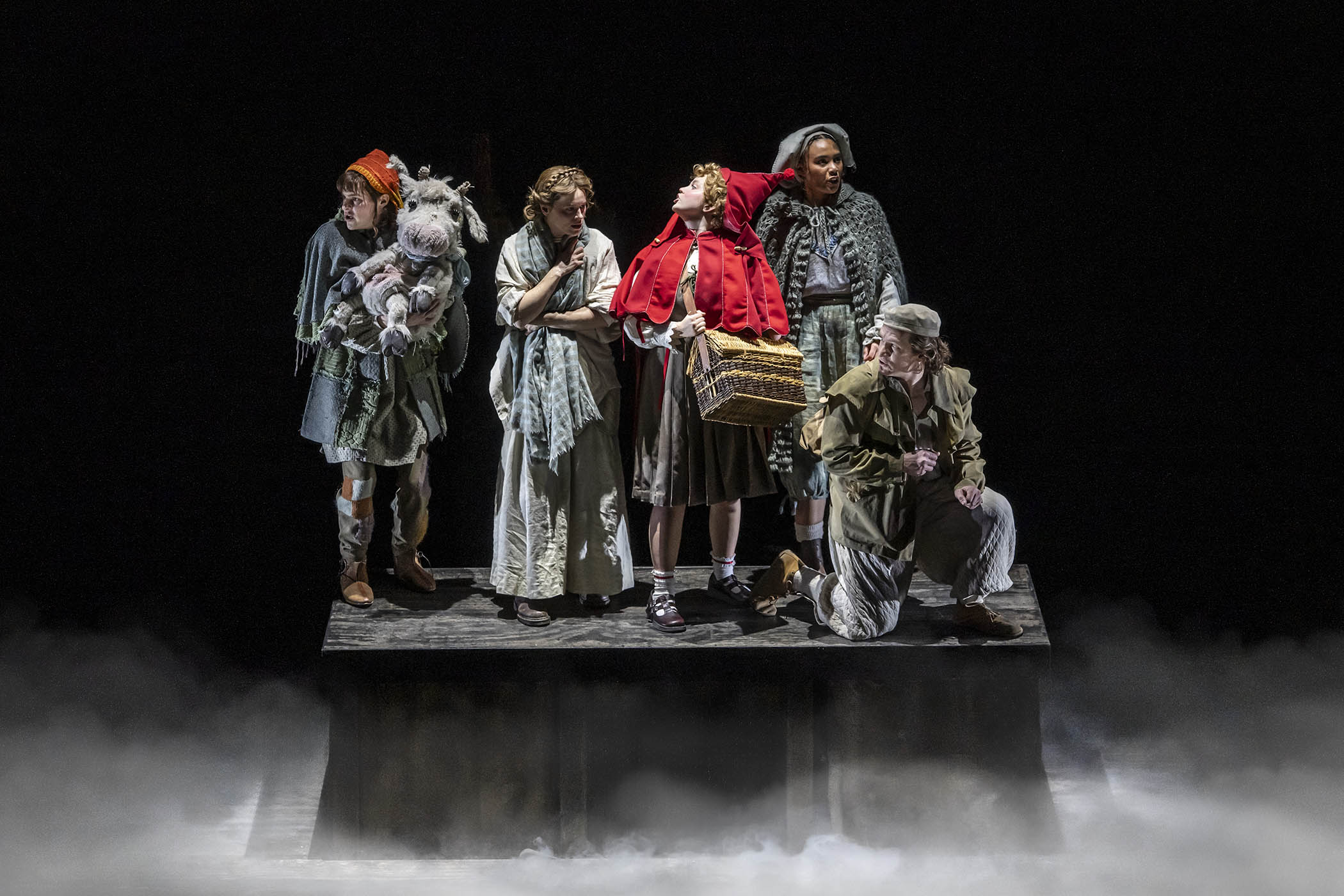
For a show that looks so dramatically beautiful, an immense effort went into a very quiet opening, where characters gather around a raised table on a monochrome stage. As Michael Gould’s mysterious narrator wanders on and mumbles “Once upon a time” they rapidly reveal their interlocking stories in what Ogilvie describes as “an exquisite piece of clockwork”.
Malone lights the scene like a piece of vaudeville theatre, with the characters caught in footlights. “It’s just a black box, that goes from five people on stage to 17, but it’s quite flat, like a comic book. Then you go to the reveal of the woods and there’s all this three-dimensional mystical light and shade. It’s just gorgeous. And we wanted that reveal to be inviting and warm and intriguing because the piece later goes quite dark.”
Fein believes that the power of Into the Woods lies in its second act, where happy endings don’t work out, and where the characters have to begin again knowing things they didn’t know before. “From the start, one of the first things out of my mouth was that this piece has to live in the great extremes of life. It’s about life and the only way it can live is if it has these extremes.”
“The music is everything for me,” he adds. “With Sondheim you don’t have to put anything on top, you don’t have to embellish. It’s just about what’s on the page and making that ring out as loud as possible.”
The Observer is proud to be the official media partner of the Olivier Awards with Cunard for the 50th anniversary year
Photographs by Johan Persson/Craig Sugden