How has a 180-seat theatre become the National Theatre of west London? The Orange Tree, founded in 1971 by Sam Walters, had what might have been a fatal blow 12 years ago, when it was stripped of its Arts Council grant just as Paul Miller was taking over as artistic director. Undeterred, Miller sent the trad space quivering into new life with new work (Pomona). Since he took over in 2022, Tom Littler has lifted the theatre to new heights – and breadth.
About half the programming is of new plays. Yet, weirdly, it is the steady stream of stage classics that now seems innovative. Going to Richmond may be a theatregoer’s main chance of seeing She Stoops to Conquer. The West End is unlikely to brave Strindberg’s Dance of Death but its savagery ate up the Orange Tree stage at the start of the year.
Littler’s programming is vivid with the idea of conversation between plays. Old and new spark off each other. You get more, he thinks, from seeing Polly Stenham’s That Face if you know Hamlet and Noël Coward. If he had limitless funds, he would, he tells me, stage The Cherry Orchard alongside Summerfolk, so that Chekhov’s portrait of a dying Russia segues into Gorky’s vision of its future. Next year, he will direct King Lear and Richard II, which he describes as “two plays about power and abdication – one pagan, the other Christian”. Roger Allam (marvellously rumbling as a siren-suited prime minister in Howard Brenton’s Churchill in Moscow) will star in King Lear and play York in Richard II; Freddie Fox will play Richard II and Edmund; with about 10 other actors, they will form something like a traditional repertory company.
The Orange Tree does not depend on star names: Littler has created a season-ticket mentality among its local audience. Yet heavyweight actors are drawn there, partly because of its tightrope risk. The stage – small and in the round – offers nowhere to hide, particularly in naturalism, Littler’s favoured form: “It is hard to be truthful while boiling an egg and having big emotions.” I have never forgotten seeing glorious Victoria Hamilton there in 1995, close enough to wipe away the tears on her cheeks.
Building work is making the stage and auditorium accessible to wheelchair users and opening up the front of the theatre. As a consequence, over the summer Love’s Labours Lost and Much Ado About Nothing will be performed in the grounds of Thomas’s College on Richmond Hill. In one of his most audacious yokings, Littler has ingeniously intertwined the plays so that they feature the same characters, their lives interrupted by a war.
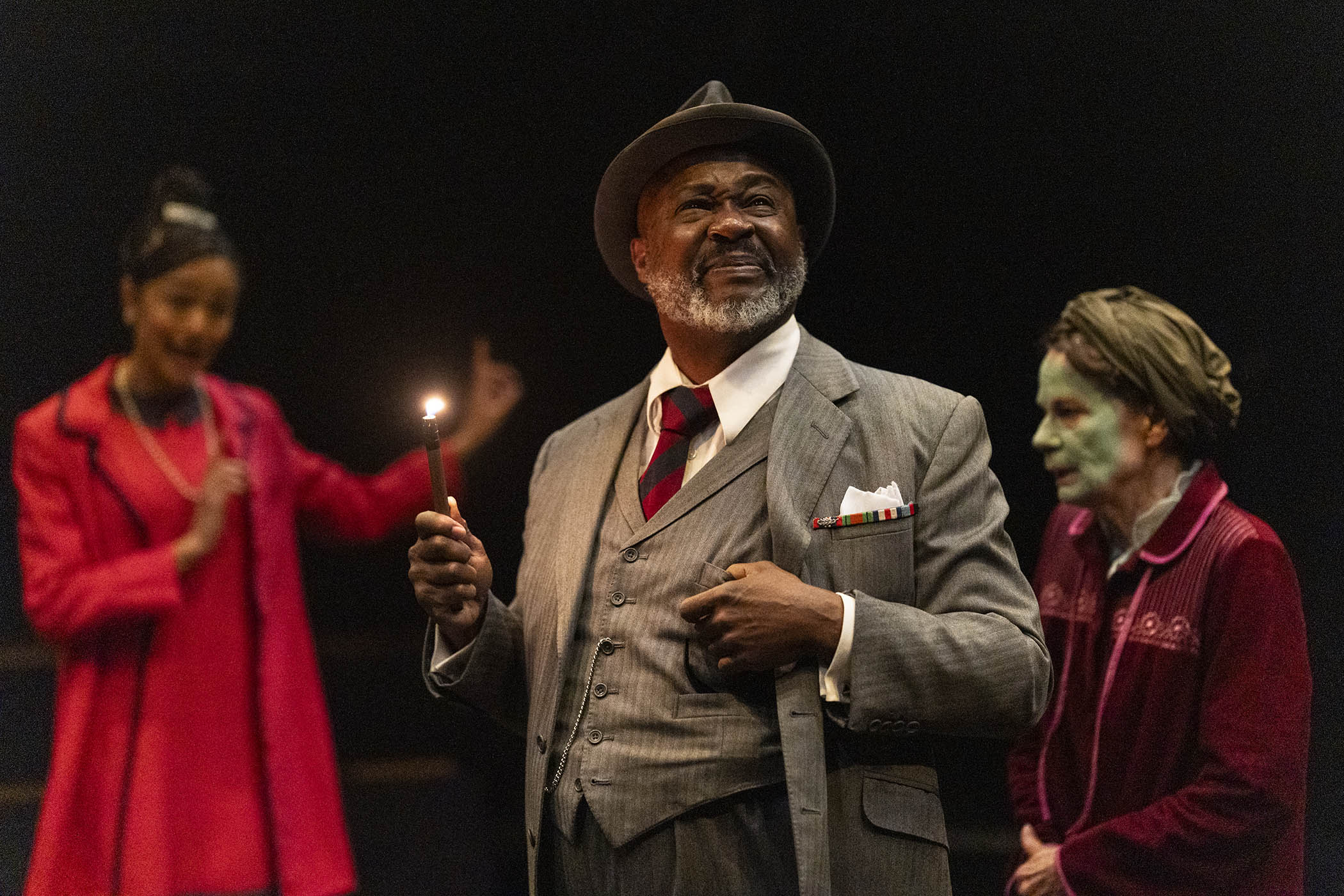
Meanwhile, Peter Shaffer’s 1965 farce Black Comedy is directed by Caroline Steinbeis. Littler considers it “one of the funniest plays of the 20th century” and clearly by the same hand as the darker, more often staged Equus (now at the Menier Chocolate Factory) and Amadeus (which comes to the West End next year, with Michael Sheen).
In Black Comedy, Shaffer’s fascination with duality (he was a twin) is literal. The action – involving stolen furniture and three people in love with the same person – takes place in a power cut. When the stage is lit, the characters are in the dark; they can see only when the audience are blacked out. “It’s an emergency. Anyone can see that.” “No one can see anything.”
It is a terrific dramatic idea that requires – and is awarded in Steinbeis’s production – physically alert actors capable of becoming bendy extensions of the set. A space-sucking-up fellow postures with his legs wide apart, and becomes a tunnel through which another character unwittingly dives. Telephone cords wind around bodies. A man gets a kiss meant for a woman.
The surprise, at a time when homosexuality was treated as a criminal offence and Shaffer himself was closeted, is a strand of male love that cleverly uses the darkness as a metaphor but then gets clodhoppingly spelled out as “afraid of being seen”. Otherwise, the characters – who include an elderly woman in carpet slippers who gets drunk for the first time, a ditzy fiancee and “foreigners” yelling in funny voices – might have escaped from a Cluedo boardgame. That capsized the comedy for me, though the auditorium was bursting with laughter.
Steinbeis’s sharp production brought my warier views of the much-appreciated Shaffer into focus. I see him as a dramatist of brilliant theatrical conceptions, approximate characterisation and heavy-handed psychological explanation. Still, one definition of a strong artistic director is the ability to persuade you it’s worth seeing something that isn’t for you. Littler’s Orange Tree consistently bears rich fruit.
Newsletters
Choose the newsletters you want to receive
View more
For information about how The Observer protects your data, read our Privacy Policy
Photograph by Sam Taylor