Alexander Zeldin’s naturalistic theatre is the opposite of reality TV. It moves slowly; it has long passages of silence. Characters are often tired and slightly unkempt. Instead of saying friendly things they don’t mean, sobbing at the departure of those they have long wanted to depart, these people talk bluntly while feeling warmly and chaotically.
In 2019, Zeldin wrote and directed the last in his trilogy of dramas about Britain under austerity. Faith, Hope and Charity, set in a community centre threatened with closure, was alarming and vivid: its social concern was pressing but never squeezed the idiosyncrasy out of individuals. The same is true of his new play, again directed by the dramatist. A version of the apparently more personal Une Mort dans la Famille, staged in Paris four years ago, Care suggests how people are obliged to spend the end of their lives, and how they die. It could be summarised as a catalogue of failure: of minds, limbs, families and institutions. Yet, though desolating, it is not dispiriting: its candour is invigorating; its humour a guiding hand.
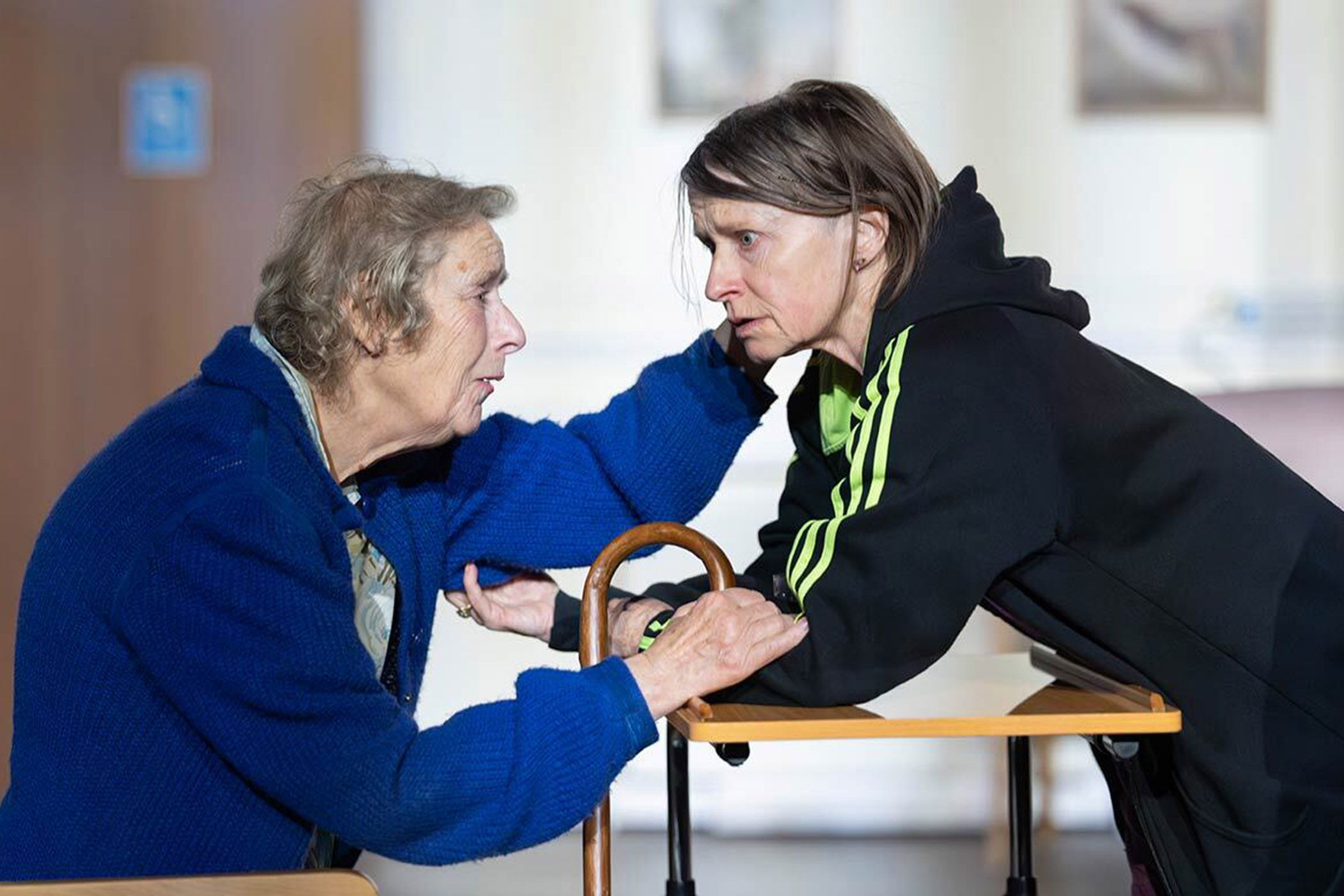
Rosanna Vize has designed an all-too-recognisable “home” for the ailing and elderly. Pale walls, a bad picture of a horse, chairs arranged in a coercive semi-circle, a dominating surgical trolley. Enter the brilliant Linda Bassett, admitted after a fall, and the perfect conduit between spectators and stage. Like the audience, she does not think she belongs there, yet it is immediately clear she will never leave. Her daughter (persuasive, pulled-to-pieces Rosie Cavaliero) suddenly widowed, with two disturbed young sons, wants to want her mother at home but needs room to breathe.
Bassett has always had a gravitational pull on the stage, whether silently disembowelling a runner bean in Roots (13 years on, I can still see her at it) or proclaiming Caryl Churchill’s apocalyptic visions in Escaped Alone. She is always central here, whether frayed or furious. Ruffled and anxious, she looks like a fallen nestling.
Head slightly tilted, she becomes quizzical, owl-like. In rage, hurling a television to the floor, she is eagle-like. She delivers a particularly convincing deathbed scene: those pauses between breaths, the tiny but utterly distinct changes in register. She also enables one of the evening’s most unsettling moments. A rare male resident takes a fancy to her. He is mentally shaken, forgetting that his wife is dead; he wants to embrace the newcomer and begins to undress: he wears a nappy.
The gentleness of the script and the skill of both actors make the moment more than merely poignant: this may be mistaken identity, but it has the shimmer of a fresh affection.
It has taken years for the stage to begin to catch up with television soaps powered by mature women: by matriarchs and matrons and stubborn singletons. Bassett has been one of these; indomitable but subtle in Call the Midwife. Ann Mitchell, in a career of about 60 years, has been another, in EastEnders and Widows. She, too, is extraordinary here as a woman steadily unravelling: immaculately turned out, genteel, and mainly interested in talking about otters. As her fingers reach up trembling to her face, you begin to see the cobwebs she is trying to pull away.
This recognition of older female actors, not as standalone stars but as a default position for human beings, is another reason to celebrate Zeldin’s work. There has never been the same problem for older actors, as there has never been a shortage of parts, from King Lear down. When Escaped Alone was first staged 10 years ago, the casting and setting – four post-menopausal women in a back garden – felt as revolutionary as the horrors presciently evoked in Churchill’s monologues.
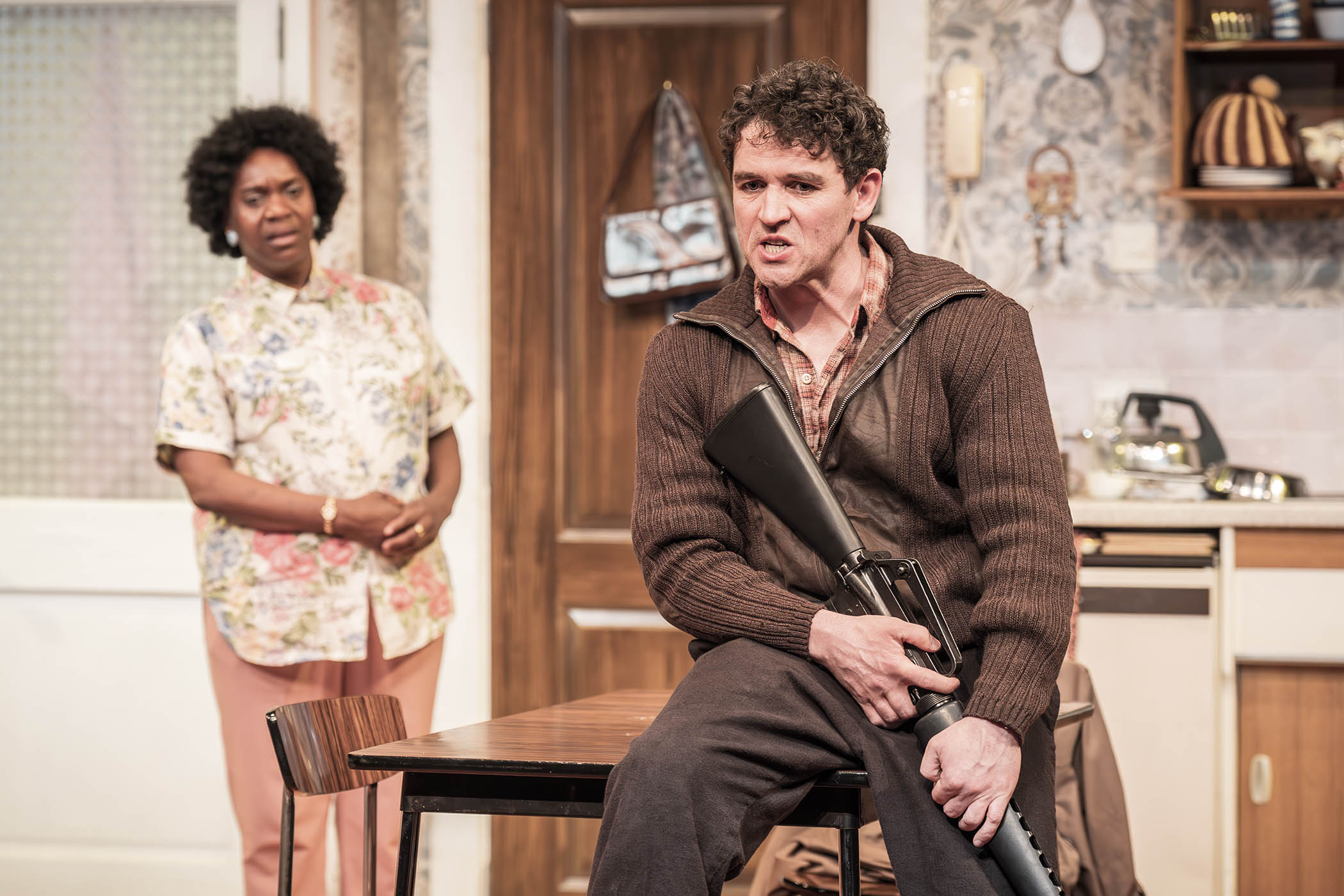
There are no weak acting links. Hayley Carmichael – she was, murmurs Mitchell, “a lady of the night” – scampers around her older companions, pleading for affection, pawing them with uncontrollable obscenities. Llewella Gideon and Aoife Gaston are unsentimental but glowing in their underwritten nursing roles. Richard Durden, who walks with aimless determination, as if he were ploughing his way through a snowdrift on skis, adroitly drops in another dramatic surprise when, tunefully and with growing resonance, he begins to sing Some Enchanted Evening.
Care is a hard evening but has its own enchantments. And mysteries. Any character who dies walks off the stage and sits among the audience. As someone habitually in the stalls, I am still trying to work out whether to feel threatened.
Newsletters
Choose the newsletters you want to receive
View more
For information about how The Observer protects your data, read our Privacy Policy
Photograph by Johann Persson