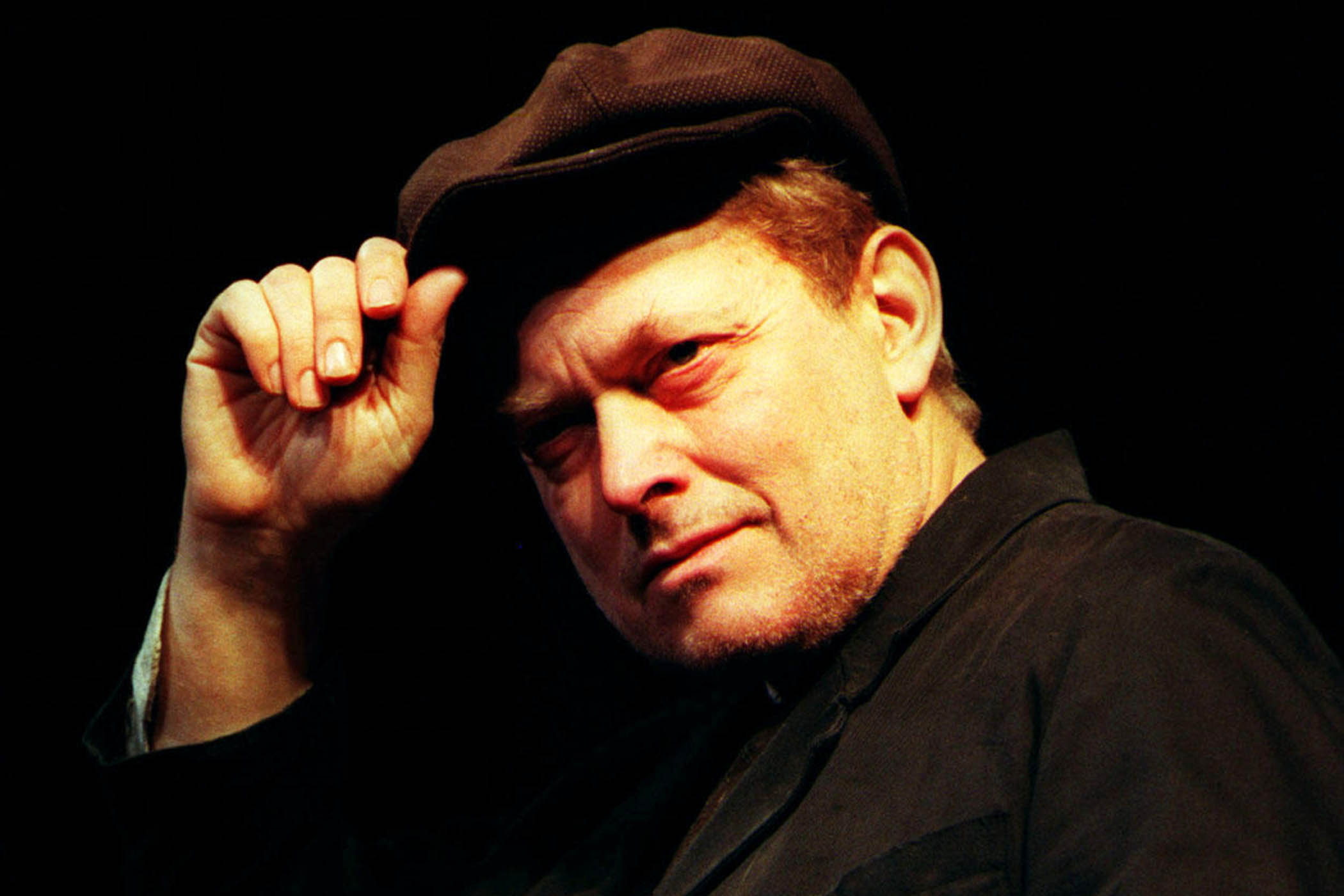

Michael Pennington began his career as a professional actor on the 400th anniversary of William Shakespeare’s birth. On 23 April 1964, with Stratford-upon-Avon in full celebration, he felt immensely lucky to be part of it, even as the “15th foot soldier from the left” in John Barton and Peter Hall’s Royal Shakespeare Company (RSC) adaptation of The Wars of the Roses. He still took his bow with David Warner, Peggy Ashcroft and Ian Holm.
On the same day 52 years later, Pennington spent the 400th anniversary of Shakespeare’s death playing King Lear. It crowned, as he put it, a lifelong “marriage” to the playwright that began when he was taken, unwillingly, to see Macbeth aged 11 and fell in love. “It was like hearing rock’n’roll for the first time,” he said.
On learning of Pennington’s death at Denville Hall, the home for retired actors, the RSC said he was “a Shakespearean to his bones”. In 1986 he co-founded the touring English Shakespeare Company (ESC) with the director Michael Bogdanov, which for six years allowed him to play all the great roles in the history cycle, as well as Macbeth and Coriolanus, across the world.
In 1980 he was a celebrated Hamlet, playing him more as a scholar prince than what he called “a red-brick yahoo”, in the RSC’s first production of the play for a decade. The critic Michael Billington called his Dane “sharp-brained, sweet-souled and mellifluous of voice” and ranked it as one of the 10 best portrayals in 50 years, up there with those of Derek Jacobi, Michael Redgrave and Warner, in whose 1965 take Pennington played Fortinbras.
Appropriately, he learned that Barton wanted him for the part while in Elsinore, on a tour of The Hollow Crown. It meant he had to turn down a big film role opposite Meryl Streep in The French Lieutenant’s Woman – eventually taken by Jeremy Irons – and a fee of £40,000 in favour of £300 a week, but he had no regrets. “There would be other films,” he said. “But there might never occur another Hamlet.” When the run ended after 150 performances, he felt bereft. “I didn’t want to stop,” he said. “That was it, I would never play Hamlet again.”
He was right about there being other films, though not many. Thirty years later, he appeared with Streep in The Iron Lady, playing Michael Foot to her Margaret Thatcher, while his next role after Hamlet was as Moff Jerjerrod, an imperial officer in the Return of the Jedi, part of the original Star Wars trilogy. It brought a different fanbase, who amused him by asking if he “ever did more acting”, and ensured a BBC obituary headlined: “Star Wars and Shakespeare actor Michael Pennington dies.”
Michael Vivian Fyfe Pennington was born in Cambridge. He attended Marlborough College, where he played Prospero in The Tempest wearing a hired cloak that John Gielgud had once worn for the role. He returned to Cambridge to read English, where he joined a golden generation of actors including Jacobi, Ian McKellen and Trevor Nunn. “My father wanted me to be a lawyer but I didn’t have the stamina,” he said.
This gave him an intense acting experience, appearing in 30 plays in three years, including his first turn as Hamlet, aged 20. “I thought it was going to be nervous-breakdown material but really enjoyed it,” he later said. He found the next production, Noël Coward’s Hay Fever, far harder.
Rather than go to drama school, he joined the RSC for three seasons. One of his small parts was Titus in Timon of Athens; 34 years later he played the title role for the company. During this time he had a brief marriage to the actor Katharine Barker with whom he had a son, Mark.
Pennington then worked on the London stage for eight years before returning to Stratford in 1974 for a longer stint. He appeared several times opposite Judi Dench, whom he had seen when she played Ophelia in 1957. “He had a wonderful sense of humour,” she said in 2015, having once punched him for eating garlic before a love scene. Pennington said they got on because, while they both took acting seriously, they realised that what they did for a living was “inherently daft”.
Newsletters
Choose the newsletters you want to receive
View more
For information about how The Observer protects your data, read our Privacy Policy
The production in which he took most pride was Strider – The Story of a Horse, adapted from a story by Tolstoy, in which he played the title role, at the National Theatre in 1984. The same year he put on a one-man show there about Anton Chekhov that he had spent a decade developing after meeting a scholar of the playwright on the Trans-Siberian Express.
He wrote a book about it, Are You There Crocodile?, as well as several “user’s guides” to Shakespeare and Let Me Play the Lion Too, partly a guide and partly a memoir. The actor Samuel West said Pennington was “an incisive, powerful, useful writer”. He was also very generous to aspiring actors. Adrian Hilton recalled applying to join the ESC in the 1980s and, although there were no vacancies, Pennington writing back with “paragraphs of encouragement, advice and wisdom” that led to Hilton getting into the RSC.
Pennington never forgot that acting is often about luck. “Even if successful you might be out of work for months,” he wrote. “You have to accept there’s no justice.” While he never quite made the heights of some of his contemporaries, he could look back with satisfaction. “I’ve never sweated in a hot tub of celebrity,” he wrote in 2015. “Rather, I’ve been appeased by the warm, lapping waters of general approval.”
Michael Pennington, actor, was born on 7 June 1943 and died on 7 May 2026, aged 82
Photograph by PA/Alamy