
What if evil were attractive? Not such a hard thing to imagine, yet still the question seduces. Somewhere between Dracula the book, the play and the movies (more than 280 of them, by one expert’s reckoning), Bram Stoker’s creation, hairy-palmed and putrid, became sexy. He is tall, with dark eyes and alabaster skin, aristocratic in coat and tails and hairline. Now he, and 22 of his fellow characters besides, are played by a black woman: 5ft, best known as a witch. She is an actor of tremendous stamina and composure, of beguiling, androgynous beauty and uncanny stillness. Cynthia Erivo brings all that – and the world’s most famous fingernails – to this one-woman show. It is not her failure that the only performer on stage for an hour and 50 minutes should feel strangely underemployed.
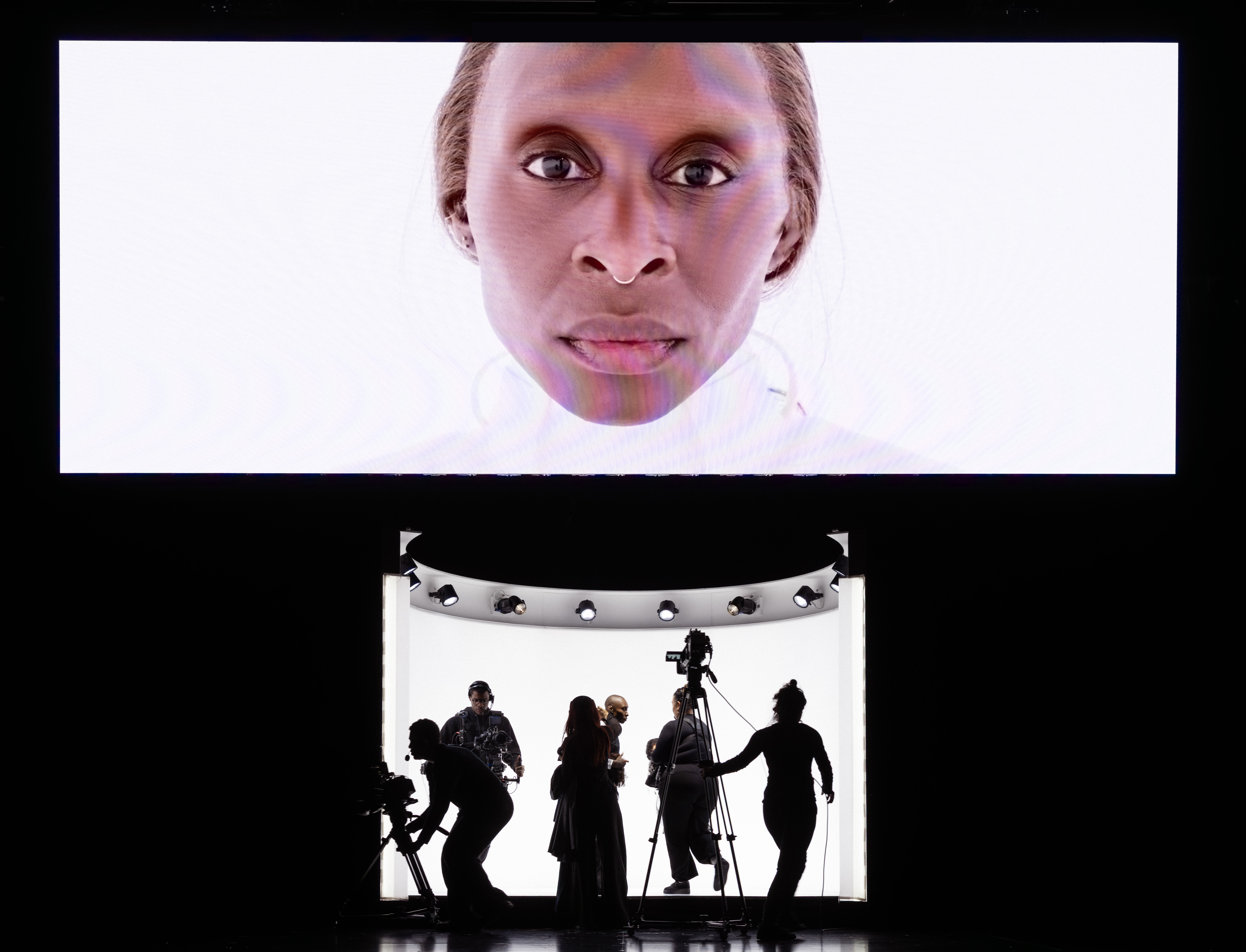
Director Kip Williams, we read, takes a radical approach to classical texts, but what he presents here is as literal a treatment as it is possible to get: a dramatic reading. Stoker’s stream of letters and journal entries, rendered in livestream and clever video trickery. Erivo, a star of stage and screen, proves she can be both simultaneously, enacting half a dozen characters in the flesh, as it were, while interacting with the others – from minor undead spirits to Van Helsing – who are pre-recorded, trapped on screen in the digital realm. She, and the camera operators who stalk her, hit every cue and mark with supernatural polish: she seamlessly converses with herself – as if across dimensions – and we believe it. Her Dracula is a revelation, cool and queer, with round, basilisk eyes and a wet lick of red hair. Cast and creatives have reinvented the vampire – they cannot say the same for the staging.
For the blueprint of this production is Williams’s The Picture of Dorian Gray – another gothic horror that is all fantasy and surfaces. It is nearly an exact reconstruction, down to the cameras, the cast of one (then Sarah Snook) and the multi-roles (26 in that case, not including wigs). It was original, distinct, ingeniously and joylessly slick: so, following the Jamie Lloyd school of thought, if it ain’t broke – and it ain’t, having sold out theatres in Sydney, London and New York, and won two Tonys – then fix it to the next project. The source material seems almost incidental: the production feeds off it, for its own gain, and turns it into image. It is vampirical, maybe, dazzling and youthful. But blank.
Diabolical desire is difficult to achieve with only one body. Lip-chewing is one thing, but you cannot bite your own neck
Diabolical desire is difficult to achieve with only one body. Lip-chewing is one thing, but you cannot bite your own neck
We could be wrapped in darkness, tempted by candlelight. Instead we are bathed in harsh studio-white, squinting through the glare at the player dwarfed by the screen. We watch it, because it is big and mesmerising, and because Erivo has her back to us, or else she is obscured by hovering drones and staring down the barrel of its lens. Her presence is a projection. Even when she turns to face us in the stalls, her eyes are trained on a teleprompter illuminated above our heads: the screen is dead, long live the screen.
The conceit, as the Count puts it, is that the monster “comes from within”. “Flesh of my flesh,” he warns, “blood of my blood.” He does not only possess; he consumes and merges. In Craig Wilkinson’s kaleidoscopic video designs, Erivo’s superimposed features twist and morph – her face on her face, image on image – like a Francis Bacon portrait.
Count Dracula is the most filmed character in history, and this show fits neatly with that cinematic tradition: the special effects, the zoom cuts, Clemence Williams’s handsome, heavily atmospheric score ranging from romance to electronic trance by way of Tchaikovsky. The set has the look of a Hollywood studio soundstage, bare and black, housing props, opening up to expose the lighting rigs. It is functional, if not austere: when displays of garlic flowers are brought in, they are a breath of rank air – a touch of the organic.
Politics are absent, along with fear of the other. Neither is this Dracula particularly spooky nor sexy: moods that enhance, I think, a text somewhat lacking in depth. Where is the eerie immateriality? Or else the flesh-and-blood horror of uncontrollable lust? Desire – diabolical or not – is difficult to achieve with only one body. Lip-chewing is one thing, but you cannot bite your own neck. In the book’s most violent passage, Lucy – prey to temptation – is bludgeoned back to propriety, to the embrace of God in death. Here, a giant cross is made out of monitors: the shrine is to hi-tech.
That cross watches over the final scene, which gives a glimpse at what this play might have been had Williams thought to put down the cameras, and the book. Erivo, facing outwards, treads a path through a blizzard of snow and arrives downstage, watching us. The flurry of narration settles. As Dracula, she sings a song, like a siren, calling on the living to cross over. It is an impressionistic moment, strange and stirring. Right there, she is close enough to touch.
Photographs by Daniel Boud
Newsletters
Choose the newsletters you want to receive
View more
For information about how The Observer protects your data, read our Privacy Policy