How many women can you recognise by their fringe? I ask as someone who was pointedly sent postcards of Highland cattle by one friend. I could track my life through female fringes. The poet Stevie Smith. Mary Quant. Claudia Winkleman. And Victoria Wood. In the Lake District theatre now named after her, formerly the Old Laundry, that pudding-basin cut on a fridge magnet identifies her as surely as a piano riff or a joke about tufted Wilton.
Wood’s popularity as a performer is so enormous that it can occlude her originality. She is rarely called a satirist, yet she blitzes class in her brilliant spoof of Brief Encounter: Celia Imrie in gusset-toting glory, Wood with strangled Celia Johnson vowels. One-woman shows made her famous but she also marvellously sparked talent in other stage and television actors – Susie Blake, Julie Walters, Maxine Peake – most spectacularly in Acorn Antiques and Dinnerladies.
These gifts are celebrated in Fourteen Again, nippily directed by Jonathan O’Boyle at the idyllically placed theatre, just up the hill from Windermere, which she often visited. Tom MacRae, who had a huge hit with his Sheffield-premiered musical Everybody’s Talking About Jamie, has built a time-travelling story based around Wood’s songs. It can’t get over the problem that, while evoking Wood, it also makes you miss her singular melt-an-audience-with-one-look quality. And it cannot disguise the fact that her songs are not made to advance a plot: they are cameos and compressed dramas.
Still, Fourteen Again proves one of the essential truths about Wood: she is hardly ever just one thing. Is this sadness dissolving into joy, or exuberance stamping against despair? MacRae’s plot allows him to include Wood’s most desolating and most boisterous numbers, and highlight her unaccustomed heroines: she did not mainly sing about young romantics.
It is impossible to leave an evening with her, as here, and not feel your sympathies expanded
It is impossible to leave an evening with her, as here, and not feel your sympathies expanded
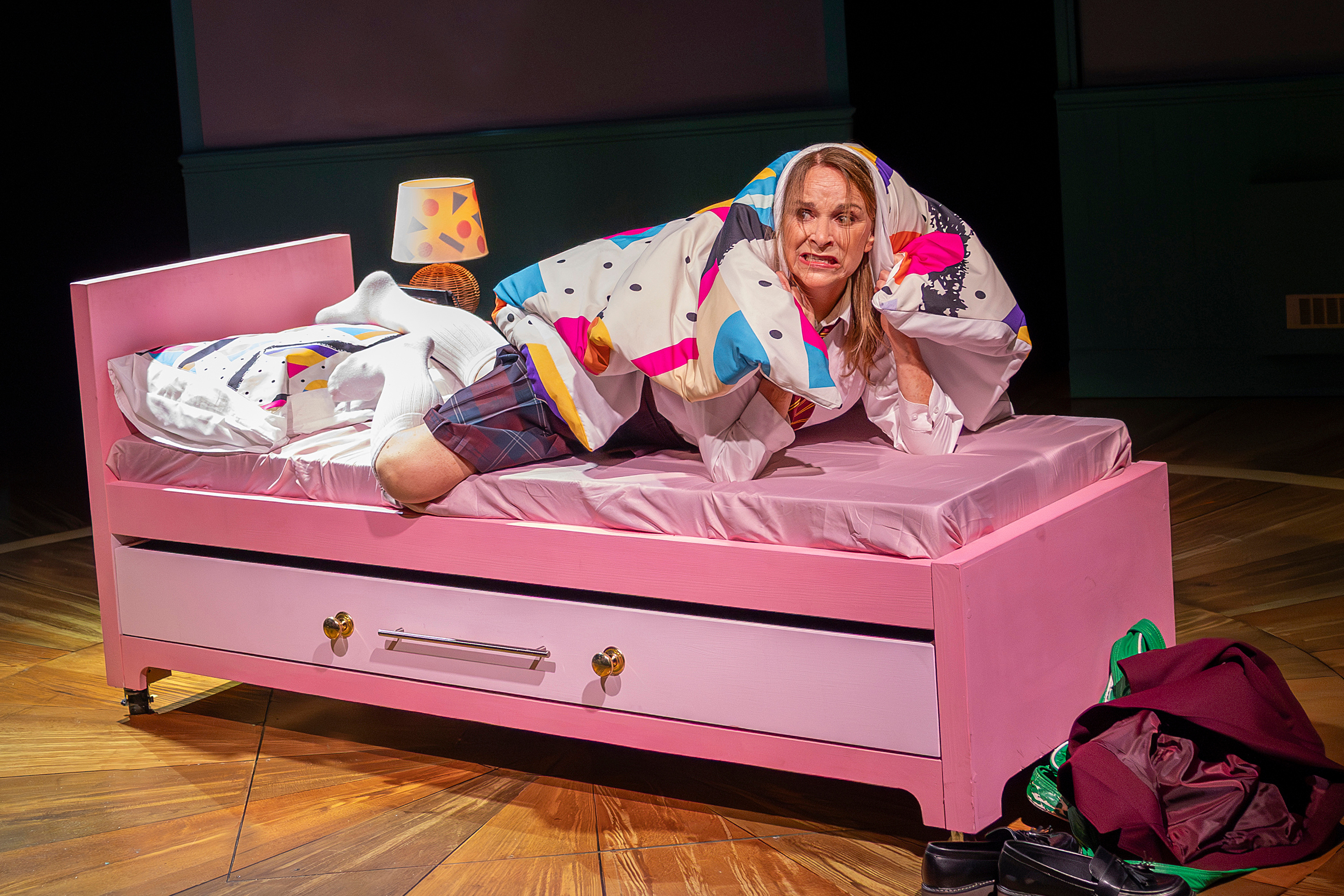
Two 50-year-olds meet at a slimming club (Wood said she once “absolutely bought into the idea that being bigger made you less of a person”); they’ve not seen each other since they were adolescent best friends. Both are disappointed in their lives. What if they had made different choices? A flash of light whisks our heroine (Sally Ann Triplett) back to being 14: when “I had no idea you could wake up feeling bored.”
Against Roger Glossop’s design of neatly patterned screens – cupcakes, school crest – the two relive decades as they actually happened, and reinvent them. For a moment, it looks as if this will be another coming-out musical. Actually, it sticks up for friendship.
O’Boyle’s production is strongly sung and cleverly cast for time travel. Triplett is particularly at ease in Snoopy T-shirt, maroon school blazer and in goth mode at a vampire-and-beekeeper birthday party. Ria Jones, who I remember as one of the sole musterers of oomph in a dreary High Society 21 years ago, is all oomph here, as a young girl heading too quickly for an older life and a sadder time: every line of her body suggests someone braced to cope. Michael Chance, when not playing a hopeless hubby, vividly captures Wood’s style as the accompanist on – of course – a baby grand.
There are several long Wood associations. Not least with the audience, few of whom need the programme glossary, which explains Babycham. Triplett played Miss Berta in Acorn Antiques: The Musical!. Glossop, who founded the theatre with his wife, Charlotte Scott, designed Walters’s varicose veins in Good Fun. Nigel Lilley has had an arterial role in Wood’s stage and television shows as her longtime musical director and arranger.
Tenuous though the plot is, it encompasses Wood’s bleakest lyrics – about the death of a wife, about a newborn baby left in a litter bin – as well as the rambunctious, rapturously greeted The Ballad of Barry and Freda. But – bend me over backwards on my hostess trolley – you’d be hard put to know whether this song, in which Freda wants to get it on but Barry is thinking about vinyl flooring, is a terrible warning about the death of passion or a hurrah for hearts beating faster after cocoa. So often in Wood, the piano is merry and the words spiky or tugging towards loss.
The late Jonathan Raban cleverly called her an acid drop. She is both sharp and sweet, though with more bons mots than bonbons. It is impossible to leave an evening with her, as here, and not feel your sympathies expanded. The cover of the songbook gets it right. It shows an ample-bottomed pianist; over her naked cheeks is written: “Now bigger than ever.”
Newsletters
Choose the newsletters you want to receive
View more
For information about how The Observer protects your data, read our Privacy Policy
Fourteen Again is at the Victoria Wood, Bowness-on-Windermere, until 6 June
Photograph by Pamela Raith